While visiting the Galapagos Islands we had the opportunity to visit and repel down into the only vertical magma tube in all the Galapagos. Below is the excerpt form my journal of that incredible experience.
We were met onshore by Jorge, the ranch owner and our guide, who quickly ushered us into a pickup truck taxi, the back full of ropes and repelling harnesses.
With only one main road across Isabela, we found ourselves on the same road we had taken to get to Sierra Negra when we went horseback riding a few days earlier. Instead of driving all the way to the top of the mountain, the taxi made a shape left turn into the dense jungle. The small truck bounced down the rut-filled muddy road. After half a kilometre or so, the trees thinned, revealing a couple of cow pastures. We came to a halt in a tiny clearing, just big enough for the truck to turn around before coming to a stop.
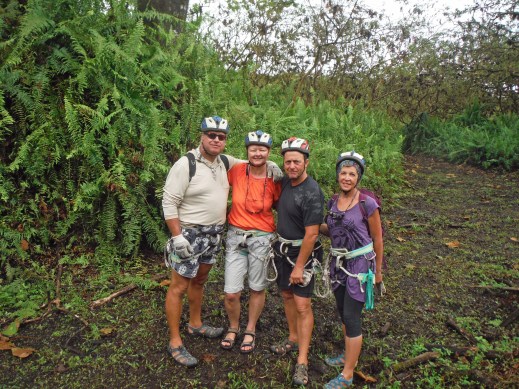
Jorge helped Janet and Teri out of the back seat, then he unloaded the repelling gear out of the box. As soon as this was accomplished, the taxi pickup retreated down the road to be quickly swallowed by the jungle. With the noise of the truck gone, the sounds of wilds greeted our ears. Birds chirped or warbled while the bush rustled as if countless insects and tiny creatures were on the move. The air, thick with humidity and laden with a light mist floating through the underbrush, smelled of damp earth and rotting vegetation. The pungent decay left a tart taste upon our lips. However, high at the tree top level, the upper branches swayed with the same stiff wind that had the harbour dancing.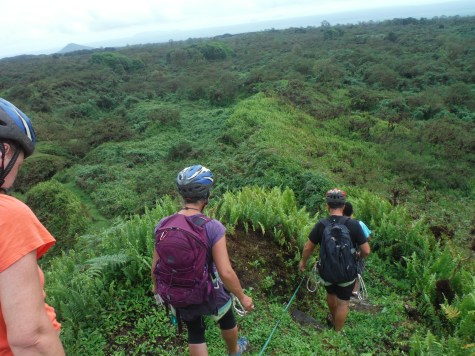
Working our way across the ridge top.
In Spanish, Jorge gave instructions in how to don the equipment, and as soon as everyone was geared up and wearing Styrofoam helmets, Jorge led the way down a muddy trail that meandered towards a nearby hill. After crossing several murky rivulets that bisected the path, our guide stopped to show us a clump of ferns that, Jorge said, represented the four endemic genera of ferns found nowhere else on Earth. He held out the leaves of each plant for the women to examine, cradling the plant as delicately, and with as much reverence, as one would a fragile and ancient treasure.
Yep, looked like a fern to me, and I can only assume pulling out a machete and hacking your way through the jungle, like you were in an old Tarzan movie, would be frowned upon.
With the heat, we all were sweating profusely, and by the time, we climbed the steep hill and crested the top, my underwear was soaked, salted and royally chaffing. We had only ascended 50 metres (164 feet) or so, but from the ridge top, scarcely a few metres wide, we were treated to a mountaintop panoramic view of the south side of Isabel and its neighbouring islands.
Before us lay what looked to be unbroken jungle. Some 12 kilometres (8 miles) in the distance and far below, we could see Puerto Villamil, its streets and the harbour. We now felt the full force of the wind, which was cool and refreshing on our dripping faces. It was a miraculous sight, so we spent several minutes taking stills and video of the vista as well as each other. When done, Jorge instructed us to turn around while pointing to the small valley and three depressions in the jungle.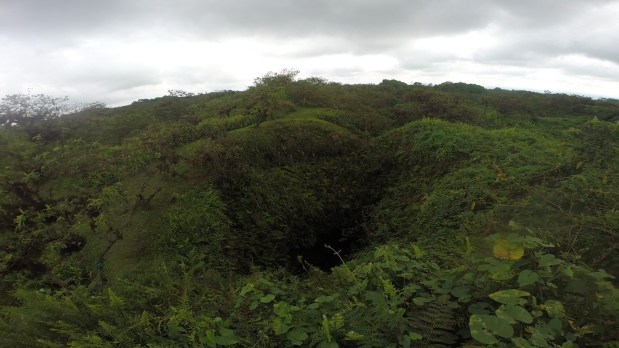
The opening of the great magma tube as seen from the ridge top.
Jorge went on to explain that down there were the openings of three magma tunnels, or shafts, each 20 or 30 metres (65.6 to 98.4 feet) across. He said his family had owned this land for many years and ran cattle here. Amazingly, they did not find the shafts until recently when mysteriously one of their cows went missing. The cow literally dropped off the face of the earth. During the subsequent search for the beast, they found the vertical shafts. The cow, the true discoverer of the only vertical magma tube in the Galápagos Islands, was eventually located on a ledge deep down in the main shaft.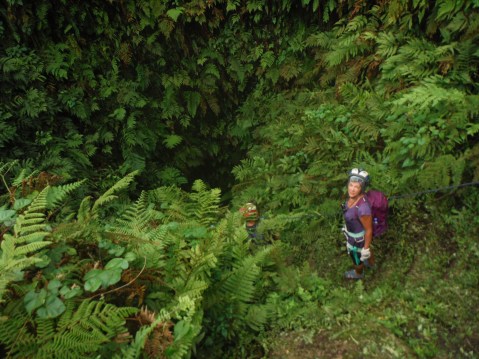
Teri enters the hidden entrance of the massive tunnel.
As we visually searched the jungle below from the ridge top, the deep holes were invisible. Our guide moved us along to the far end of the knife-edge ridge where a metre or two (3.2 to 6.4 feet) on either side was a shear drop-off. Carefully moving along the ridge top for approximately another 100 metres (328 feet), we followed the trail leading steeply downward back into the jungle.
All of us were thankful Jorge had constructed a handrail out of old rope to cling too as the slope was slick with mud. With some trepidation, we followed our guide down into the valley and up to the opposite side of the ridge. From this vantage point, we could now see a break in the tress below where Jorge said the first of the shafts was located. He led us around the lip of the hole until we came to a rocky outcropping, and at its base was a small hole of 2 metres (6.4 feet) tall and about half as narrow. Again a rope handrail marked the path that we were to take. Jorge disappeared inside; the rest of us paused for a moment to get our bearings, catch our breaths and take a drink from our water bottles. As I passed the bottle to Janet, I could see she was suffering from the heat and strain of the mountain hike. The trail ahead led nearly vertically downward, and I was fearful of her falling or not being able to get back if she were to descend much further.
It felt like it was miles back to the clearing were we were to meet the truck, and there were many hills to challenge us further.
“Hun, how you doing?” I asked as she took a long draw from the water bottle. “You know, if you have had enough we can wait here for the others to come back,” I offered.
I wanted to carry on, but if Janet had reached her limit, we would stay. I knew the hard part was just beginning, and perhaps this would prove too much for her. Janet wiped the sweat from her brow and passed the bottle back to me, which I returned to my backpack.
“No, I’m okay. If we take it slow, I’ll be fine. I’ve come this far,” she said.
One by one, we dropped into the hole. The tunnel covered maybe 5 metres (16.4 feet) before the ceiling vanished. Inside, on a small ledge barely big enough for the four of us to stand side by side, we all gazed in wonderment at what lay before us.
It was a great cavern of perhaps 50 metres (164 feet) in diameter, with a dome ceiling high above where the apex or crown had once collapsed, permitting an intense beam of sunlight to pierce the earth. Great vines, as thick as a man’s arm, firmly rooted in the jungle above, draped downward until they reached the sloping sidewalls of the cavern where they again took root. In an effort to reconnect with the jungle above, new shoots, thick with emerald leaves, climbed the fractured walls in a bid to regain the sunlight.
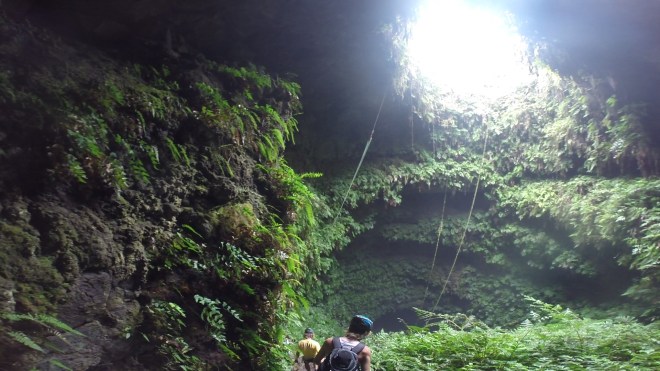
The view when you first enter the tunnel.
As if raining, large water droplets wept from the porous stone above, causing the dome and side walls to glisten and shimmer as if gilded in liquid silver. The air was earthy, damp and dense, making it more laboursome to breathe than the open air above. The rush of flowing and dripping water hauntingly echoed through the chasm, adding auditory stimuli that chilled the spine while completing the image one would expect when venturing into the bowels of the earth.
The cavern was a sight that could have inspired Jules Vern to pen Journey to the Centre of the Earth or serve for the opening scene of an Indiana Jones’ movie. All we needed to complete the adventure was to be pursued by a villainous doctor and poison dart-spewing Amazonians.
Jorge called to us from somewhere below, breaking the entrancing spell and calm of the muted moment. “Ven aquí abajo.” (“Come down here.”) His demand now echoing from the walls.


Apparently, we were so enthralled with what was above we had not taken much notice of what lay below. The muddy trail we were on slopped steeply down for perhaps 30 or 40 metres (98.4 or 131 feet) where it abruptly ended at a ledge where Jorge stood. From there, the trail became even steeper, and instead of a footpath, the trail was now a makeshift rope ladder with wooden rungs that appeared to end at another drop off. It was here at the last drop off where the walls of the cavern narrowed even further, becoming vertical. The magma tube formed a perfectly round shaft that plummeted off into utter darkness.
Reluctantly Mark and Teri took hold of the dirt-caked rope and did as our guide asked. I waited for our friends to get ahead some distance before turning to Janet to say, “So, babe, what ya think?”
I was surprised when she replied, “You first, but give me your hand.”
It only took a few minutes to descend to the ledge where Jorge was busy securing a pair of lanyards to a repelling rope, which lay atop the crudely constructed rope ladder. From there the trail sloped downwards, only to drop out of sight into a hole I suspected had no bottom.
Jorge tested his pair of lanyards by leaning back with his full weight. Satisfied the knots would hold, he looked at us all and queried, “¿ quién es el primero?” “Who is first?”
I looked at Janet, who quickly said, “This is it. This is as far as I go. I will wait for you here.” She gave a nervous grin.
I agreed to go first, but only after I helped Janet find a comfortable place to sit—well, as comfortable as one can be on a narrow ledge just a slip away from oblivion. I took Janet’s lanyards and made sure she was securely tied to the repelling base line in case she slipped, fainted or if there was an earthquake. It was at this time I remembered we were deep inside a part of a volcanic chain that was still classified as active. The last eruption of nearby Mount Wolf was a mere 33 years ago, and in geological terms, that was merely seconds ago!
Tensely, I took a good look overhead where I spied a surprisingly large number of boulders in the walls and dome that looked suspiciously loose. The scree or rubble slope we had descended likewise contained precariously perched rocks ranging from fist size to that of small cars, all appearing poised to tumble at the slightest provocation. An old high school geology lesson suddenly flashed back as I suddenly remembered the term “scree” comes from the Old Norse word for landslide. Perhaps this was not such a good idea after all.
With Janet safe for now, I joined Jorge on the precipice where I secured my pair of lanyards, which were an arm’s length to the base line, with cinch knots one atop of the other. The idea is to climb down until the lanyards become taught, then slide the knots down the base line to waist level, and then climb down some more. The theory is if you were to slip and fall, the cinch knots would tighten under your weight on the base line and arrest your fall. It was comforting to know how in theory it worked, yet in practice, with wet, dirty and worn lines, it was nerve wracking. Perhaps I should have enquired of Jorge how he intended to rescue someone dangling from a single rope while suspended hundreds of metres in the air. However, with the language barrier, I deferred asking.
I copied Jorge’s example and tested my knots by applying weight to them, and as I did, Jorge gave me one last set of instructions. He told me when I get to the bottom, I should not move around as there is another hole that drops straight down hundreds of metres. I was to carefully move to one side of the ladder and wait for him.
To make sure I understood, he walked his two fingers across his flattened palm, then with a fading scream, he simulated a man falling off a cliff.
“Fucking great,” I thought.


Tied off, I began to make my way down the slope, kicking loose small stones and dirt, creating tiny avalanches as I went. After 30 metres (98.4 feet) or so, I found my ass hanging in midair over a blackness that appeared to have a substance or density to it. I searched for the next rung on the weather-eaten rope ladder and tested the wood slat carefully until I was confident it could hold my entire weight. I now understood why Jorge was happy to have the biggest guy go first-I was the ladder’s stress test. Step by step, over the rim I went to be swallowed by the complete darkness. I was thankful I had brought a headlamp and not accepted the handheld flashlight our guide was ready to provide, but the headlamp was only useful to see the next rung. I also brought gloves, the textured palms helpful in clinging to the slime-covered rope and ladder. After 20 metres (65.6 feet) or so, I paused to have a look around, but all four sidewalls were too far away to be illuminated by my headlamp and any hope of seeing the bottom at this point was obviously fruitless. I was suspended on a rope ladder, encased in utter darkness, depriving many of my senses. It reminded me of the night-time dives I had made while working on the oil rigs, descending to work on the well’s blow out preventer located on the sea floor.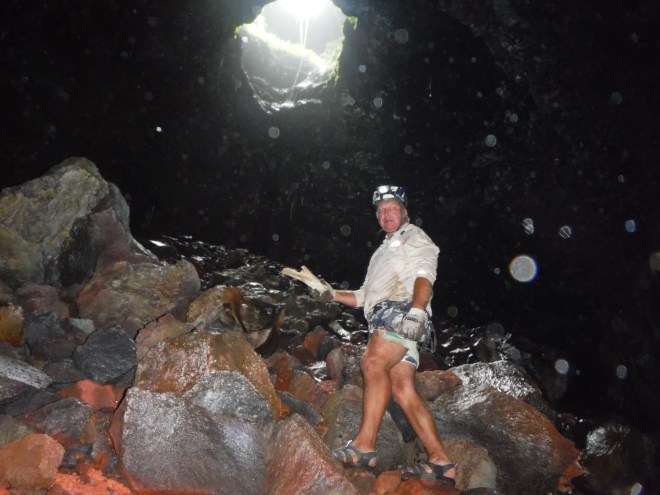
Andrew (me) holding the bones of Jorge’s lost cow.
Water was still streaming down, forming tiny waterfalls around the rim above. I was now more soaked than before, if that was possible, and not surprisingly, despite sweating profusely, I was now cold, as the temperature had dropped rapidly. The ladder shook from the weight and struggling of the others above as they too made their decent. As I looked upward to where I had come, illuminated by the faint daylight above, I saw silhouettes of cascading rocks and dirt as they broached the rim to plummet towards me. Fortunately, the rocks’ momentum launched them far enough out to miss me as they passed by, just barely. I would not need the helmet in this instance; still I was thankful for having it, nonetheless.
Teri’s foot appeared over the rim, sticking out, hesitantly searching for her next rung. I could not dawdle any longer, so I carried on down until a ledge covered in broken rock became visible. Back on relatively solid ground, I untied myself and carefully moved a few metres away from the ladder in the direction Jorge had instructed, away from the now steady stream of falling debris. Nervously, I waited for the others to land.
Jorge was the last to descend the ladder and join the three of us standing tensely in the dark. My friends likewise brought headlamps, but it was obvious they would be insufficient in exploring the cave. Fortunately, Jorge brought the powerhouse. Jorge unslung a potent flashlight from his shoulder and aimed it overhead to illuminate the sidewalls and a dome almost as large as the first one where we had left Janet.
Jorge went on to explain that we were standing in a massive magma chamber, with what looked like a single tiny opening in the ceiling high above, our point of entry and regrettably our only point of egress. (Again from my high school geology lessons.) Molten rock underground is called magma, but when it reaches the surface it becomes lava. The rock walls here were smooth, as if having been plastered or polished, but instead of being solid black like the solidified lava flows above; the rocks were splashed with colour, in varying shades of red, as if stained by the very fires of hell. Which by all accounts, it was. Colours ranging from blood red to almost pink, and embedded in the surface were billion of gold specks that danced when you passed your light overtop of them.
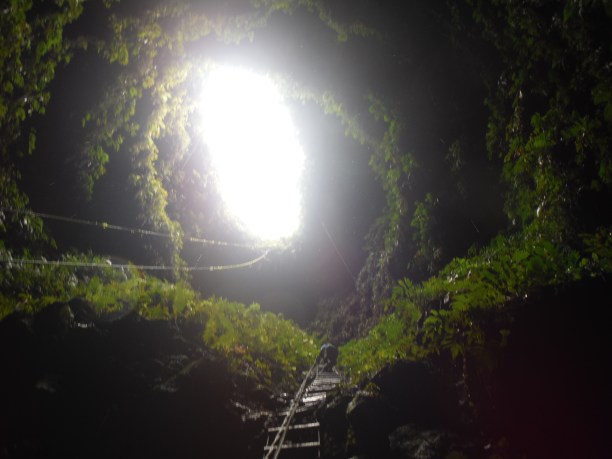
Teri descending down the ladder just before the next big drop off.
Jorge called this room “the discotheque.” At first, I was puzzled by his comment and thought perhaps I misunderstood him, but it suddenly became clear when he started to shuffle his feet and mouth a disco beat while flashing his light on the ceiling. The dancing light brought to life the myriad of colours while the gold specks remarkably resembled a nightclub’s mirror ball. We all laughed.
With the room better lit by all of our lights, it became evident we were standing atop a rubble pile, remnants of the partially collapsed ceiling. The thought of earth tremors giving us a shake kept crossing my mind.
“So how deep do you think we are, Andy?” Mark asked as he stared back up the long rope ladder and the distant prick of light, representing the surface. “Two hundred feet?” he guessed.
I was the first down, so I had some time to count the rungs of the ladder. It was easy to calculate how far it was back to the last landing, which was approximately halfway back to the surface.
“I’d guess an easy 250 feet, straight down, maybe a bit more,” I offered.
Mark hadn’t taken his eyes off the light above. “That’s a long climb back up, and I wouldn’t want to have to do it in a hurry or try and get a body out of here,” Mark concluded, with a nervous chuckle. Being an advanced life support paramedic and trained in the art of rescuing people, I was not surprised he would contemplate such a thing, but I was a little concerned he choose to use the word “body,” as in dead, instead of “patient,” as in still alive! As we were the only four down here, I couldn’t help wonder whose body he might be referring too? Being the largest, I would most assuredly give him the most trouble if it came to that.
“Yes, I know what you mean,” I agreed, then added half-jokingly, “You know, I don’t think you could get a tour like this back in Canada or the States. The liability insurance would be a killer.”
Carefully, Jorge led us down the rubble slope for a few metres before coming to a stop. He shone his light straight down into another shaft that was almost perfectly round and perhaps 15 metres (49.2 feet) in diameter. Jorge told us that after they found this place, he had led a scientific National Geographic team down to this point. They repelled straight down another 200 metres (656 feet) to the bottom where they found the remains of several species of birds and reptiles, some of which are now extinct.
“Did you go all the way to the bottom?” I asked Jorge.
Jorge laughed, “No! Muy asustado.” (“No! Very afraid.”)
As we moved back up the slope, we came across a large pile of heavy bones. I pointed them out to Jorge, which brought a smile to his face. Jorge raised his hands to his temple and spread his fingers to form horns and said, “Mi vaca.” (“My cow.”)
Ah, so here were the remains of the discoverer of this magnificent magma tube.
I said to Mark and Teri, “I don’t imagine there was much more than hamburger left by the time the cow got all the way down here, eh?”
We explored on, discovering three more large tunnels that penetrated the dome above. These horizontal tunnels were reported to extend for kilometres underground, leading further up the mountain. We were told by Jorge that most of tunnels and shafts were still unexplored or mapped and he had no plans to explore further. Apparently the park’s board has been putting pressure on Jorge and his family to sell them the property so that they could explore further and open it up to thousands of paying tourist. Jorge was adamant he would not sell; he wanted to leave the land to his children.
At the top of the rubble pile, Jorge had us climb a low rock face, and at the top, hidden from view, was another small tunnel with a low ceiling, requiring us to hunch over to enter. Like most of the tunnels we had already seen, the floor was covered in broken remnants of what was once the ceiling. The collapse most likely occurred after the magma had drained away and the tunnels cooled and contracted.
At times, wading through puddles of water, we penetrated deep into the mountain. The tunnel grew smaller the further along we went until we were only able to proceed on our hands and knees. I was not sure how long it had been since we left Janet on the ledge above, but I was thinking we should start back. When I informed Jorge so, he said he had one more thing to show us and it was right ahead.
We all crawled over one more boulder and under a rock bridge to find ourselves in a slightly larger room, but not large enough to stand. Here was Jorge’s pride and joy. On the tunnel walls and floor was some magnificent quartz crystal deposits. How theses delicate crystals had formed here and did not get destroyed by the molten magma, I could hardly guess. I found the formations fascinating, but I had my mind on returning to Janet’s side, so after taking a few quick pictures, I lead the way back to the base of the rope ladder and began my ascent.
The long climb back out of the pit wasn’t as bad as I had imagined, and I was happy to find a still content Janet perched on her ledge as I had left her. With everyone safely back on the surface, we hiked to a nearby ridge top to take one last look and to allow the hot wind to course over our muddy and weary bodies. Our guide led us back along the trail we had come until we reach a small hill, and atop of the knoll was a cabin.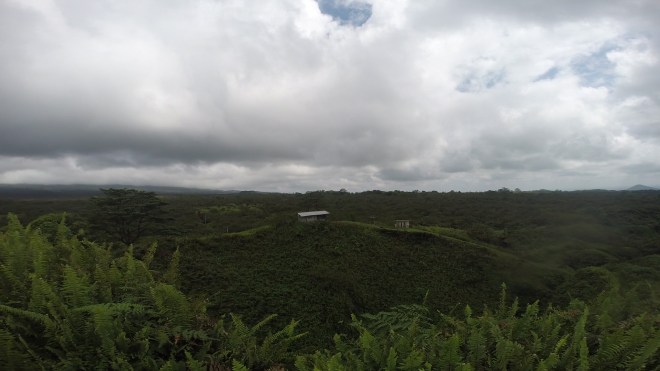
The tiny one room shack only possessed two walls on the side that would normally face the prevailing winds—much cooler in the living room when you only have two walls instead of our customary four. Inside the cabin sat a table and chairs, with beds all made and ready. Apparently this was where Jorge or one of his cowboys slept while tending cattle. Interestingly, some 20 metres (65.6 feet) away was a concrete block, duel outhouse with running water. It was there we washed off much of the mud that had accumulated on us. The twin stalls had doors, but no hinges. I had to lift one of the heavy wooden doors into place so that the ladies could use the facilities.
“Just knock when you are done,” I said to Janet as the door slammed shut.
From the outhouse, it was a surprising short downhill walk (thank God) back to the clearing where the taxi was waiting for us.
 The Naked Canadian