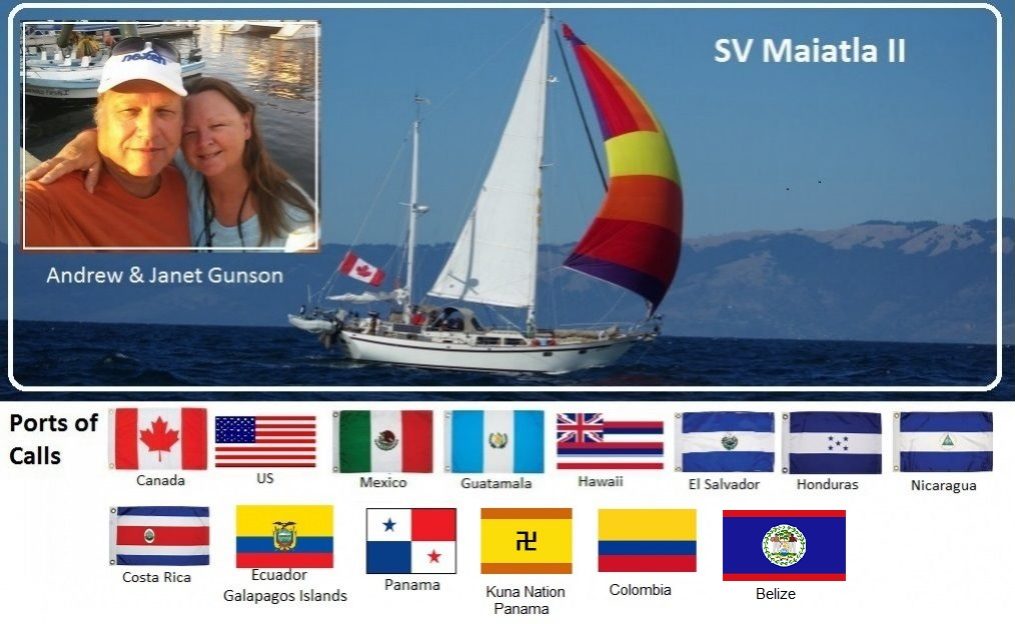
San Christabel Island- The Galapagos.

January 10 2016.

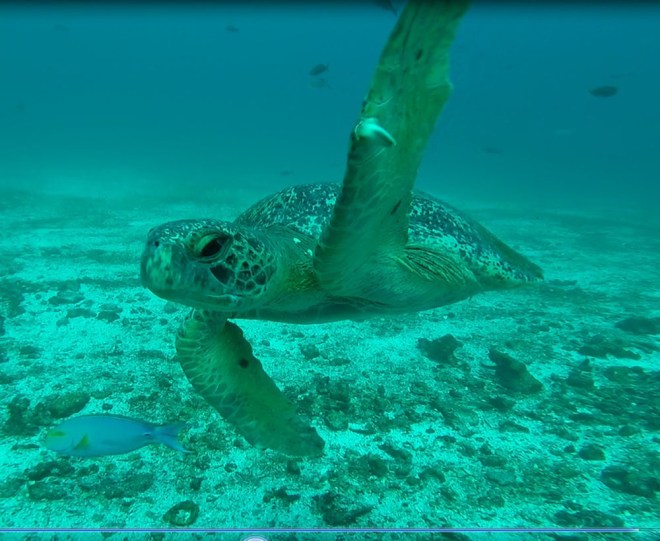
See more pics at end of post.Sea Turtle-6
 

Our time spent on Isla San Cristobel has been a busy and exciting. Mark, Teri Nic, Marina, the French Cape Horner, Eric, and Jan and I hired a taxi to take us on an island tour.  The taxi was a small Mazda 4 door pickup truck as are all the other taxis on the island. The island is 25 miles by 7.5 miles wide and is the only island with an abundance of fresh water. This is mainly due to the extinct volcano, Cerro Mundo which has a crater lake with a larger lake sitting in a valley in its northern wind shadow. It was sunny and warm-(Too warm) when we left the port of Baquerize, but as we left the city limits it quickly clouded over and it began to rain.  Hard!

Aside from blurring the view for those of us inside the cab of the taxi, the very heavy downpour soaked all those that decided it would be cool (physically as well as socially) to ride in the back of the truck. Mark, Teri and Marina sat with their backs tight against the cab while facing backward. Nic on the other hand sat facing forward while resting against the tailgate. He endured the onslaught of the hurricane force winds and rain for almost half of the one hour journey.

This day, we trekked up to the top of Cerro Mundo, saw little as the clouds were still hugging the hillside. Then we were off again, getting a scenic tour of the islands’ inland jungle until we reached the southern shore of the Island where we visited a Galapagos Tortoise breeding center. We were given a guided walking tour of the centre were free roaming adult tortoises roamed and wallow in muddy ponds. They have pens where they raise the young tortoises until they are big enough not to get carried away by a locale hawk species, then they are released back into the wilds. Apparently the hawks will pick up a young tortoise, carry it high into the air then drop it to break the shell- Dinner time!.

We left the breeding center to head to what is perhaps the most beautiful beach on all of the island, Playa Chino with its turquoise waters, flour-fine white sand Beach which is home to lounging sea lions and Marine iguanas basking on the black volcanic rocks. Jan and I opted out of the 20 minute walk through the noonday, Dante’s Inferno to get to the beach. The rest of the crew slugged through the heat and humidity to spend 30 minutes on the beach. While the crew made their beach trek, Jan and I had a cab take us to the cantina to have a few cold beers while we waited for the others. At least Nic had a chance to thoroughly dry out on his long hike through field of black lava rock and cacti. I imagined it was like strolling through a giant hibachi. Once the crew made their way back to the cantina, it was then lunch and more beers at a hill side cabana, with a spectacular view of the coast. (Lobster and Chicken for Jan and I) .The sea breeze kept the heat in check.

Then it was back to the interior where we stopped to look a t a funky tree house built on and inside a giant ceiba…tree.  Access to the tree is gained by a dubious looking suspension bridge with missing lats  under your feet. The tree house has a living area, tiny kitchen with a balcony big enough for two with a single bedroom-loft which you can rent for the night. If living in the branches wasn’t to your liking you can sleep in the basement which is accessed through a hole in the tree trunk. If you ever wanted to live like the “Swiss Family Robinson”, this is your chance.  It was interesting and I would have stayed longer but the mosquito swams quickly convinced us to move on.

A few days late we all took a snorkeling tour out to “Kicker Rock” in a 25 foot speed boat. (That great volcanic plug that first greeted us when we arrived.)   The visibility wasn’t great but we did see some 4 foot black tip sharks and got to play with sea lions. We even swam through the tunnel that pass through the width of the island.   Leaving kicker rock behind we motored up the coast to a beautiful beach called Puerto Grande, where we beached the boat and explored inland looking at lava tubes and a landscape one would expect to see on the surface of Mars. Burnt, sharp volcanic rubble interspersed with cacti. No Cacti on Mars I suspect.

Back at the beach Jan and I explored tidal pools full of brilliantly red Sally Lightfoot Crabs and snapping pictures of Blue Footed boobies and marine iguanas. Jan and I snorkeled here some more but was less than impressed with the lack of marine life on the rocks. A function of locale waves and currents no doubt.

By New Year’s Eve, Nic and Marina had moved onto Santa Cruz as there time was fast running out.  By now I had the engine repaired and most of the other necessary boat repairs done so we too prepared to move on to Isla Santa Cruz. Mark and Teri would stay with us for another three weeks as we move about the islands. We stayed on San Cristobel for new year’s eve and went ashore to watch the festivities. The waterfront Malacon was busy, mainly with locals all dressed to the 9s in their best or sexiest ware. Not sure why, but there were stuffed mannequins with paper-mache heads placed about. Some had photos of real people glued to the heads. We thought perhaps they were to represent friends or family members who were not here or who had perhaps died in the previous year.

Not sure, but I will dig into this ritual a bit more to find out. There was live and recorded music at several venues with hordes of children running about. Despite the amount of beer flowing, it was definitely a family affair.  By 10 am we were all pooped out so we caught a ride with our friend Eric who dropped us back off on Maiatla, before heading back to his own boat. Eric’s boat had a low transom, (back end) where the sea lions were able to easily board his boat. Once onboard they would find a comfortable spot for a nap. There were days when his boat was covered in sleeping beast, from bow to stern. Eric would keep a big bumper on a rope that he would swing to clear the squatters whenever he arrived back home. There was a weak fireworks display at midnight along with the chiming of the church bells. That was enough for us so it was off to bed. But not ashore. Apparently things were just getting started and we would miss the best part of New Year’s eve, anyway the party ashore lasted till dawn, the music never stopped all night. Eric, our Cape Horn friend left for the Panama then back to france. As a farewell, after a viscous game of Mexican Train Dominoes aboard Maiatla,  I gave him copies of my books so he would have something to read along the way.

After taking on fuel that was arranged by our harbour agent, and took delivery (It arrived in 10 gallon jugs carried by a water taxi) we were ready to go.  We were up early and underway just as the sun popped over the Cerro Mundo. We motored out between the channel markers and the breaking surf on either side. Once clear of the harbour the wind filled in and we had a great sail on a tight reach for the 28 miles over to Isla Santa Fe, the next un-inhabited island. We’re not permitted to stop but we moved close inshore for a photo op. It was a barren island with scrub bush and cacti but here was a beautifully protected bay on the east end that would have been perfect place to anchor and cavort with the abundant marine life, but it was off limits to us. Maiatla had a 90- three island cruising permit. The only island we were permitted to stop was, San Cristobel, Santa Cruz and Isabela. That’s it.  If we wanted to visit any other island we had two options, the first was to hire a local charter company to take us there. The cost of visiting the other islands this way ranged from $100.00 to $1000.00 USD per day per person, depending on the island and the level of comfort we desired.  The other way was to hire a park guide directly to accompany us. This seemed like a reasonable alternative and I looked into it but I quickly back off when I found out that the cost of doing so would be $200- per person, per day. With 4 crew that would mean $800 USD per day. Ouch. So that was out.

So we skirted Santa Fee the headed for Puerto Ayora on Santa Cruz which is the largest town, (15000 people?) in the Galapagos Archipelago and ground zero for the islands massive charter fleet.

More to come later.


The Galapagos, the Hard Way!

Friday, January 8, 2016

Well hello everyone and Happy New Year from Jan and I from the Galapagos Islands off of the coast of Ecuador. We have been anchored in Puerto Baquerizo on San Cristobel for 18 days now licking our wounds and fixing all of the boat stuff we broke sailing over here.  It’s with no exaggeration when I say I have spent probably 80% of our time here so far either repairing the boat, looking for boat parts or shopping for provisions to restock the ships larder.

As most of you already know we lost our engine due to water in the fuel which struck while we were still 400 miles north of the Galapagos Islands. This left us to beat up wind, (Sometimes in gales as well as calms) driving the boat hard while battling the strong currents that surround the islands.   If all this wasn’t enough, the brand new radar system that I had installed just days before departing Mexico, failed within hours of leaving port.

The loss of the radar meant that not only was it hard to track nearby shipping or fishing boats, but it also  left us virtually blind as we relied upon sharp navigation as we passed close to islands in the dead of night or in blinding rain storms while engineless.

At times it was very nerve wracking. On the dawn of our 9th day at sea the growing light gave us our first glimpse of the Galapagos, it was Isla Santa Pinta which was less than two miles away. The excitement of the land fall and beauty of the uninhabited, green volcanic isle was lost to us because a strong, west setting current was drawing us in towards shore. The sight of the braking waves upon the black bolder beach was all the encouragement we needed to sail sharp and attempt to claw our way back out to sea. We spent the remainder of the day trying to avoid being driven ashore on first, Isla Pinta, then her sister island, Isla Marchena, a barren shore already known for shipwrecks.

At one point, in light winds, I was forced to launch our inflatable and with its 15hp motor, tow Maiatla around the rugged southern headland on Isla Marchena that just seemed determined not to let us pass.

Just arriving at our chosen port here in the Galapagos safely was no small feat and I’m so proud of Maiatla and her crew, (Mark, Nic & Marina) for rising up to the challenge.  If you ever had to throw a reef into a big mainsail on a pitching deck in the middle of the night during a gale, while functioning on just a few hours’ sleep for days on end, you know what I mean.

Well aside from the engine problems, our freezer packed it in preventing us from keeping most of the fish we caught. (Hooked two sword fish but lost them.) We ripped a batten out of the mainsail and blew some stitching our of our head sail. Because we were working the boat so hard, (and the caulking dried out in the tropical heat over the last four years) the portholes started to leak.

Under normal circumstances in typical rain this would have been a mere aggravation but since approaching the equator the sky has become confused and at times, it thinks it is the sea that it normally hovers over. I have never seen rain so dense. It came down so hard that you would think you could snorkel while on deck.  During this rain, when we were forced to leave the relative comfort of the (now not so dry) cockpit dodger, your first reaction was to hold your breath for fear of drowning.

The rain got in everywhere soaking everyone and everything thing in the cockpit as well as in cupboards and drawers down below. Worst of all was, all of Jan’s cloths that I had laundered back in Mexico before departing which were neatly stowed in her hanging locker, were soaked. They would have fared better hanging in the shower while the crew bathed away. UGH!    With the heavy rain we were forced to keep all portholes and hatches closed so with 100% humidity and 28c heat, it was stifling between the decks. Nic and Marina often took to sleeping in the cockpit just to get a break from the inferno down below.

So I will have to start systematically pulling and resealing port holes. (In my spare time).  Fortunately most of the rain water found its way into the bilge which would normally get pumped out by the automated bilge pump, but the electric bilge pump had also mutinied and we were forced to hand pump. Oh yes and I almost forgot. The hydraulic steering pump has also developed a nasty habit of spitting oil out of one of its orifices which then dribbles down the back of my engine instrument panel to find its way into the towel drawer in the head below. What oil wasn’t caught by a bath towel seeped down through the engine room, coating my transmission before completing its migration downward to finally collect in the bilge.  The combined rainwater and hydraulic oil accumulation, if I were to pump it out, (that is if the bilge pump actually worked) would leave a slick behind the boat rivalling that of the Exxon Valdes Alaskan oil spill.  Aside from the resulting greasy mess, the steering is working fine. Just needed to keep topping up the fluids.

It was at about this point while attempting to furl in our big headsail as another squall approached, the furling gear on our roller furling headsail began to jam, making it very difficult to reduce the amount of head sail we had up. I was fearing the bearing were starting to go which would not only mean I was in for a very expensive and difficult repair, but any work done on the  furling gear would have to wait till we arrived in Panama some three months later. The loss of the furling gear would mean that the big sail would have to be manually put up and taken down, and one size would have to fit all as there would be no way of reducing the size of the sail once up. I have a smaller #2 headsail that we could use but the manual handling of sail from now one would mean for a lot of work.  It has been almost 4 years since we departed our home port of Ladysmith on Vancouver Islands and we have driven the boat hard, mostly in the tropical heat and humidity which plays havoc with a boats’ systems. Maiatla was in need of some TLC but unfortunately, again that will have to wait till we get to Panama.

Our 10th night at sea found us 100 miles from San Cristobal Island and our final destination.  It was a difficult night of sailing hard on a wind that kept clocking and backing 15 or 20 degrees, (Shifting). The wind would also die to an almost calm then quickly build to a gale as another rainsquall approached.   Early one morning we had the added excitement of approaching 0 degrees of latitude. The midpoint between the north and south geographic poles. This point is better known as the equator.

A sailor who has never crossed the equator is known as a pollywog, a veteran of the crossing is called a shellback. Normally crossing the equator is a big event for sailors and is often celebrated with grog and pranks set upon the crew and often later commemorated by an ear piercing or a tattoo.  ( my crew was discussing getting a Southern Cross Tattoo).   But in the wee hours of this morning with soggy misery haunting the cockpit with a crew that just finished reefing the main as another gale crashed upon us, no-one was really in the celebrating mood. We just watched the GPS count down the last few seconds then, when the GPS kicked over to display all zeros in the line indicating latitude; and the Big “N” switched to a “S” we furnished a weak cheer and gave ourselves a verbal “pat on the back”.  This was my 3rd crossing of the equator by boat but by far my most hard won.

By our 11th morning at sea we closed in on the shore of San Cristobel’s western shore where the harbour is located. The wind was fresh out of the south east at 15 to 20 knots as we sailed fast to the west while being pushed by a 1 knot westerly current. Still in the predawn, we tacked back towards shore to cover the remaining 10 miles to the harbour, but as luck would have it, just as dawn broke, the wind died leaving us to wallow in a deep swell with just 8 miles to go.  From this vantage point, so close to shore we could see what we would later learn was kicker rock. A split volcanic plug that raises over 300 feet out of the sea a couple miles off shore. The Rock boasts a water filled cavern and a slot between the island that is a popular snorkeling and dive spot.  After about an hour bobbing about without a breath of wind, I decided to again launch the dinghy and attempt to tow Maiatla the remaining 8 miles to the harbour.  No sooner had we started the tow when we spotted an Ecuadorian patrol boat that likewise spotted us and came over to investigate. Using my rudimentary Spanish I manage to explain to the ship’s captain who we were and what our intent was. I had them call my Galapagos to see if he could assist us. Bolivar, our agent was aware of our engineless condition as I had sent him a email over my Ham radio a few days previous so I was hopeful that he was ready for us. I was told by the captain of the patrol boat that he would request permission from the port captain to tow us in, but after an hour of waiting, the patrol boat sudden re-engaged its engines and motored off to the east, leaving us to wonder what was going on.  As I stood on the foredeck watching our supposed help sail off, I felt a puff of wind from the south which quickly built to a breeze. Not wanting to waste such a good wind, Mark and I hoisted the main and, with much difficulty, unfurled the jib. I put Maiatla on a heading that would take us back offshore a few miles where I would then see if we could lay the harbour.   Maiatla was sailing well at 5 knot and as long as the west setting current didn’t suck us past the point, we would make it into the harbour. While the crew was tidying up the lines, a burst of rapid Spanish came over the radio in which I thought I heard our boat name. Taking up the binoculars I scanned the shore line and sure enough, a couple of miles back, I spotted a small fishing boat which appeared to be in hot pursuit. We quickly tacked the boat and closed in on the fishing panga. Bolivar, our Galapagos agent and his friend, Nocho came along side then took us in tow.

So there we were, 11 days after departing Mexico making our landfall at the end of a long rode behind a 8 meter fishing boat. Perhaps not the most dignified way to end a voyage, but we were exhausted and grateful to finally get the anchor down in the calm waters of the bay. All celebrating would wait as we all went straight to bed, going ashore would have to wait till later in the afternoon, after we had received visits from customs and immigration agents, the port captain and then the parks board representatives.

Perhaps one of the most disconcerting things I discovered later occurred while I was at the top of the mast performing an inspection.  I was horrified to see that the two little wooden jumpers that support the upper part of the mast were cracked. Further probing revealed that dry rot and taken its toll over the past years in the tropics and had weakened the structure. These jumpers are critical to the stability of the mast and would have to be either repaired or replaced before we dare venture back to sea. Fortunately I found a local carpenter who is now making me a new set, and with luck I will have them re-installed at the top of the mast in a day or so.

I also had to send my laptop computer away for repair as the screen mysteriously got broken one night during our crossing. As I use it for navigating I needed it fixed.  I also sent a furry of emails to my radar tech and after a trip up the mizzen mast to disassemble the radar dome, I located a loose wire so the radar is now functioning as intended.  So no more playing chicken with supertankers or islands in the dead of night. Yahoo! Also after dismantling and servicing the bearings, the jamming of the furling gear is cured. What a relief!

Despite being an isolated archipelago, I have been able to find much of what I need for repairs, including a good engine and refrigeration mechanic.My fuel injector pump had to be flown to mainland Ecuador for repairs. I also sent a flood of emails off to the manufacture of my steering pump, Wagner, asking for repair options. Nothing came back yet but I’m hopefully it will be an easy fix.

So I’m happy to say that at this writing that almost all of the critical repairs are done or nearing completion.

Despite being harbour bound in Puerto Baquerizo, we have made every effort to see some of the island, explore and try to relax. Jan and Teri, flew into the Galapagos just one day after our arrival. (They chose a more sane way of getting here). The village has about 4500 residents that live in one or two story block houses, most in various stages of completion or disrepair.  The Malecon, or waterfront Main Street is pretty and well-kept and along the brick lined streets is where many of the tourist shops, restaurants and bars are located.

During the day and late evening the Malecon is swollen with foreign tourists who share the streets with giant marine iguanas flanked by belching and snorting sea lions that will sleep virtually anywhere. (The sea lions, not the tourist.) Park benches and roadside curbs being a favorite spot of the sofa size beasts.  Down an alley and up a set of stairs in a narrow corridor, we found what would become our favorite breakfast restaurant. The rustic, six table eatery with exposed concrete block walls, serves their version of and American breakfast, a fruit smoothie, eggs, toast, jam and all accented with a fist-size ball of Plantain and cheese. Tasty but it has the texture of play doh. Each morning we would be cheerfully greeted by the overly friendly owner who would usher us to our regular table by the balcony rail so we could watch the early morning goings on down in the street. All for the reasonable price of $5USD per person.  (a real deal here)

Out in the anchorage, daily, large tour boats come and go, picking up passengers for week long excursion between the islands.   It’s easy to imagine that a large part of the local population derive a living from the tourist trade. There are two great concrete piers here but due to the heavy surge, you can’t tie alongside so, all passengers and cruisers use a water taxi to get out to the boats. A $1 a ride could be had on a 8 meter panga, “ La Perla Negra” was our favorite boat which flew a tattered, black skull and cross bones flag.  The water Taxi was captained by Danny, an equally colourful local character who wore a head bandana and the caramel skin that is indicative of the locals. Danny, who spoke broken English and had a German wife, took good care of us and tried to make sure that we were all back aboard Maiatla before he quit running at 7 pm.

The water taxi was economical and it was not worth taking Maiatla’s tender ashore. Besides, the harbour is home to over 3000 sea lions that will claim you dinghy so they can have a noonday nap.  The animals my look cute with their big puppy-dog eyes and cat’s whiskers but it’s all the smelly crap, (literally) and possible tooth holes that you get when they use your expensive rubber dinghy as a bed or teething ring, it’s just not worth the risk taking our tender ashore.

Anyway we have settled in and with most of our boat work done, we began to explore this magnificent tropical South Sea island.  So far the Galapagos Islands appear as enchanting as all the tourist hyper-descriptive literature proclaims. We can’t wait to see more.

Check out our pictures.

More to come.

Bye from the crew of the Maiatla.


Safe arrival in the Galapagos Islands

DSCF1344
 the crew Marina- Andy Nic and Mark.  First steps on dry land in the Galapagos Islands.
Hi folks, well as most of you know we made it to the Galapagos islands after
a 11 day passage, but not without incident. We lost our engine 400 miles
from the islands then we were slammed on the nose with high winds and gales
then calms that left us spinning in circles for hours with out a breath of
wind, not enough to move a thread of cotton. Add to that, wicked
currents surrounding the Galapagos islands that threaten to drive us on
shore of an uninhabited island.
And rain! lots of rain! So much that it would have given Noah reason to pause. We are all bruised, ( Literally!) and exhausted as we hadn’t gotten more than a few hours sleep each day for. the last several days. I never left the cockpit for two solid nights, just getting cat naps between tacking the boat up wind. All and all it was a
great sailing adventure and our beloved Maiatla came through with flying
colors. Just some sails to re-stitch and new deck leaks that had opened up
do to all the stress on the hardware. Oh yes did I mention that the engine is broke?
We will spend a couple of weeks on San Cristobal islands repairing the boat and playing tourist.
More to come
later.
Love from all of the crew of the Maiatla.

Leaving Mexico for the Galapagos Islands

Well its done! A surprisingly painless check out of Mexico, (if you don`t count the 5 a.m visit by the harbour master). Its hot and very humid this morning. So much moisture that the outside of the boat is dripping as if we just suffered through a downpour. It will be sunny, when the sun finally peaks over the distant volcano. But there is little wind predicted  so we will have to start our voyage motoring while searching for breezes. ) good time to fish).

I estimate that our nonstop, 1000+ mile voyage to last about 7-10 day before making landfall on the enchanted Iles, the land of giant Tortoises, Salt spiting lizards and displaced ant-arctic Penguins. Follow our progress in our  `Where in the World is Maiatla II.`part of this blog.

Wish us luck!.

Andrew, AKA the Naked Canadian.


Another Trip Around the Sun!

The Maiatla Log- 2015 to 2016 The Galapagos Islands Voyage.

December 2 2015. My Birthday.

Well aside from being my birthday and the start of my 56th year as a sentient being on planet earth, today is the day I commence my journey from Nanaimo British Columbia back to Tapachula Mexico to rejoin Maiatla to initiate our next big adventure on the high seas. My friend and crew-member Mark Taylor and I are departing today and once we reach the Mexican coastal town of Puerto Madero, located just a handful of miles from the Guatemalan boarder on the Pacific Ocean, we will start to prepare Maiatla for the long, open sea passages ahead.The rest of the crew, Marina Sacht, a Maiatla veteran of 3 previous cruises and her boyfriend Nic (who has never been offshore before) will arrive in Mexico on the 9th of December after which we will depart.

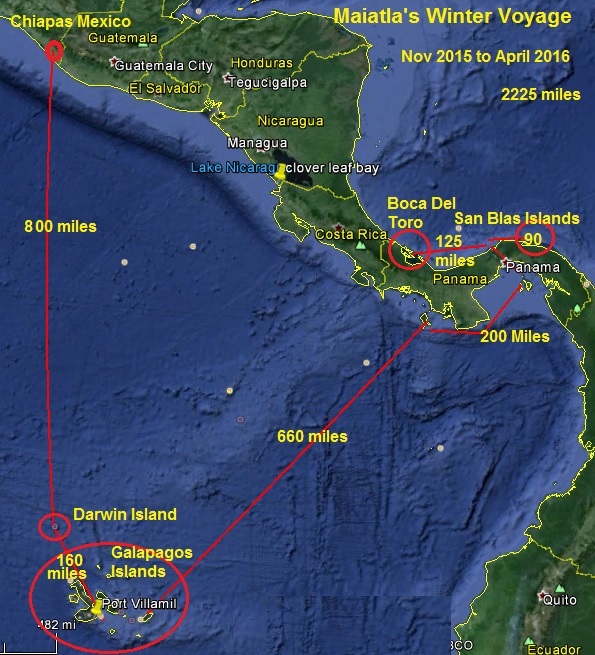
Jan and I had left our beloved boat in a safe marina in the Mexican seaside port last April after spending another season cruising and country hopping as far south as Costa Rica. Our plan for this seasons’ cruise is a bit more ambitious as we will immediately set a westerly course to take us well offshore covering over 800 miles of open ocean with our first intended landfall being Darwin Island, a mere speck on the chart of the pacific ocean. The island that was named after the famed naturalist, Charles Darwin and is nothing more than a few acres of guano covered rock, the top of a great and ancient sub-sea volcano that just barely breaks the surface.

The significance of this tiny islet is that it belongs to the renowned Galapagos Island chain which in turn are governed by the country of Ecuador. The bulk of the isolated archipelago lie just south of the equator and almost 700 miles off the coast of Ecuador. Amazingly the next nearest landmass to the west is over 3000 miles and is another archipelago called the Marquesas’

Janet and Mark’s wife Teri will fly into the Galapagos for Christmas and the crew of Maiatla will spend the following 4 weeks or so exploring the Galapagos chain then head back east to sail another 800 miles of open ocean to the Central American city of Panama where we will transit the famous canal to enter the Caribbean.

Bearing south once again we will sail to the beautiful coral atolls of San Blas, located in southern Panama and just to the north-west of South American country of Columbia. In late March of 2016 we will sail back north to Boca Del Toro where we will bed the boat down for another summer and return home to family and I hate to say, work.

Jan and I are very excited about this year’s adventure and we invite you to follow along. If you log onto our blog, you will find more details of our planed voyage and if you click on the globe in our “ Where in the world is Maiatla II” you will see precisely where we are on any given day during our voyage. I use our ham radio to send emails to update our position daily so our family and friends can watch our progress both down the coast as well as far offshore.

The two pics are of Darwin Island and a map our this years voyage.

Untitled

Maiatla’s 2015/16 Winter Cruise


The Wandering Mermaid’s “Our Village”

Hey, I am happy to announce that my books have just been adopted by the WANDERING MERMAID’S ” OUR VILLAGE” an awesome new web site from Las Vegas that promotes exceptionally talented musicians and writers. 🙂 Please check it out and share!

Andrew Gunson A.K.A The Naked Canadian.


12115478_10207273973114832_5145876156549893390_n


Check out their Facebook Page   Click here

Preparing for another Cruising Season

August -2015 Winter Cruise Plans

Come December the Maiatla and her crew will be sailing over 900 miles from Chiapas Mexico down to the enchanted Galapagos Islands where we will spend 3-5 weeks cavorting with Penguins, marine iguanas and diving with Giant Manta Rays and Hammerhead sharks.

From the Galapagos we will set sail for the Panama Canal. 700 miles to the east along the equator where we will cross the Isthmus of Panama to the Caribbean and then head south to the San Blas Island, the land of the dugout canoes and Kuna Indians.  For a month we will explore the isolated islands where we will again dive our brains out on the magnificent coral reefs.

Come March it will be time to return to Northern Panama  and Boca Del Toro where the Red Frog Marina was carved out of the jungle. For another month we will sail out of the marina exploring the coast, diving and perhaps renting a car for some inland tours of the Mayan Ruins in Honduras. We have cruising friends already in the area and we hope to hook up and get reacquainted. Sometime in April we will bed down the boat at the Red Frog for another summer and we will head home to Nanaimo to see family and regretfully… return to work for a bit. Well that’s it in a nut shell. Can’t wait to get started.

There may be some crewing opportunities for a few bodies from Mexico to the Galapagos or through the Canal. If this interests anyone please visit  the “Crewing Opportunities” section of this blog for more information.

Maiatla's 2015/16 Winter Cruise

Maiatla’s 2015/16 Winter Cruise

Hey Maiatla made the News!

 Nanamio Daily News

 Author working on ‘Naked Canadian’ series

 Marina Sacht / Daily News                                           January 30, 2015

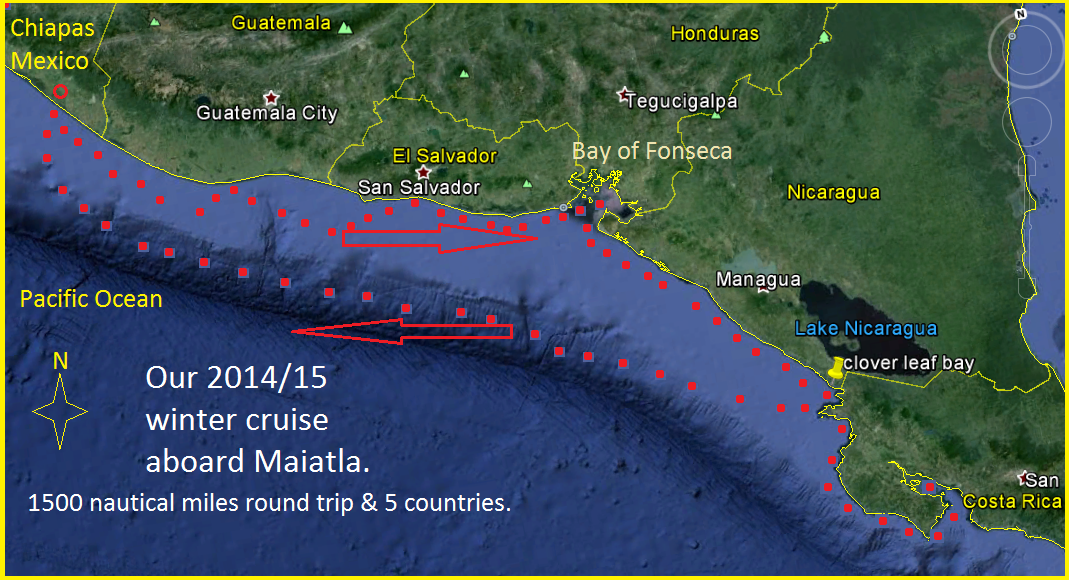
I’m back! This winter I took a few months off to join the sailboat Maiatla in Tapachula, Mexico, and sailed to Costa Rica, stopping off at El Salvador and Nicaragua.

The boat is owned by Andrew and Janet Gunson of Cedar. Gunson has written several books on his family sailing adventures and is working on his third in the Naked Canadian series.

The book should be a good one. On this trip we had a lot of wind, over 50 knots blowing so hard that the dodger was starting to come apart. Fishing, snorkelling, exploring jungles and being held at gunpoint by the Nicaraguan military on a secluded beach were just some of the interesting episodes on the trip. To read more or see photos visit his blog https://thenakedcanadian.wordpress.com/

Voyage of Escape!

Saturday, March-28-15

Voyage of Escape

Well our voyage of escape from Costa Rica went well. We departed from our little bay in Costa Rica at 3am Saturday morning with Bahia Del Sol in El Salvador as our intended destination.  It was very dark as it was a moonless night but the stars were all in full attendance.

By 7 am we had reached the northern limits of Costa Rica and Bat Island. The tip of the peninsula and area that for the past two weeks has been blanketed in continuous gales. This would be our fifth attempt in two weeks to get around this notorious headland. 4 times we had been driven back to seek shelter in a seclude bay to lick our wounds and question our sanity.

Fortunately, on this attempt,  the high winds and rough seas had subside some. As we rounded the barren rock island, we were greeted with 25 knot winds and 6 to 8 foot seas, a gift compared to what greeted us the previous 4 attempts. On our last try we were smacked with 40 to 50 knots of spray laden wind.

Since we had officially been kicked out of Costa Rica and were forbidden to return, (for at least 90 days) we had no choice but to carry on and find a friendly country.

The condition for the next six hours were a bit rough and I was rather concerned for Jan as the sharp motion was hurting her back. Fortunately the winds dropped and seas leveled out and it turned into a fine sailing day up the Nicaragua coast.

We had two days to get to Bahia Del sol and be there by the 5pm high as that was the only time we could pass over river sand bar into the protected estuary where a nice dock awaited us. We made good time, too good in fact as we arrived off the bar 15 hours ahead of schedule so we had a choice to either anchor and wait for tide change of carry on and make a run all the way back to Chiapas Mexico.

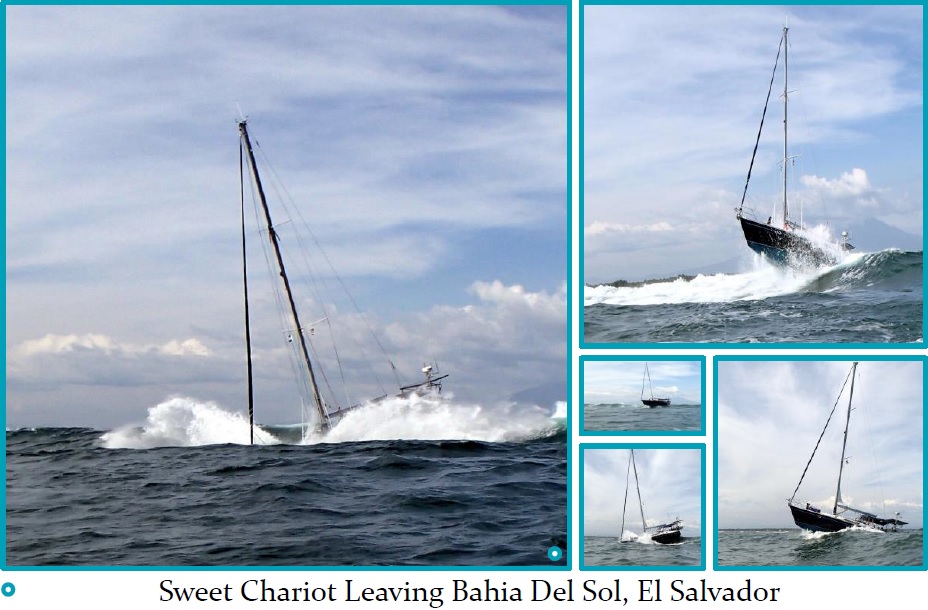
Chiapas is where we preferred to have the boat as there was a better repair facility and the steering was still giving us some grief. (I was not looking forward at attempting to surf Maiatla through the breakers over the bar with bad steering). See below our friends on SWEET CHARIOT crossing the Bar.

Seet Chariot at the bar

See what I mean?

So carry on we did. The fine weather held and we continued to make good time. We even caught a large Jack Gravel that took over half an hour to land which burned both Rick and I out. Nice fish. We even got to see the smoke from and erupting volcano on the Guatemalan coast. Way cool.

Well just over three and a half days after leaving Costa Rica we sighted the harbour lights of Puerto Madera, the home of Marina Chiapas. By 9 pm we were securely tide to the dock and ready for a full and uninterrupted night’s sleep.

We were lucky that our weather window was so good and lasted as long as it did. Just a couple of days after our arrival the weather deteriorated and the radio was reporting 30 plus knot winds and 8 meter seas. That would have been very ugly and I’m sure glad that we didn’t doddle along the way and get caught it that.

We could breathe a deep sigh of relief, but not for long. No sooner had we settled in, I got an email that the project that I had up in the Tar Sands that was scheduled to start in just over a week, was starting now and I needed to get back to Canada asap. So with, that I booked a flight home and left Jan and Rick to bed the boat down for the summer.

Jan is due to fly home next Wednesday. So the boat will stay in Chiapas for the summer and I hope to go back down in July to start on the many repairs in preparation for next seasons cruise. That is if we haven’t had our fill of the tropical heat and corrupt third wold officials.

Bye for now.