The Bucket List

The water was blood warm and pool clear while lacking any discernable current. The cliff and the 8 foot long stalactite before me was formed eons ago of a light-grey limestone which reflected the intense Caribbean sunlight, channeled down to us by the vertical walls. The illumination gave us the false sensation that were not very deep and safe, but in reality we were passing the 110 foot mark as we plunged deeper into a geological feature which has claimed the lives of many well trained divers before our attempt. The dangers of the dive were starting to become apparent and they had nothing to do with the 6 foot long reef sharks circling above and below.

As an 11 year old boy growing up in Burlington Ontario Canada, I was fascinated with the sea, a condition brought on by faithfully watching the television series, The Undersea World of Jacque Cousteau. One particular show that stuck with me was Cousteau’s documentary account of diving and exploring the Great Blue Hole of Belize. Then known as British Honduras.
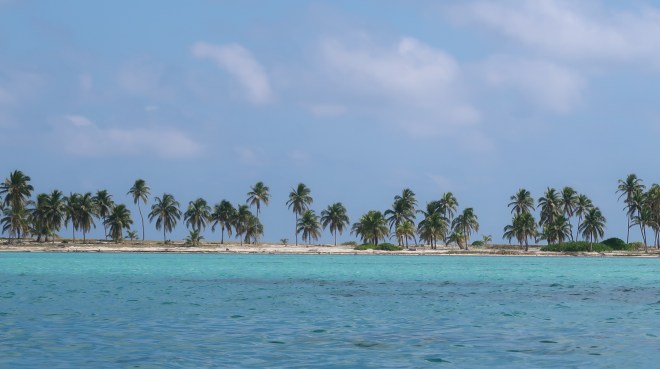
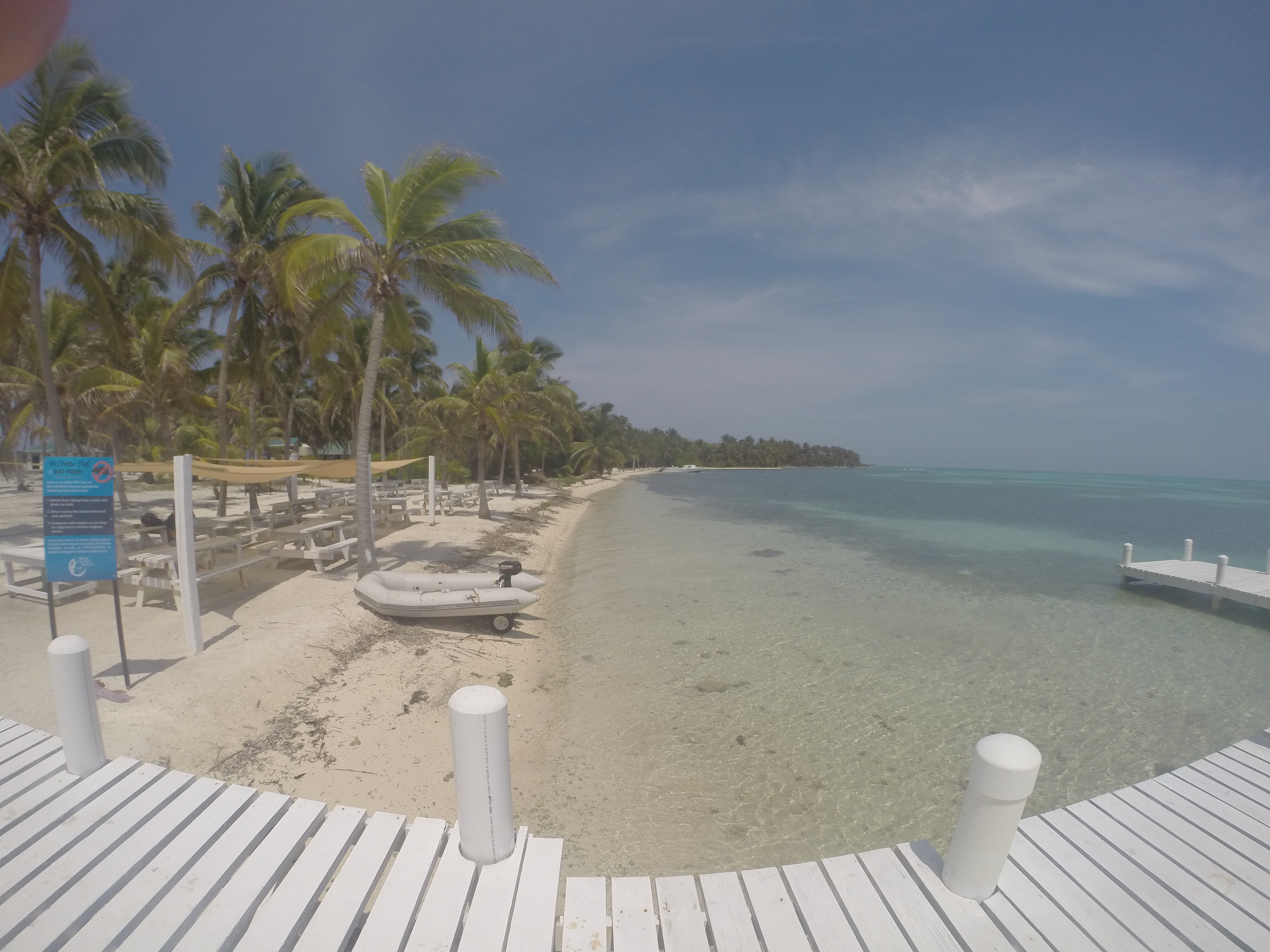
Half Moon Cay.

As a pre-teen, I had not heard of nor understood the concept of a “Bucket List” but apparently I had unknowingly started one as I had decided then I would dive the Great Blue Hole, but I could not imagine at the time that I would have to wait 54 more years to do so.
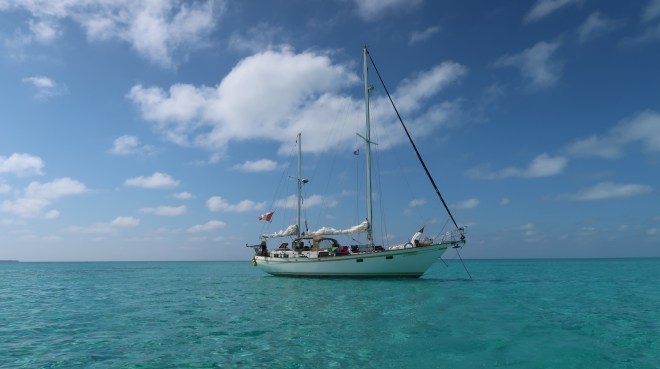
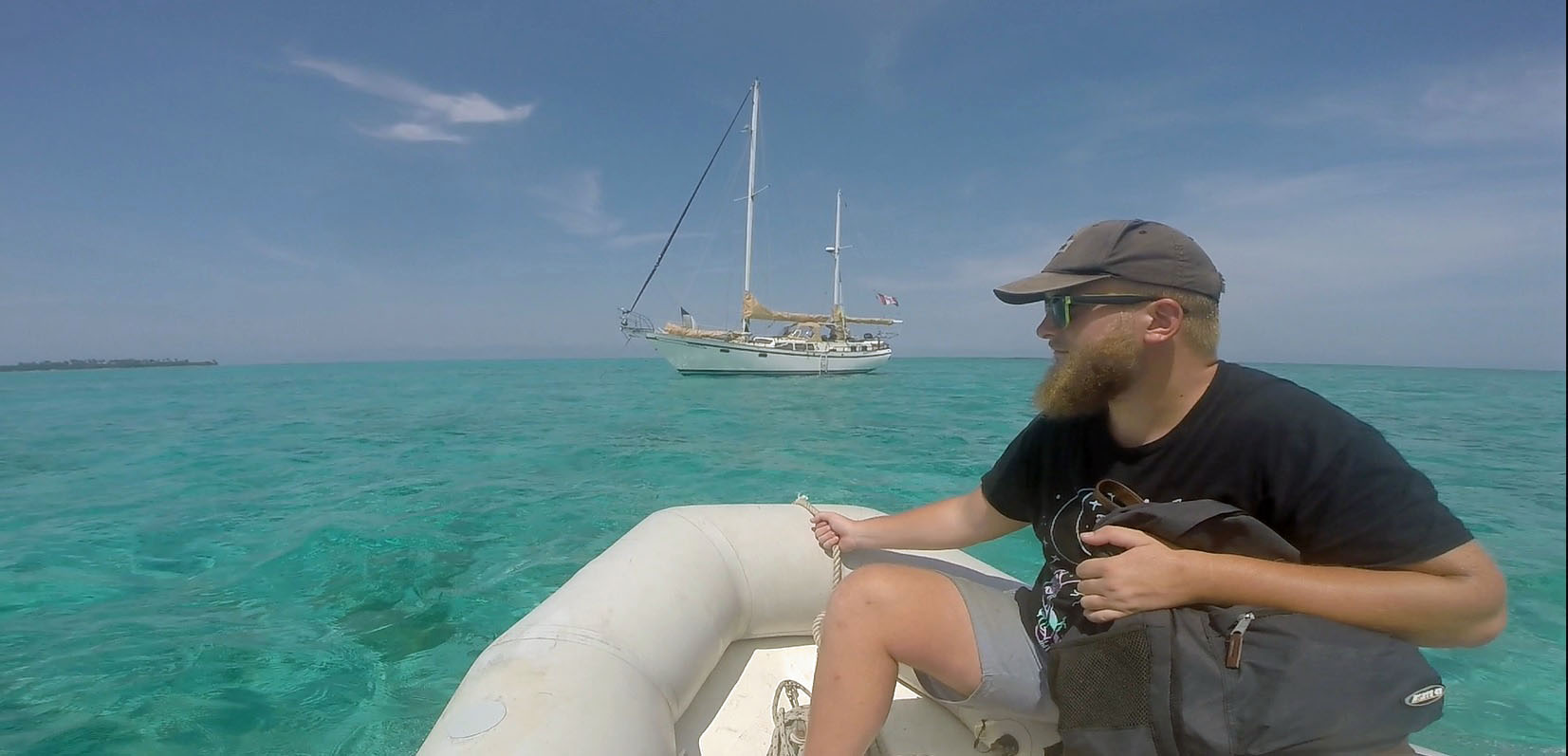
Maiatla at anchor at Half Moon Cay

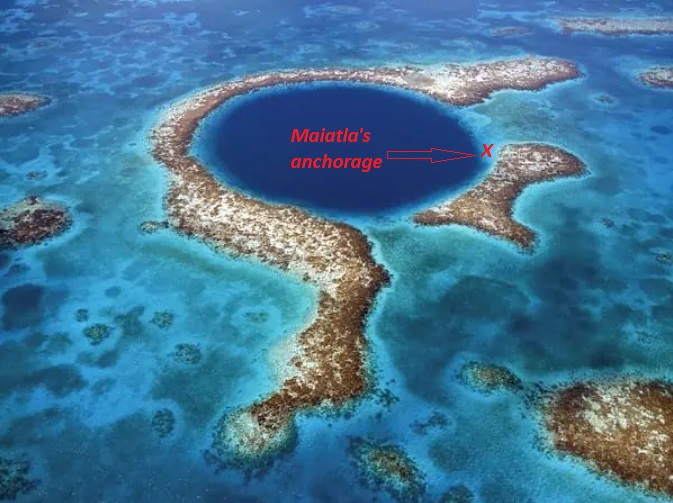
The Great Blue Hole is a large marine sinkhole. It lies near the center of Lighthouse Reef, an atoll 42 miles from the mainland and Belize City. The hole is circular in shape, 1000 feet across and 400 feet deep. When the seas levels were much lower, rain water permeating the ground for millennia, eroded the soft limestone to create a massive cavern. After the last ice age the sea levels rose to flood the coastal shorelines. The ceiling of the now submerged cavern collapsed, creating a perfectly round sink hole.
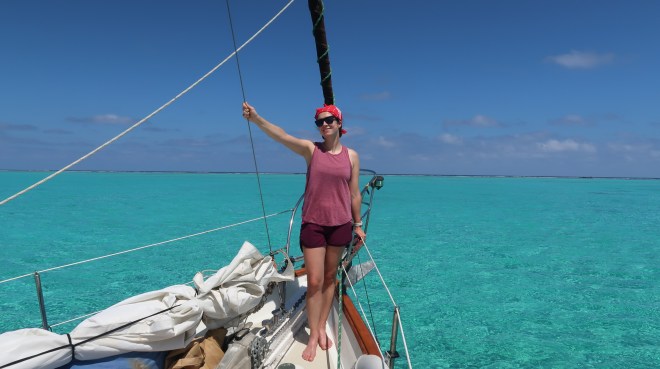
Stephanie admires our anchorage and the crystalline water Half Moon Cay

In March, three friends joined my sailing vessel, Maiatla for a little fun in the sun sailing cruise of Belize with the focus of venturing out to the Great Blue Hole.  On board was an old sailing buddy Marina Sacht, her sister, Adriane Polo and her daughter, Stephanie Sykora. Stephanie was an avid diver and when I suggested we team up to dive the Great Blue Hole, she was all in.
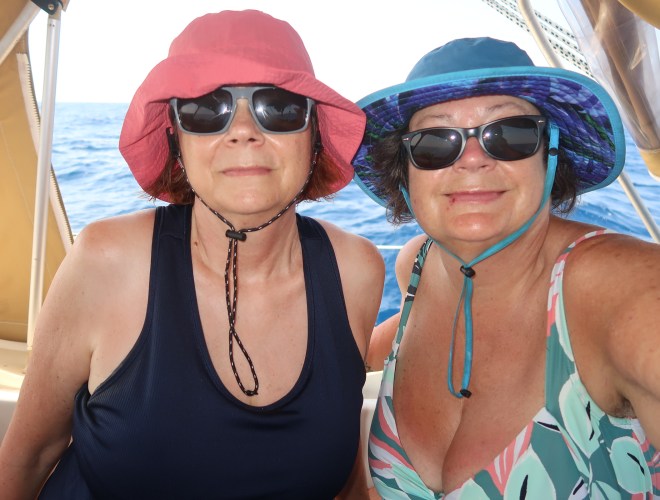
Adrian and Marina, best crew ever!

 We arrived and anchored off of Half Moon Cay, dropping the hook onto a glaring white sand bottom. Half Moon Cay is a national park, and one of the cays that boarder the perimeter of the massive atoll. We wasted no time in heading ashore to announce our arrival to the park rangers and to pay our fee that would permit us to visit the Blue Hole. At $10 USD a head, it was a bargain. Aside from the rangers, the park was deserted giving us free rein to explore. At the small and dilapidated visitor’s center, there was a cross-sectional artist rendering of the Blue Hole. The hauntingly cathedral-like structure was almost mind numbing.

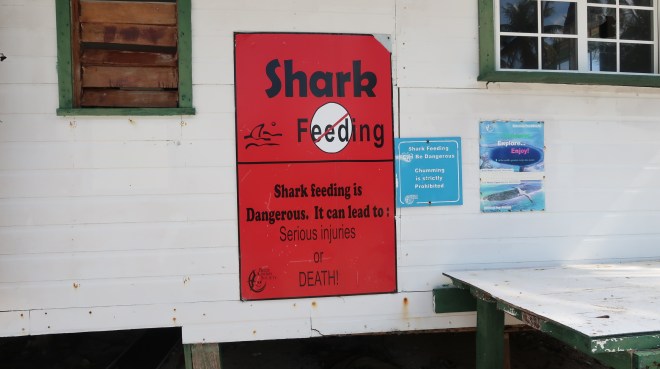
Sign on the wall at the visitors center.

Our group asked many question about the Hole, but is was Adriane who asked about the presence of sharks around the atoll. The ranger, a middle-aged fellow of Mayan decent, smiled and seemed too please to share what he knew.

“Oh yes we have lots of sharks, Grey and Black Reef sharks, Hammerheads, Bull and Nurse Sharks.” He paused for dramatic effect before adding. “But don’t worry, we haven’t have a shark attack in over two years.” Again he paused to gauge our group’s reaction. I believe it was Adriane who queried further about the attack. 

As recounted by the ranger, he said. There was a group of divers who had returned to the boat after a successful dive. To add some excitement to the experience, the tour group operator began chumming the water to attract sharks which quickly turned into a feeding frenzy. He said that a woman decided to jump back in to swim with the feeding sharks. Subsequently she was attacked and lost a leg.

I performed an internet search and found this. “A 15-year-old girl named Annabelle …. suffered a serious shark bite in Belize’s Blue Hole in August 2024. She lost her leg in the attack and had to be airlifted to a local hospital. The shark was reportedly a reef shark, about 6 feet long, and the attack occurred after she finished a scuba dive tour with her family. 

Doesn’t sound like the same event as the details are so different. But it is unlikely we are talking about two separate events and we will probably never know the truth. Either way, the story unsettled Adriane as the following day I was planning on taking her daughter deep into the same hole with the same sharks.
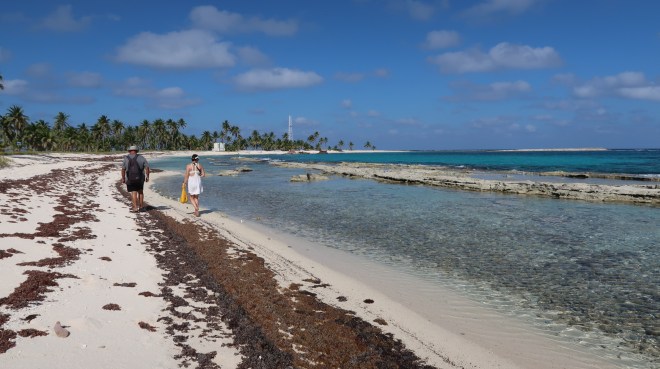
Andy and Stephanie walking the beach at Half Moon Cay

We spent the rest of the afternoon exploring the island’s pristine beaches and hiking trails meandering through the interior to visit the nesting colonies of Boobies and Frigate birds. We ended the day by taking a swim off the sandy beach at the west end. It was a beautiful spot and the heat had us all done in. It may have been the shark attach story that kept Adrian out of the water while the rest of us waded into the shallows. If anyone thought Adriane was just being a bit paranoid, well that thought would have quickly vanished as moments later, Stephanie called out as she stood in waist deep water. “A shark! A big one right in front of me!” I quickly headed over to where she was to see what type of shark it was, but I needn’t had bothered because after nearly colliding with Stephanie’s legs, the shark turned to bolt at high speed and directly at me. Standing fast, I watched as a frightened 5 foot nurse shark shot past.
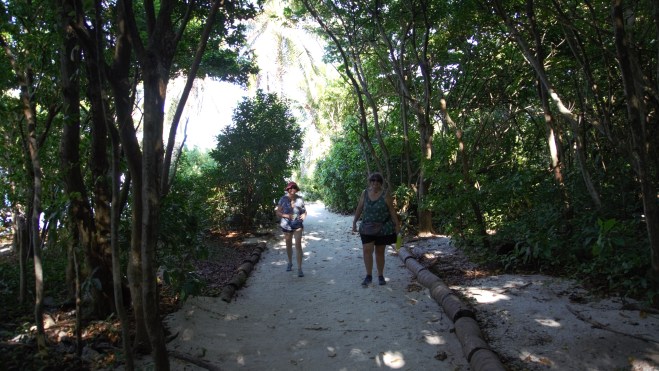
Island hiking trails
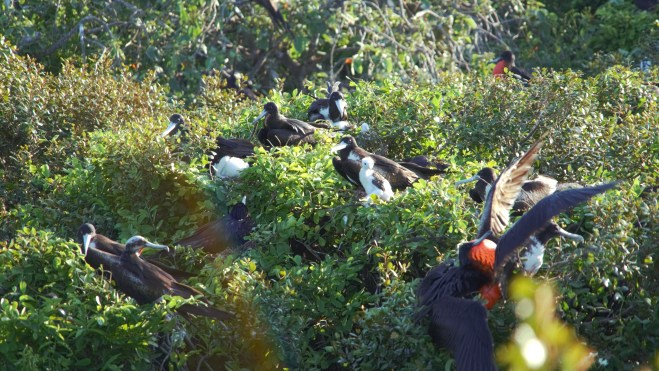
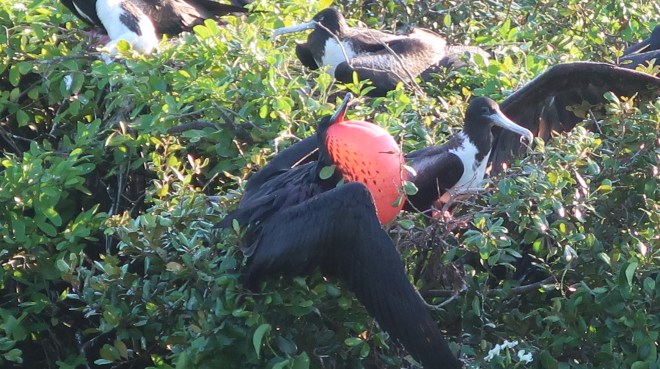
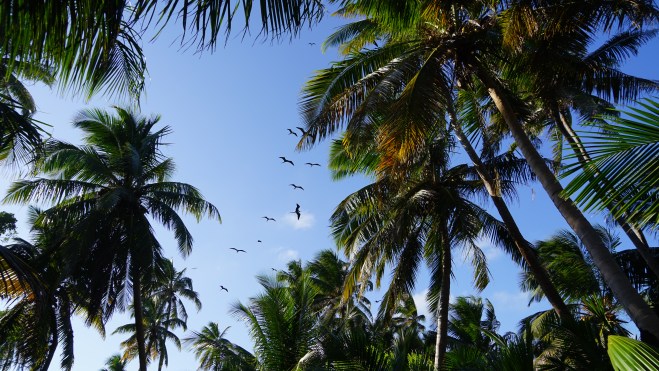
Frigates over head
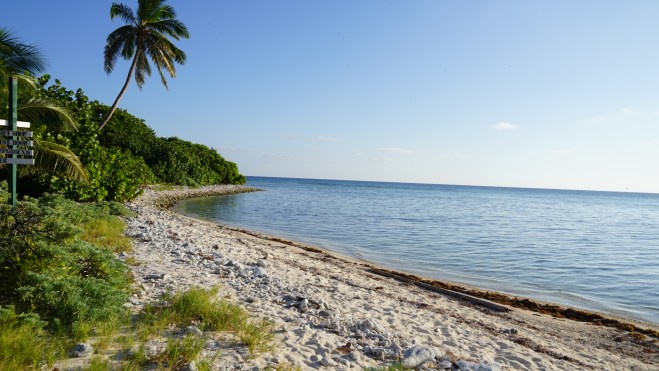
Swimming Beach at the west end of Half Moon Cay where Stephanie encountered the shark

Back aboard Maiatla that night we watched as a full moon rose from the east and over the following 8 hours, the moon vanished only to reappear as it went through a full lunar eclipse.
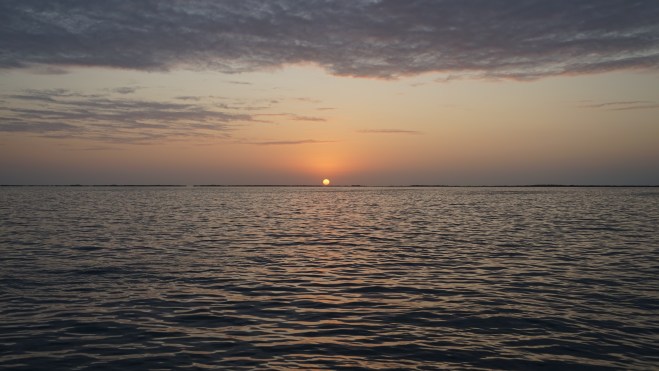
Sunset in the Lagoon.
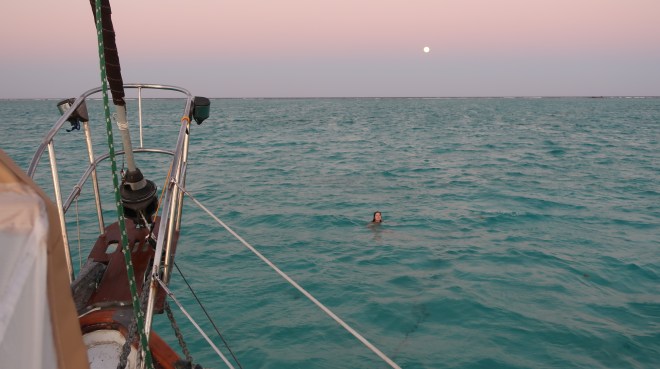
Sunset swim as the Moon began its full eclipse.


The following morning was beautiful, cloudless and azure. After breakfast we made preparations to get underway.  We were soon weaving our way through the reef and bommie-strewn atoll on our way to the Great Blue Hole. Our goal only lay approximately 7 miles to the north. This would be my third trip into the blue hole so I was fairly confident as to my route, but I still took extra persuasions by placing Stephanie up on the bow, armed with a radio to stand as a lookout. By 10am the sun was high and off to our starboard so we had a good view of what lay beneath the surface.
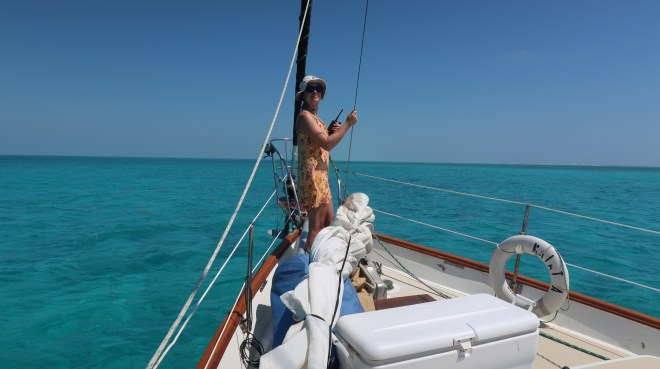
Stephanie with Radio on Bommie watch.

We navigated through the reefs reaching the Blue Hole without incident and easily took aboard the large mooring line that was set for the big dive boat, The Aggressor. Fortunately, it was the weekend and the Aggressor was not due back until Monday.
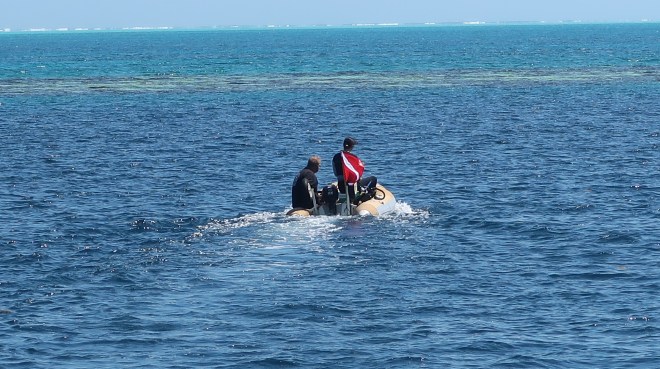
Off to dive the Great Blue Hole!

Stephanie and I wasted no time in suiting up and took the dinghy to the far side of the Blue Hole where there was a diving buoy to which we could moor. This would only be my third dive with my new partner and previous to this trip, it had some years since her last dive so I would have to pay close attention to her, in case she got into trouble. After completing our pre-dive checks, we rolled into the water.

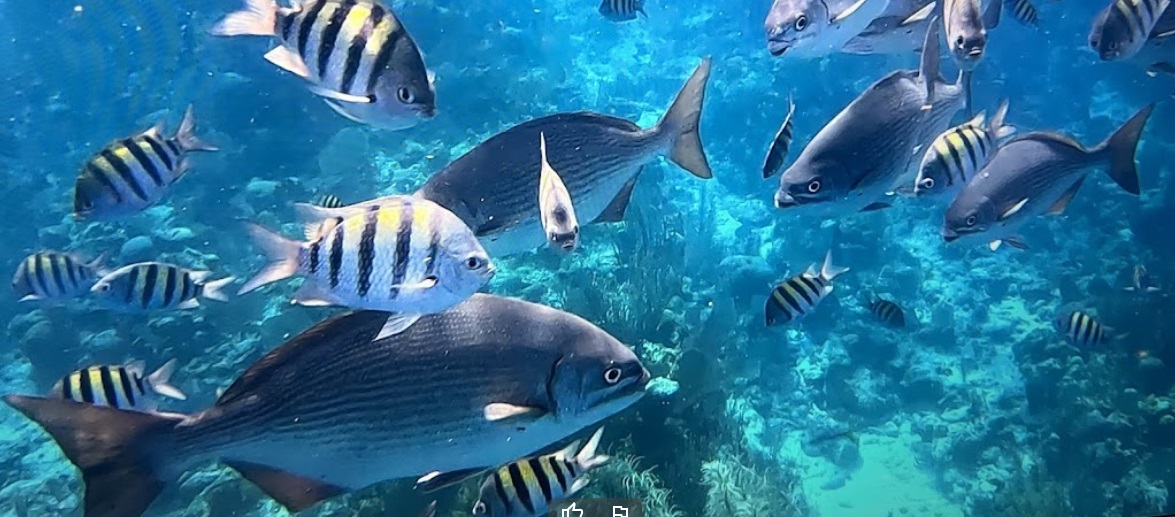
The anchor, which consisted of a bolt embedded into the coral lay 40 feet below, just a few feet from the edge of the deep drop off. The visibility was excellent giving us a view of the schools of fish milling about the coral perimeter. On the bottom we peered over the vertical edge giving us our first good look at the deep abyss. We could see down perhaps another 80 feet or so but then the waters turns black.  I gave Stephanie the all ok sign, without hesitation she smiled behind her mask and repeated my hand signal. With that, we launched ourselves headfirst over the rim. The wall was vertical, but rugged from having large chucks of limestone breaking away. As we descended, I noticed that there appeared to be a near constant avalanche of coarse coral sand cascading off the edges which was often caught by tiny ledges and shelves. This white sand helped to reflect the penetrating sunlight from above.
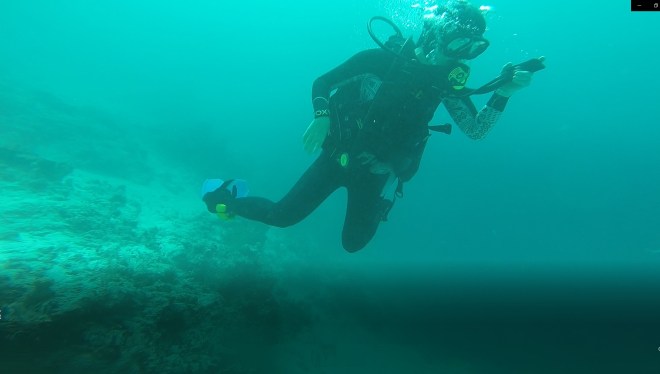
Stephanie checks her gauges as she hovers on the lip before we dropped into the great abyss.
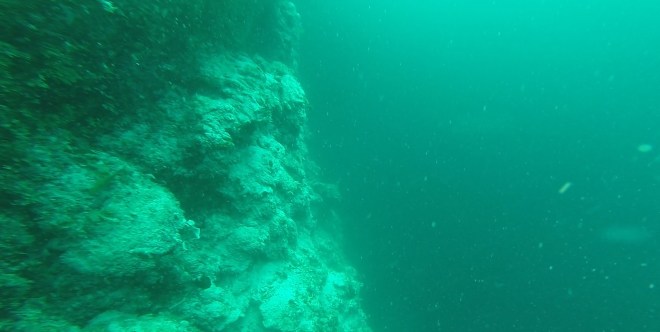
The rugged wall of the hole is covered in course coral sand which reflects the light.
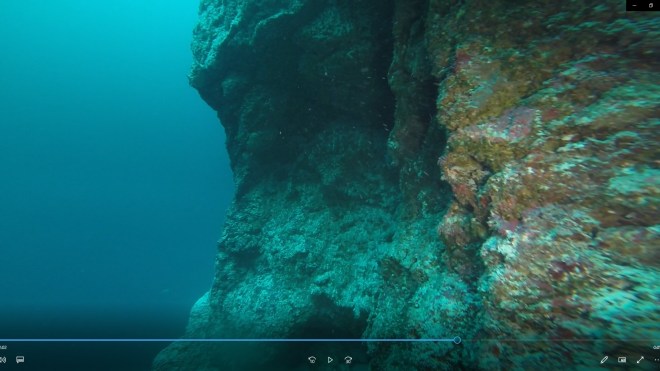
the wall at 90 feet with some colorful soft corals under a ledge which protects it from the cascading sand from above.

There was very little marine growth on the wall, which I presume was due to the scouring effect of the abrasive sand as it migrated towards the bottom.  From a depth of approximately 100 feet, the surface appeared as if it were a mirror or even a giant moon suspended above.  I stopped our decent a couple of times to have a face to face with Stephanie to make sure she was ok and to see if I could detect any signs of narcosis. Normal air, for all practical purposes is 21% oxygen and 80% nitrogen.  At depth, a diver can experience Nitrogen Narcosis a condition is caused by the large concentration of nitrogen which creates a drunken affect, instilling a sense of euphoria with the retardation of senses, mostly common sense. Onset can begin around 100 feet and start becoming acute around 130 feet.
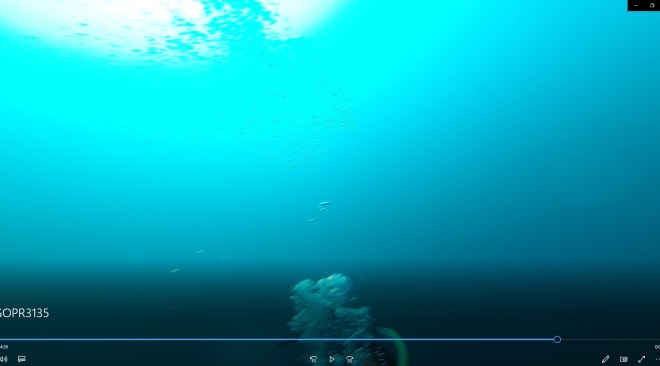
What appears to be the moon shines from above
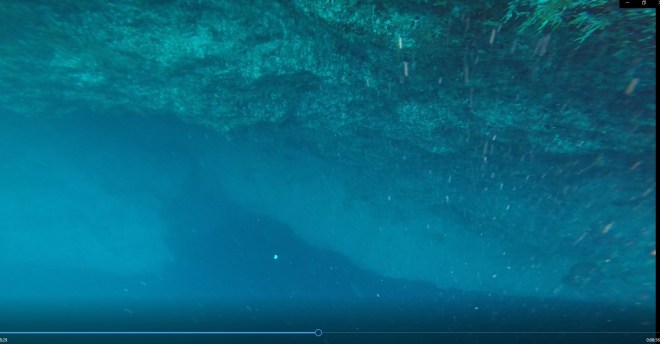
 

Our last stop, the ledge.
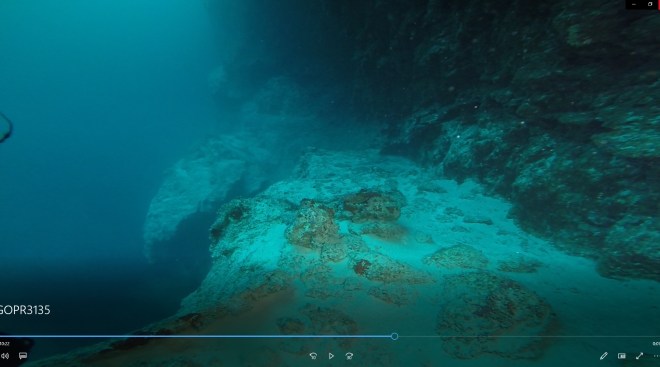
The ledge with a coating of coral sand.
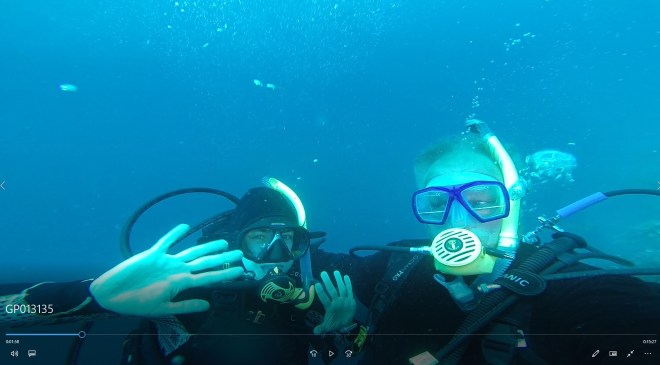
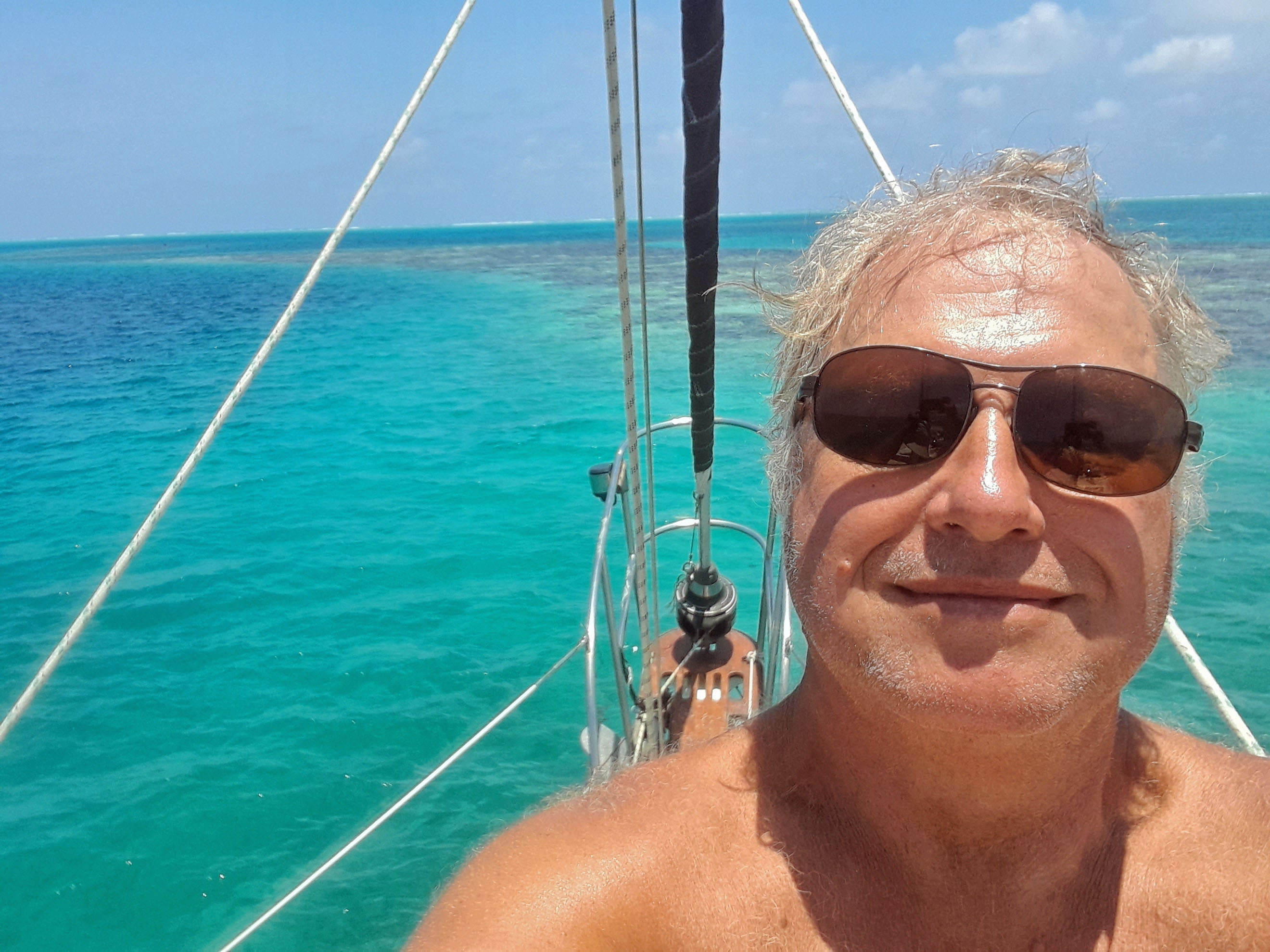
A celebratory selfie while sitting upon the ledge. Notice the clarity of the water.

Aside from her constant broad grin, she seemed fine. Keeping within arm’s reach, we descended further. Directly below me I spotted a large ledge, perhaps 3 feet wide and 20 feet long and what struck me was that at one end appeared to be a massive stalactite clinging to the cliff face. We disturbed the sand on the ledge as we landed, causing a mini avalanche to flow over the edged. On our knees, we glanced about. The tranquil scene was surreal. Shattered shards of light sliced down to us from above, piercing our escaping air bubbles as they shot back to now unseen surface.

Above and below was the silhouettes of a circling sharks. Apparently paying us no heed. The only sounds were our breathing and rush of fleeing bubbles. When I held my breath, I could hear my own heartbeat.  I had been constantly monitoring our depth and when I did a final check while on the ledge, my gauge read 150 feet.
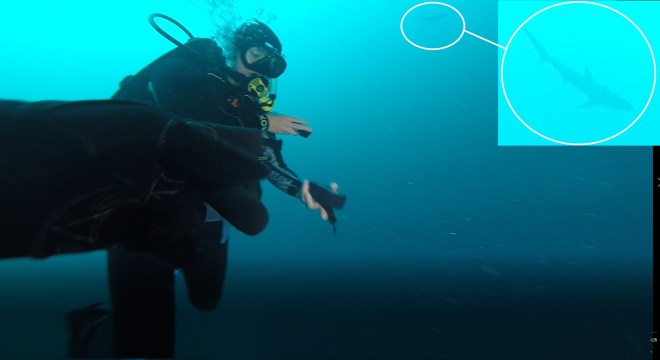
I point out to Stephanie a thrasher shark circles above
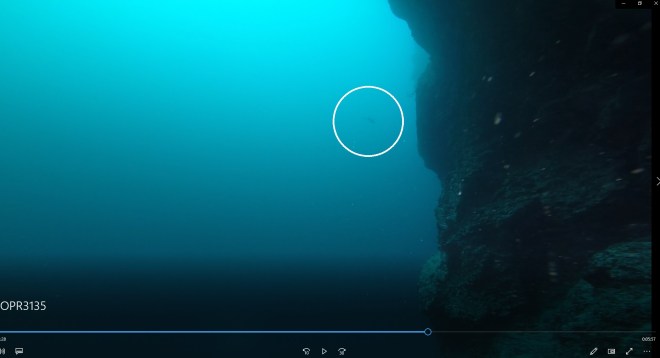
A total of 6 sharks were spotted during our dive, but all at a distance.

An ancient stalactite clinging to the wall.
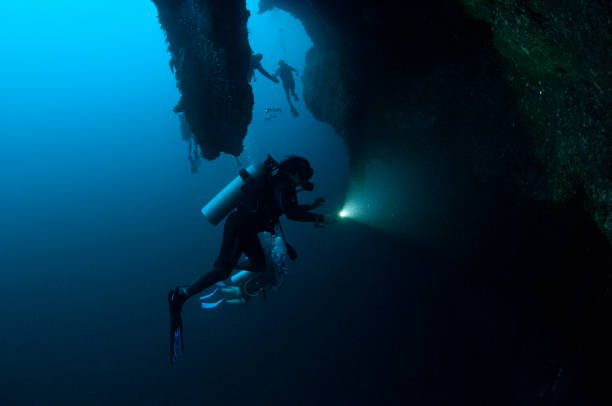
Not my photo but it gives a better perspective of the stalactites.

It was there on this ledge that it finally occurred to me why this dive had claimed so many lives. By all accounts it was an easy dive, too easy. Straight down while clinging to the safety of a wall, no discernible current, abundant lighting, great visibility and warm, soothing water.  The whole experience gives you the illusion that you could just carry on down to the unseen bottom. And when you inject the Nitrogen Narcosis factor, that illusion can easily turn deadly.  Other factors also can come into play in the form of inattentive dive masters or trying to watch too many divers’ with various diving skills. Old and improperly serviced rental dive gear has also been factors in some of the deaths here as my research showed.

As a former commercial diver on the Artic oil rigs, I was very familiar with my own limits concerning narcosis and comfortable working at depths up to 330 feet. So I was hyper-focused on my charge and dive buddy Stephanie, who by all accounts was doing fine as she took in the sights from our perch.

Five minutes was all we had at this depth. Stephanie was our official time keeper and when she tapped the face of her watch, it was time to start our slow assent.
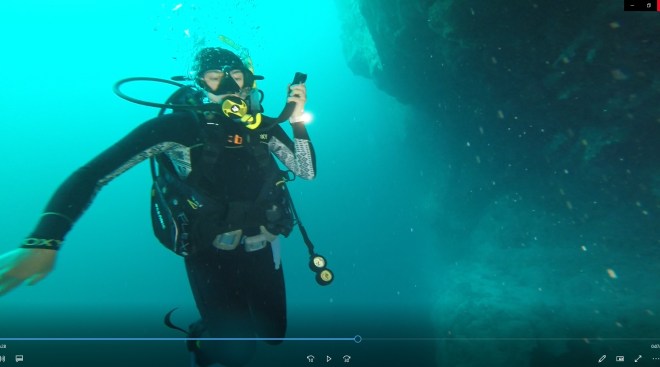
Stephanie begins her accent from the ledge.

After inflating my bouncy compensator with a little air to assist, we began to fin our way up on a diagonal line so we could explore more of the cliff on our way up. We performed several switchbacks so we would emerge from the hole approximately where we had entered. On our accent we again noted the lack of marine life below the rim. The only exceptions being a pair of spiny lobster sitting boldly upon a tiny ledge. My first though was to rescue these poor creatures before they fell into oblivion, but when I approached they declined my help so I let reluctantly let them be.
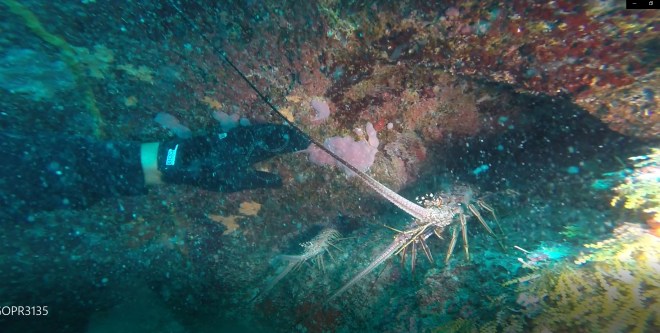
A pair of friendly lobsters.

After topping the rim with still forty feet of water above. I moved us up to our first decompression stop. Checking Stephanie’s and my remaining air supply, I was pleased to see that we both had ample air so we spent the next 17 minutes decompressing and exploring the upper edges of the reef. 
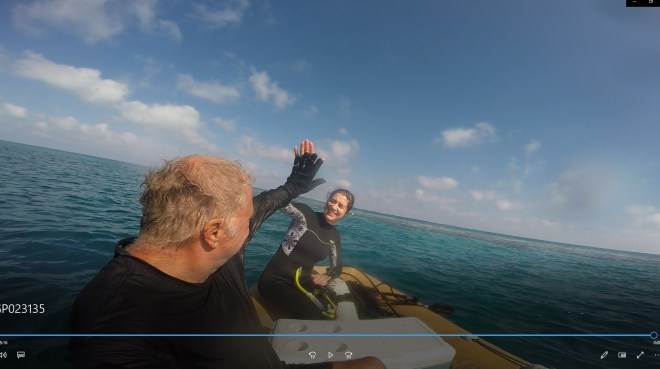
After dive Hi five.
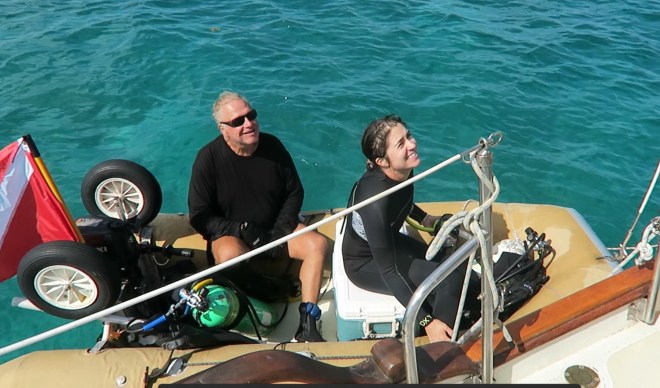
The newly anointed Blue Holers return.

Another tick on the bucket list. I will dive the “Hole” again, but that will have to wait till next season as Hurricane season was fast approaching and it was time to start thinking about heading back to the Rio Dulce in Guatemala.
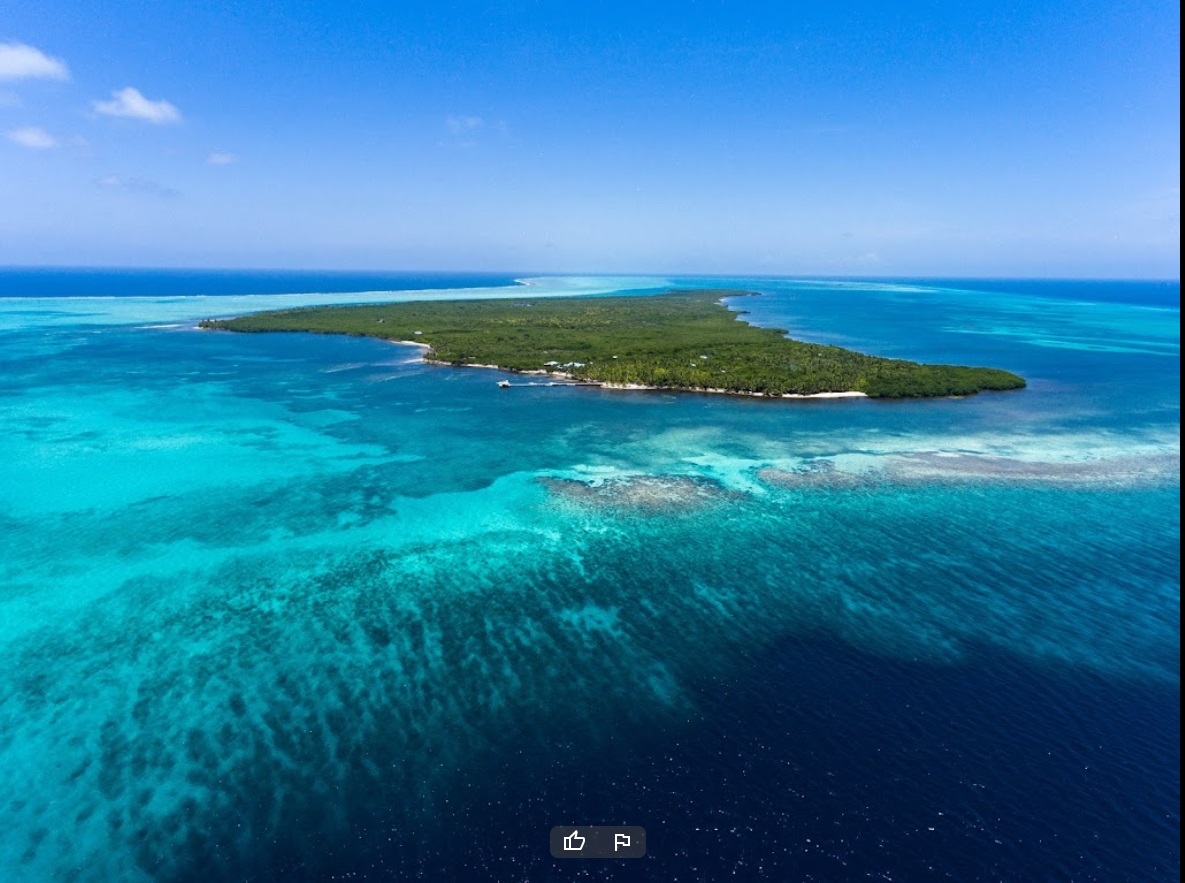
Half-moon Caye and the Blue Hole.

Easton and I were still sitting at the bar having beers when one of the dive boats arrived to disgorge a dozen or so exhausted looking divers. Amongst them was a tall black man that the cook identified as the manager and head dive master. With a female companion, he found a table near the bar.  I marched over to introduce myself then explained what we were doing there while expressing my appreciation for the help his staff had provided while making my pump repairs.

Long Caye

 He seemed pleasant enough but was more focused on the young lady in his company than what I had to say.  In a few days’ time, I would learn that her name was Susan and was a diver from Montreal and here for a week. I tried to pick the managers brains about some of the better dive spots on the atoll, but he was not too talkative, to me anyways. Shaking his hand I then returned to my own table.

Earlier Easton had expressed an interest in learning how to scuba dive so he could dive with me when we reached the blue hole. I had heard the resort offered an intense, 4 day certification program which would work for Easton. I suggested that he talk with the manager about taking a dive course, which he did.

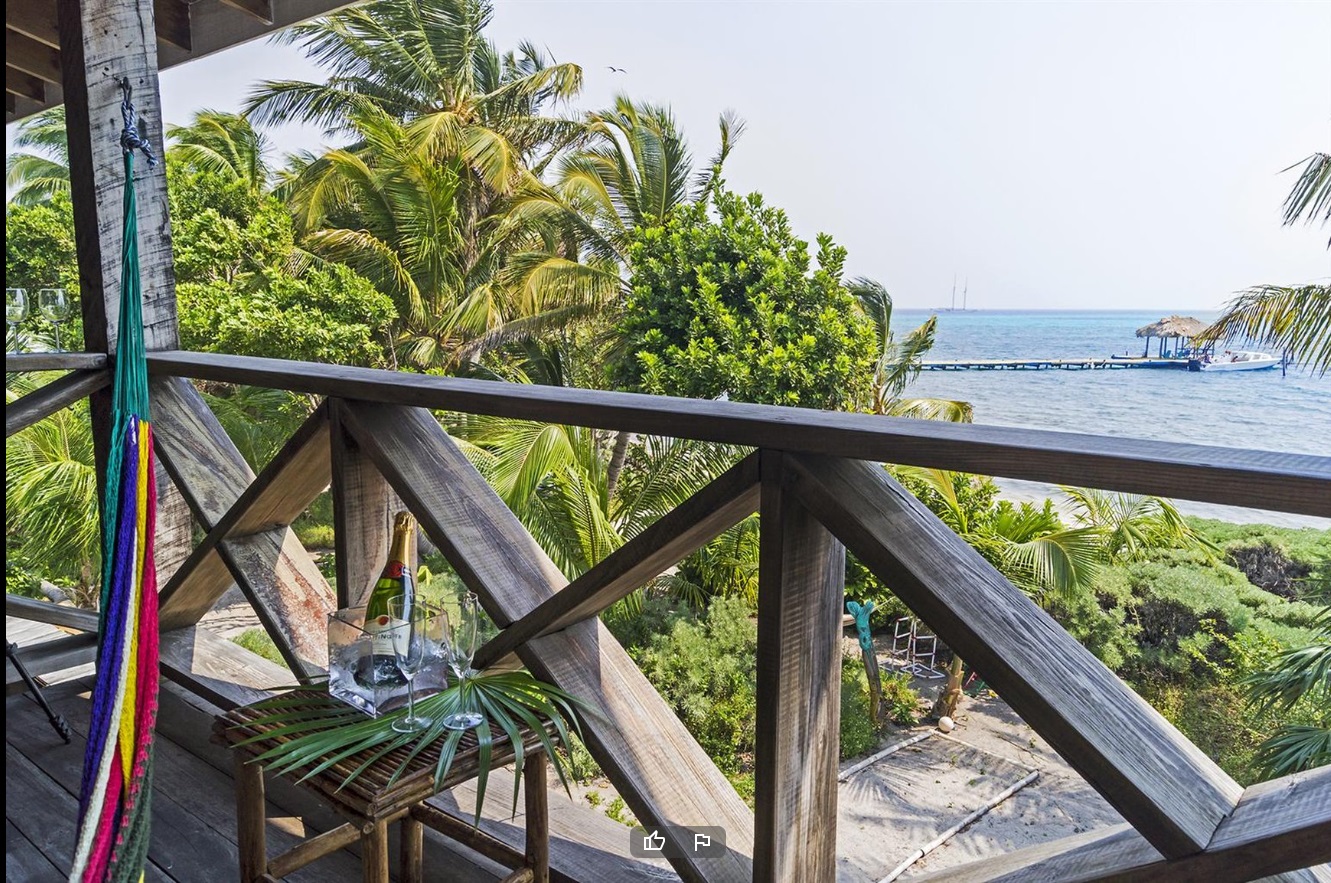
While Easton talked to the manager, I took my beer for a walk down the beach and the resort’s remarkable waterfront. As I passed a series of two story cabins or bunkhouses, I noticed that the upper stories all sported an outside deck with empty mesh hammocks swinging in the breeze. No one seemed to be around so I took the stairs of one of the cabanas with the intent of taking some photos of the lagoon and Maiatla beyond. As I took pictures, I heard someone emerge from the door behind me. Thinking I was about to be admonished for trespassing, I prepared to plead my case as a lost and ignorant tourist.

The bar at the resort

His name was Roberto, a native Belizean who turned out to not only be a pleasant fellow, but a wealth of information on diving the Blue Hole, and did not hesitate to share his knowledge.   He asked me about how I knew of the Blue Hole as I was from Canada. I told him that as a kid, I saw the TV documentary of Jacque Cousteau taking his exploration ship, the Calypso into the hole and dive it with his mini sub. Roberto’s face lit up. He went on to tell me that he was there! At first, I thought it was just a boastful claim, but he went on to explain that his father guided Cousteau’s ship through the labyrinth of coral into the hole where the ship moored for a few days.

“I was only 8 years old but my father took me along!” Roberto proudly declared. We talked of his experience and by the time he finished his story, I could not doubt his sincerity. I pointed out to Maiatla swinging peacefully at anchor off in the lagoon.

The deck where I met Roberto, Child guide for Cousteau

“Do you think I can get my boat through the reefs and into the hole?”  Roberto did not hesitate. “Yes sure, no problem just do it when the sun is high and behind you”.

We talked a few minutes more about the way in, then I departed. I regret that I did not have the forethought to take the man’s picture. I found Easton, sitting in an Adirondack style chair, looking a bit downcast as he stared out to sea.

“So kid what did the dive master have to say? Is there a course you can take?”

Without much enthusiasm he answered. “Yes, a four day course but I wouldn’t take a course from that asshole!” I was surprised by my Nephew’s response. I probed him for an explanation.

 “Well first off, he seemed upset that I was trying to talk to him when he was with that girl, and he was talking big, bragging about all the diving that he’s done, think he’s trying to get laid!” Easton added. ”

I had to chuckle to myself because I had the same thought when I was talking to the pair.

 “I told him I would want a course right away as my uncle and I were taking your boat out to the Blue Hole to dive.” When he heard that he laughed and said that you were crazy if you thought you could get the boat into the hole! He then said “I have made a lot of money off of people like your uncle who crash on the reefs and need saving!”

Anchored well offshore of Halfmoon Caye. bare 2 meters of water. Inches under the keel.

After hearing all this, Easton’s use of “asshole” seemed to appropriate.

“Well I guess he just lost a paying customer, screw him, let’s go back to the boat kid.”

 As we marched down the dock, Easton hesitantly asked,

“Can you really get the boat into the Blue Hole Uncle Andy?” Yes sure kid no problem.” I said confidently. “When we come back in a few days we will stop here for a beer and to tell that dick how much we enjoyed diving the hole.”

Funny thing was that if Easton had asked this question the day before, my answer would have contained words like “maybe and try” but after talking to Roberto up on the deck, I was filled with optimism and I was excited about the prospects of the following days. 

In the morning, we sailed across the lagoon to Half-Moon Caye where there was a range’s station, it was there we would have to buy a park permit before heading out to the hole. Half Moon Caye is located at the southeast corner of Lighthouse  Atoll and was the first nature reserve to have been established in Belize under the National Park Systems Act in 1981 and first Marine protected area in Central America. This is also Belize’s oldest site of wildlife protection since it was first designated as a bird sanctuary in 1924 to protect the habitat of the Red Footed Booby birds. The island has an expansive sand beach and dense mangroves crisscrossed with trails taking you deep into Bobby nesting country.  

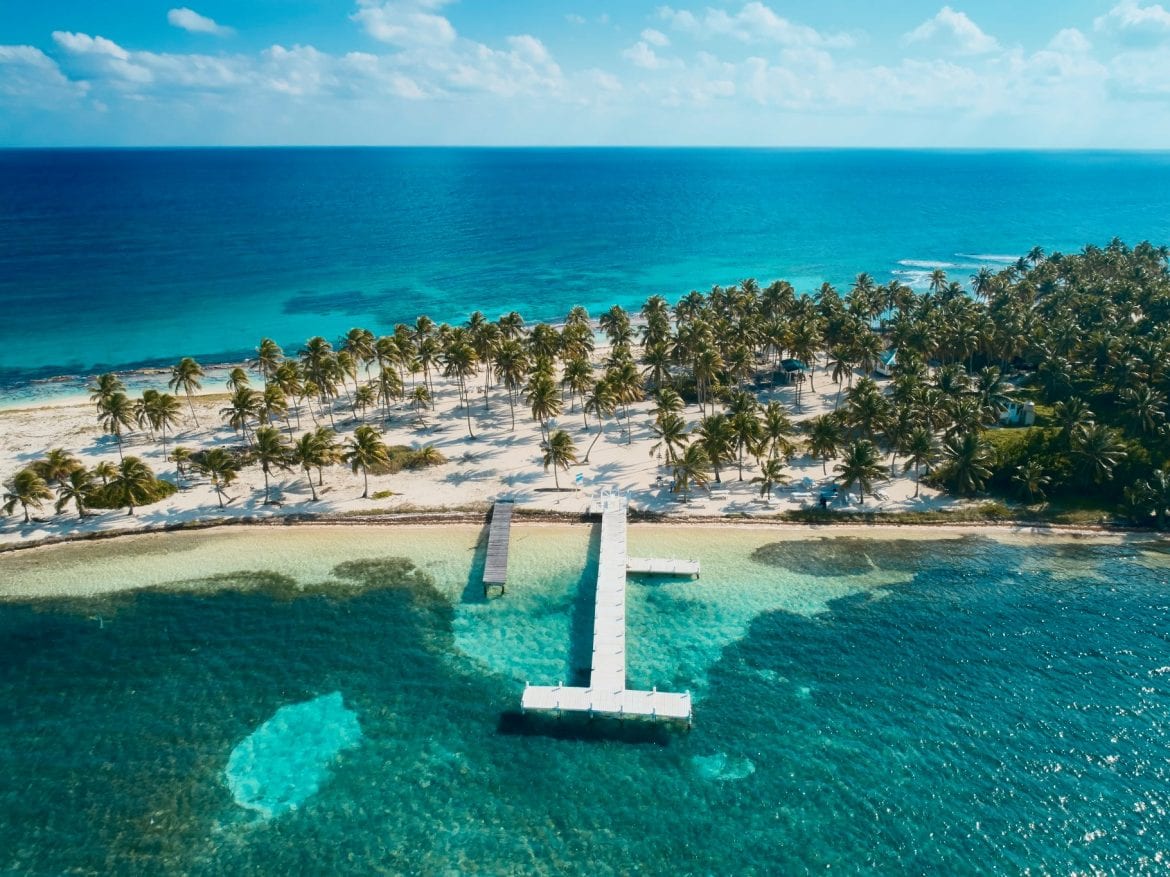
The Dock at Halfmoon Caye

The approach to the Caye is very shallow, forcing us to anchor over half a mile from shore with only inches under the keel. The island itself is spectacular, enticing you to stay for a few days to explore, but that was not our intent, not this time anyway. We would only spend a few hours ashore, wandering, but only after we purchased a two day permit to anchor out at the Blue Hole for $60 Belize dollars per day. ($30 USD).

There were only a hand full of other tourist on the island so we pretty much had the place to ourselves as we hiked to the far western most point for a swim.

Beach at Halfmoon Caye with our dink on the beach.

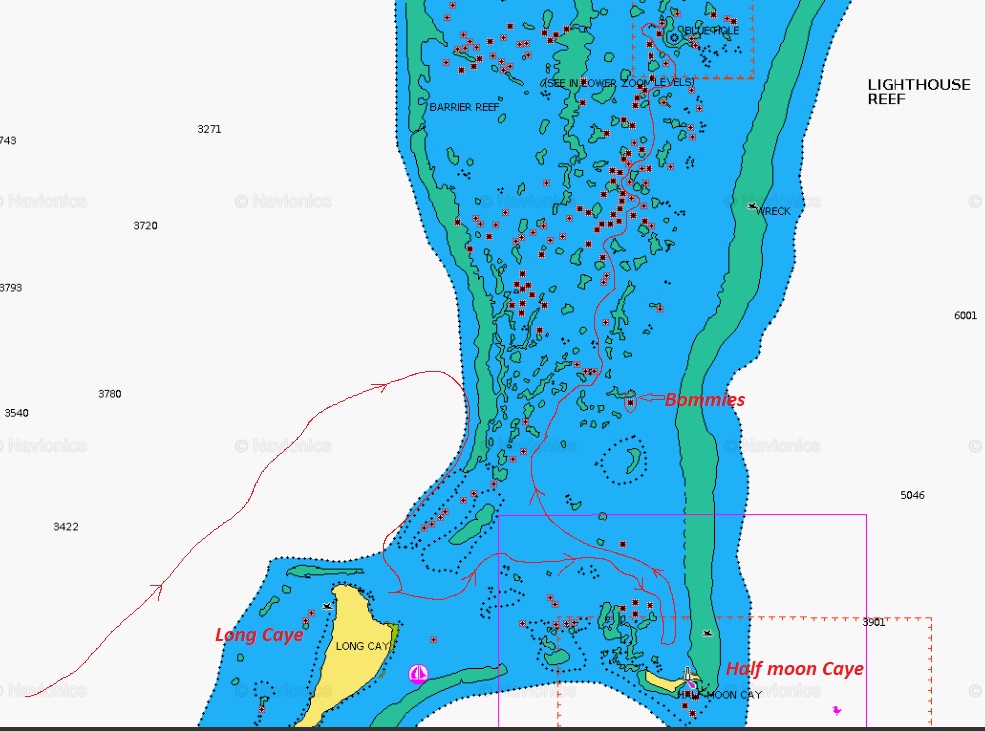
I planned a snaking route through the coral using Navionics. Water depths varied from 2 to 5 meters with countless bommies lurking just below the surface. Striking the reef would be disastrous, as fines for doing so are horrendous. I met a cruiser at Nana Juana marina last year who ran aground and had to be pulled off by the Belizean Coastguard. His boat was impounded and he was forbidden to leave the country until he paid$50,000 USD fine. After months of negotiations he finally agreed to pay $19,000 USD. Despite being in the custody of the Coastguard at their privet docks, most things of value had been stripped from the boat. The cruiser vowed to never go to Belize again.

The general consensus of most cruisers is that if you run aground, never call for help, get yourself off and if your boat is going to be a total loss, grab what you can and fly out of the country as fast as you can. This was also my plan.

Maiatla’ s route through the Bommie mine field to the Blue Hole.
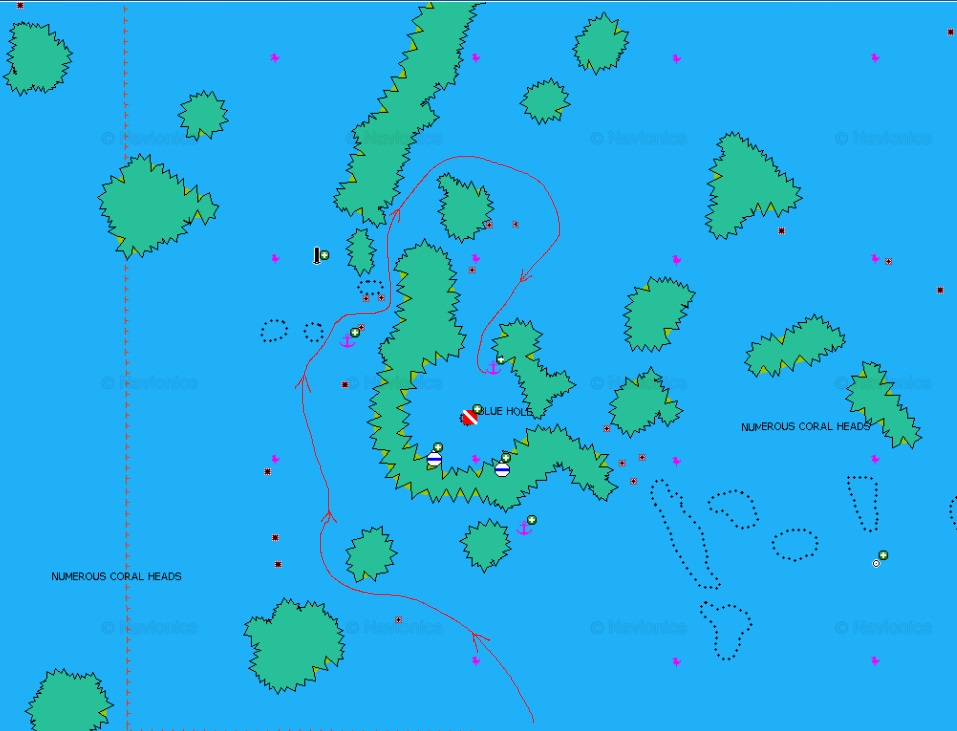
Final approach into the Blue Hole.

By 10am the following day we haul anchor and entered the expansive reef system. The sun was to my right and over my shoulder, the intense sun caused the sand patches to glow in stark contrast to the browns and greens of the coral heads.  I was nervous but by all accounts it went well and by noon we had found our way into the Great Blue Hole, securing to one of two mooring balls located within the hole. The park ranger told me about the balls which he recommended we tie. The moorings belonged to a liveaboard dive boat, the Aggressor which visits the hole something like twice a week. It was a great mooring with a line as thick as my right arm. Once secured, I was confident that we were not going anywhere.

At the Mooring inside the blue Hole- tick one off the bucket List.

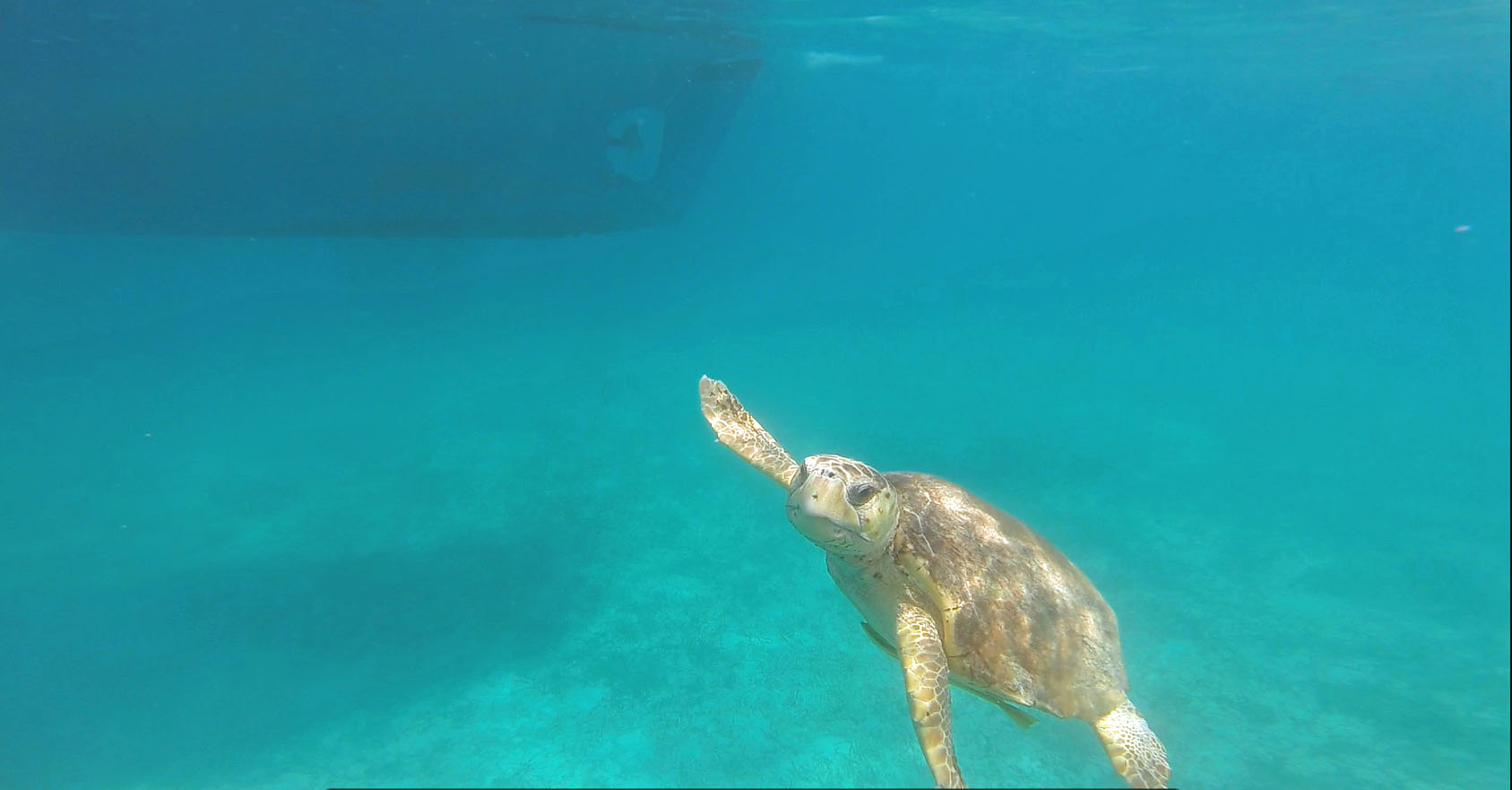
Our bow hovered 3 meters above a beautiful sand bottom with our stern peaking over the brim of the hole with the bottom some 150 meters below. We had hardly settled in when a sea turtle came for a visit, Easton and I quickly donned our snorkeling gear and jumped in to greet the friendly beast.

Location of our mooring ball.

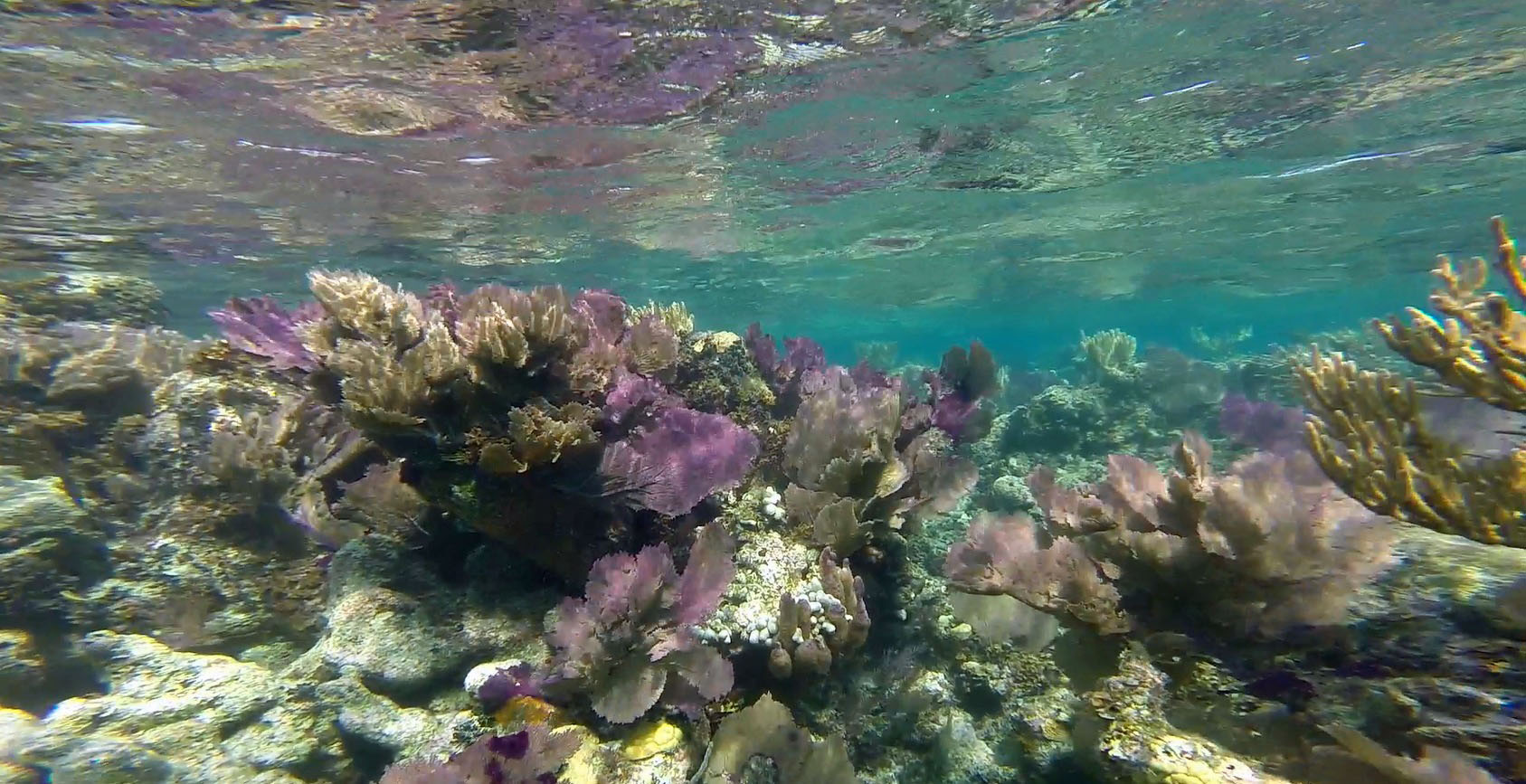
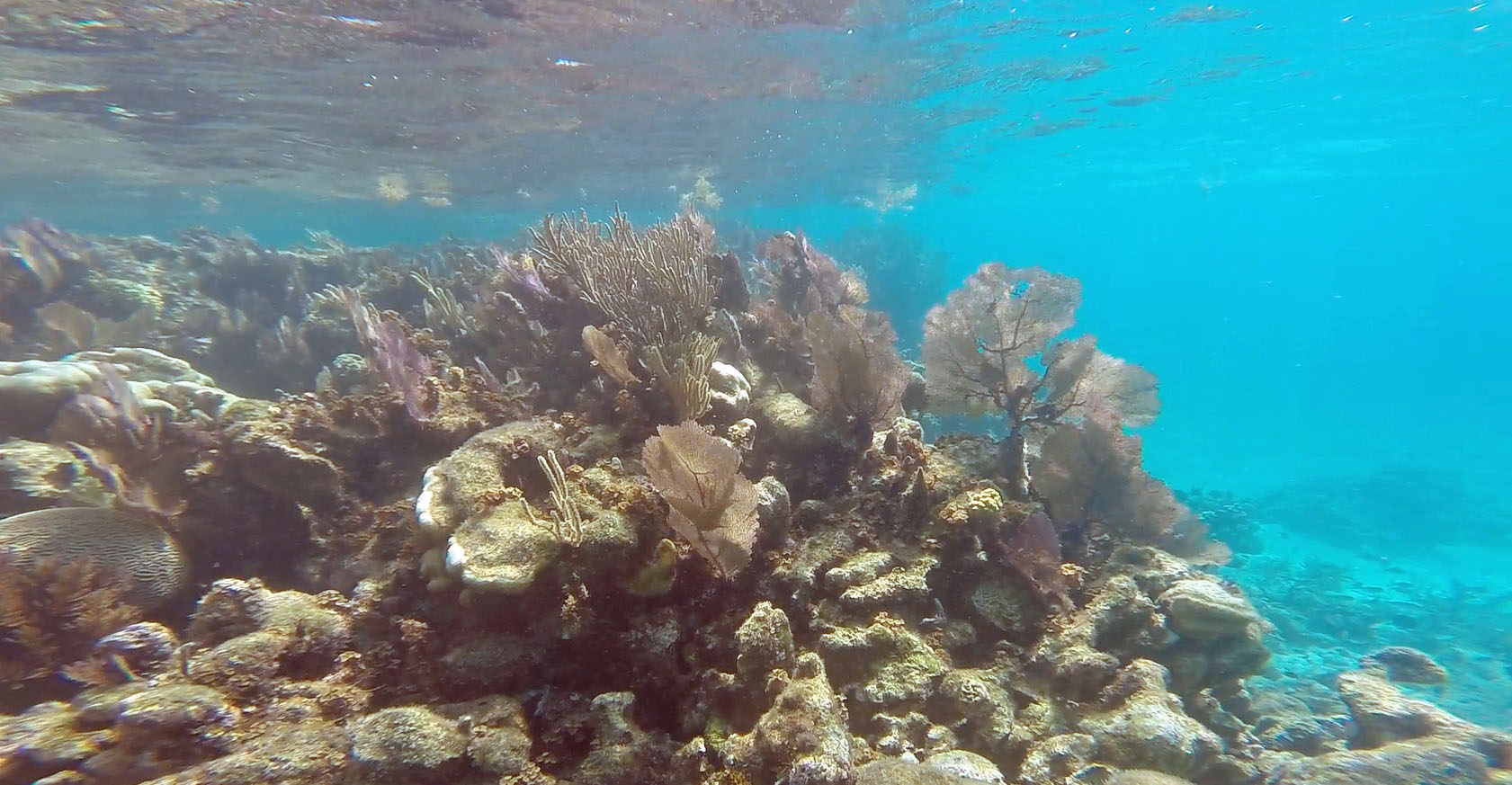
We spent the following 2 days with the place all to ourselves, snorkeling around the perimeter of the Blue Hole. The marine life and coral was magnificent and I was surprise to see much of the coral brim came within inches from breaching the surface, a condition preventing us from swimming overtop of large sections of the reef.  I never did break out the scuba tanks as I was content on free diving. Besides, deep diving into the hole solo would have been a bit fool hardy. We could see several sharks cruising the depth but they never did come too close.

A friendly turtle came to visit.

We had a grand time and could have stayed longer but on the morning of our 3rd day, I spotted a large vessel heading our way. It was the Aggressor what meant we had to move. We quickly dropped the mooring lines and exited the hole to attempt to anchor outside the rim in 5 meters of water. The wind had been building all morning creating whitecaps across the lagoon. I attempted to anchor but without luck. The bottom consisted of a thin layer of sand overtop a dead coral base. Poor holding and after three attempts, I decided not to risk dragging anchor and finishing up on the reef that lay a few hundred meters behind us. It was time to go.

Corals of the rim of the blue hole

I followed my old GPS course coming in. Now feeling confident in my course, I had Easton unfurl the headsail and sheet it in putting us on a fast broad reach. It was a spectacular way to depart the Great Blue Hole. I vowed to return next year and use the scuba gear to probe the depths.

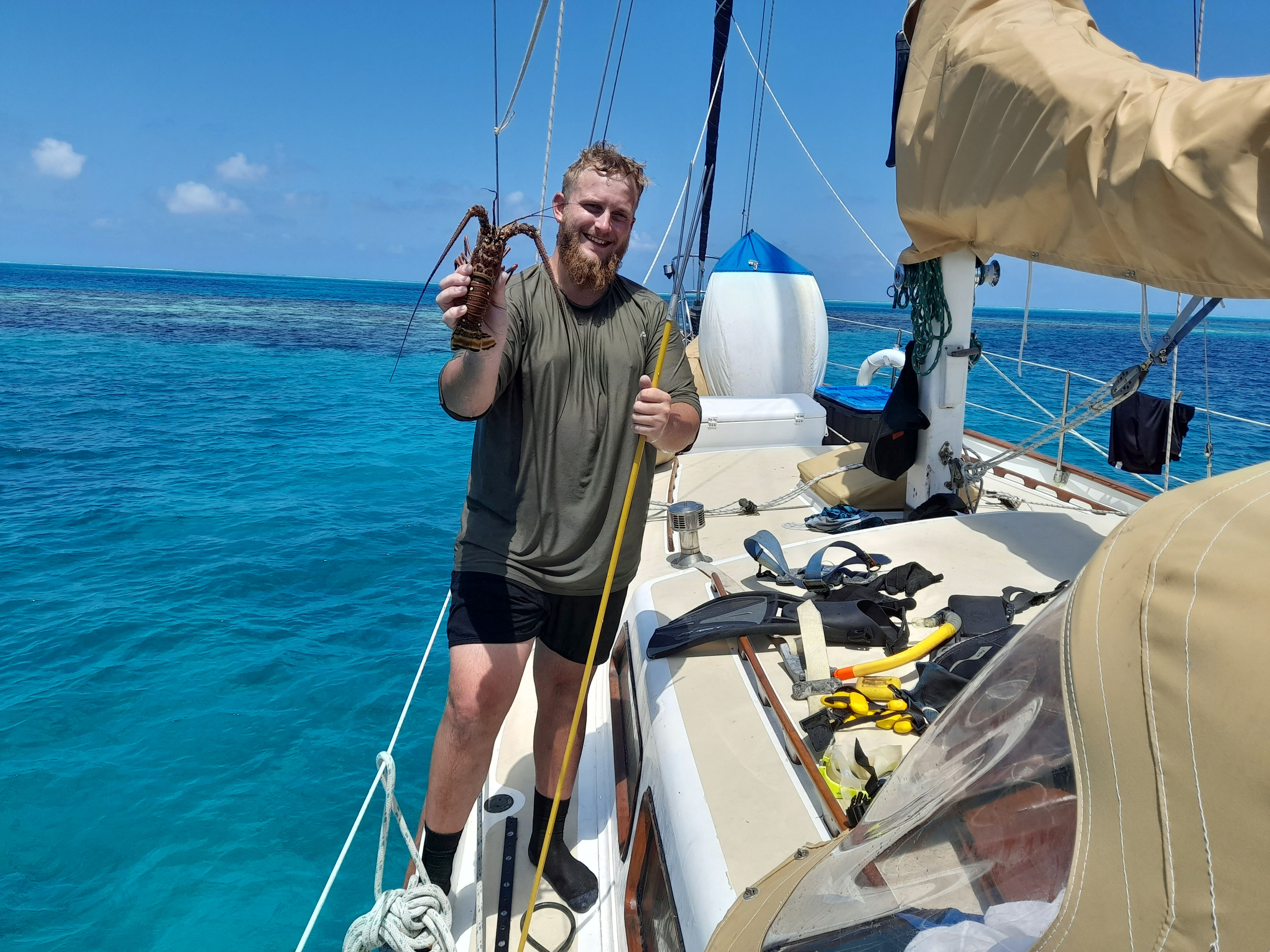
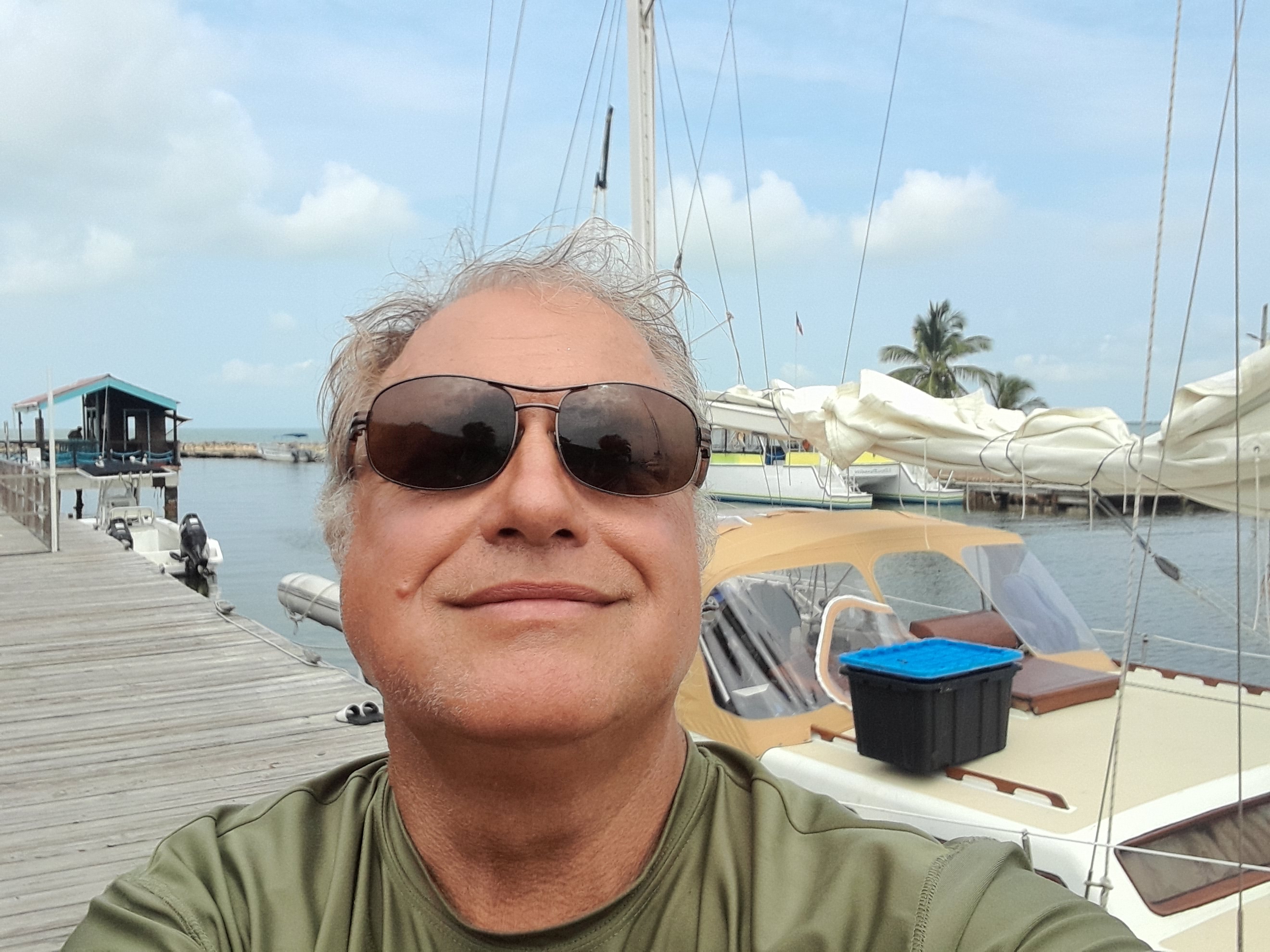
We anchored back of the Dive resort for beers and to use the internet to tell our families of our triumphant return to civilization. Easton received some measure of satisfaction telling the dive master of his snorkeling adventures in the Blue Hole. While Easton went for more beers, I noticed Susan, the lady from Montreal sitting alone at a nearby table. I went over to say hello. I guessed that she was in her late 30s and I was surprised to hear that she was traveling alone. She had been diving daily out of the resort but she had not done the Blue hole. A shame considering that she was so close. Like us, she would be leaving the Atoll in the morning. We moved Maiatla out of the lagoon to find a quiet anchorage on the west side of long Caye where we found several lobsters that accepted Easton’s invite for diner.

Diner time!

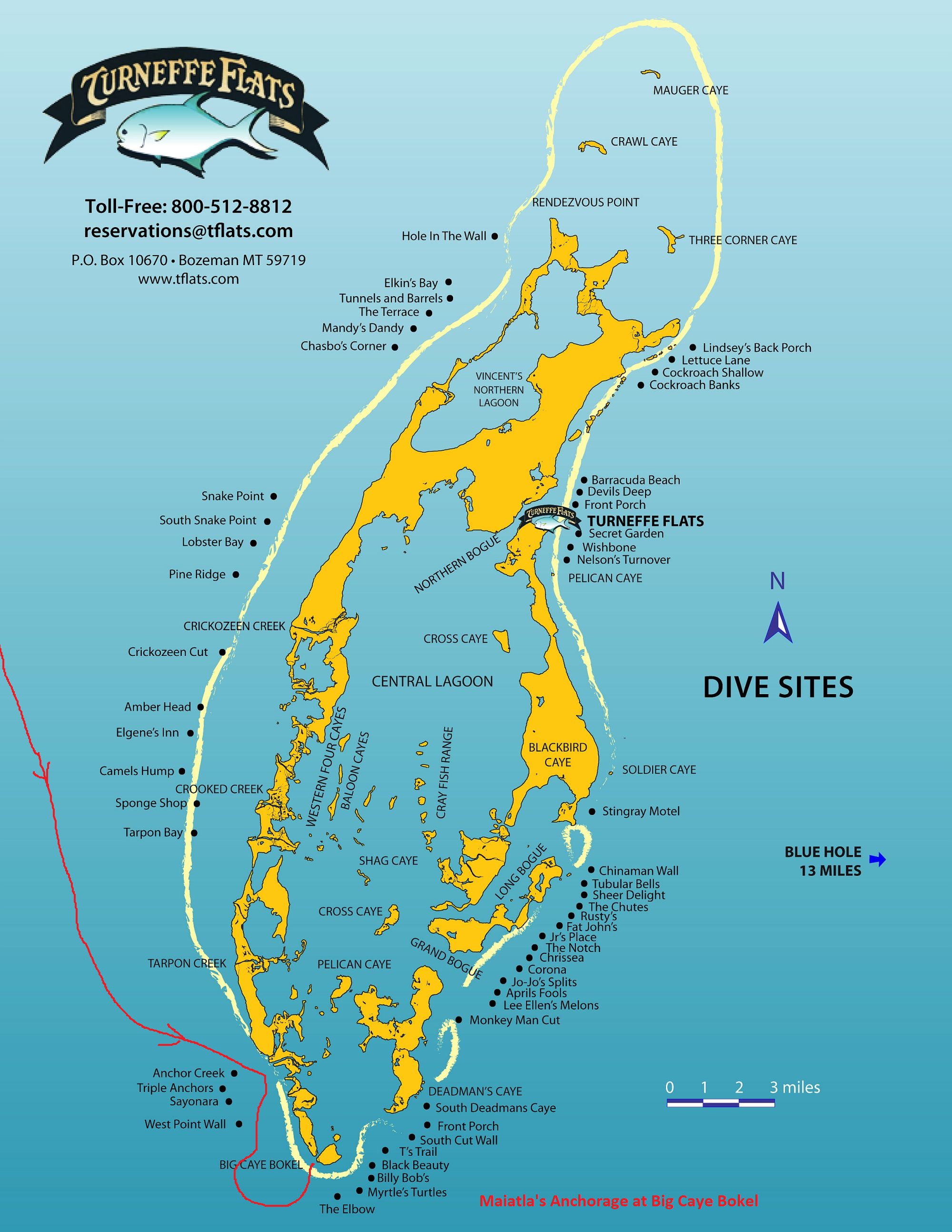
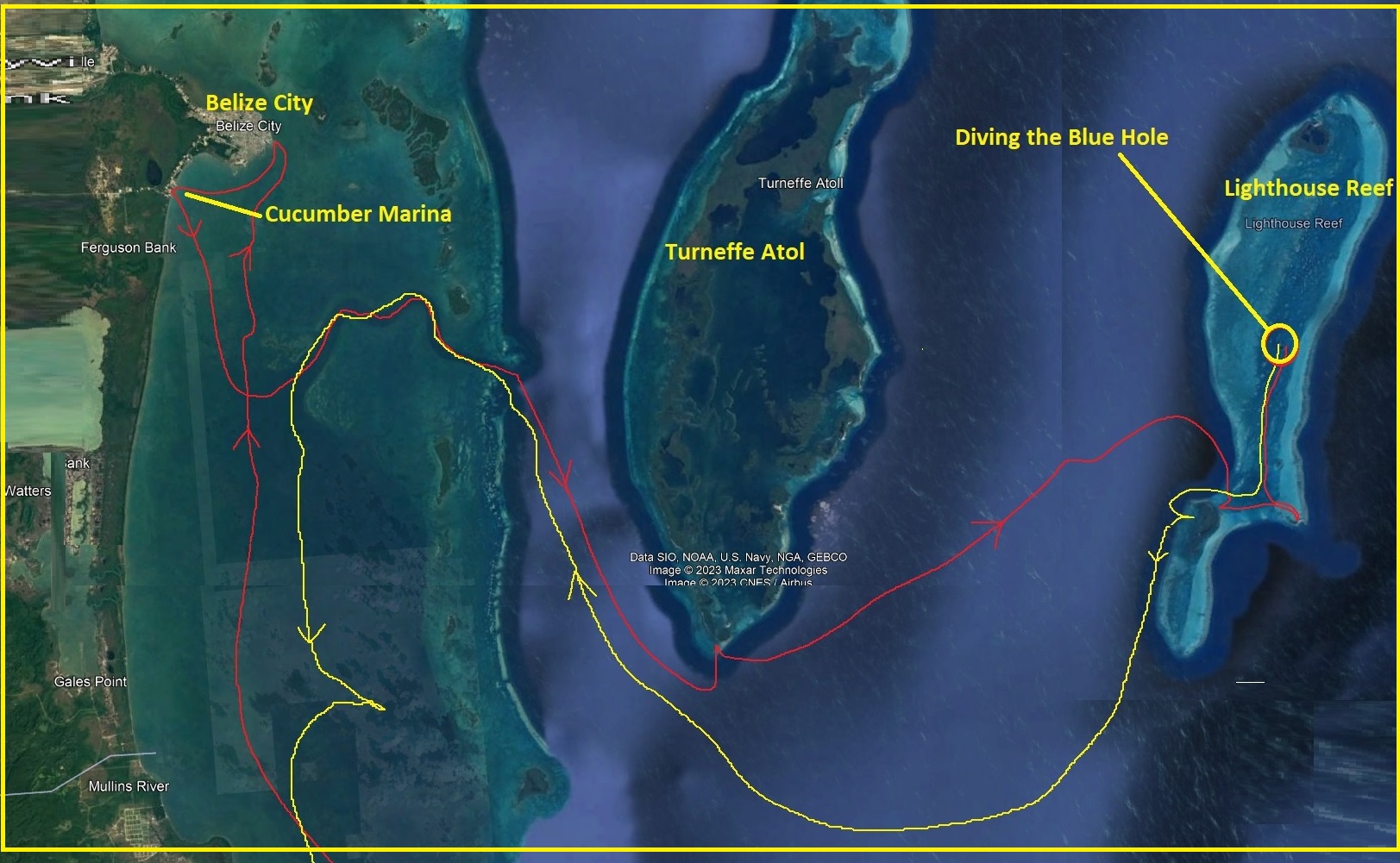
Cucumber Marina and through the Great Barrier Reef.

June 1st.2023

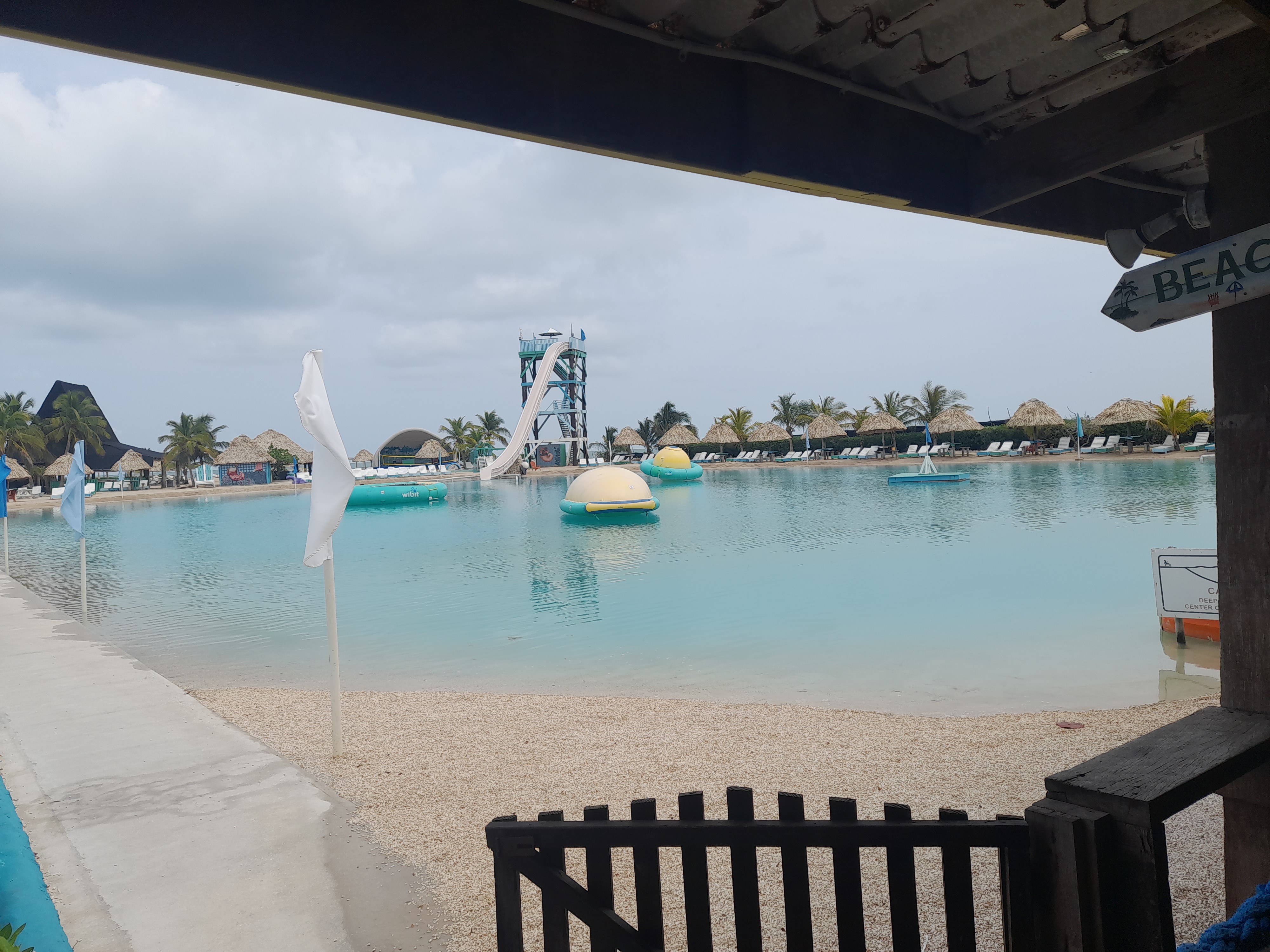
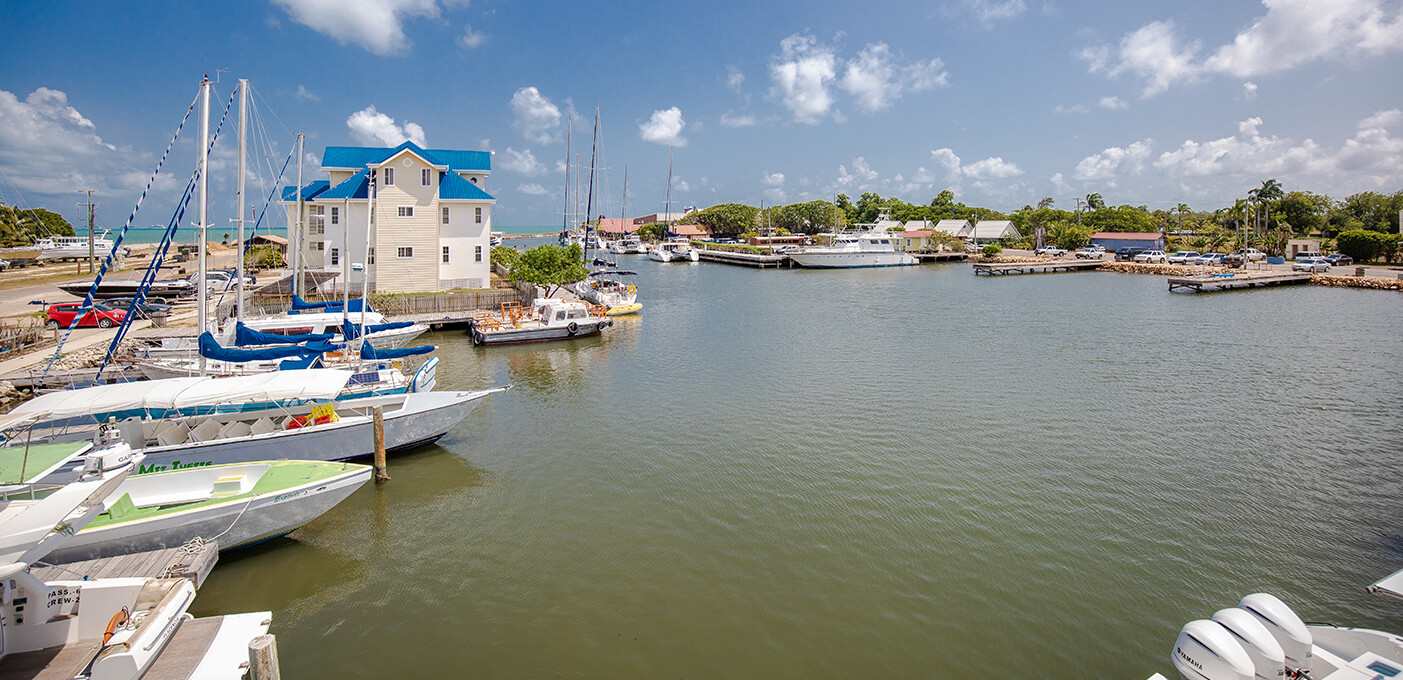
Cucumber Marina was a surprise as it was a well-kept marina with full facilities including haul out and it was a short cab ride to Old Belize with good shopping. The added bonus was the destination theme park on site. Right next to Maiatla was a intentionally rustic looking building housing a gift shop as well as a miniature train that could take you on a historic ride through displays depicting the history of Belize. Beyond the well-stocked gift shop, covered by a barn-style roof was an open air food court and bar with tables that could accommodate a couple of hundred People.

 From anywhere within the court you had a grand view of a man-made tropical lagoon complete with a with sand beach, real palm trees, giant floaty toys and a massive waterslide. All managed by what we would come to learn was a friendly staff and the best part was that the theme park admission was included in our docking fee of $1 USD per foot per night.

A Great deal and one Easton and I took full advantage. When we first arrived there were perhaps a dozen or so families, not a massive crowd by any stretch of the imagination and I wondered how they could survive with so few patrons, but I learned the answer early on the second day when three busses full of school children arrived to take in the park, then in the afternoon a second wave of revelers arrived which apparently came from one of the three cruise ships that arrived this day.

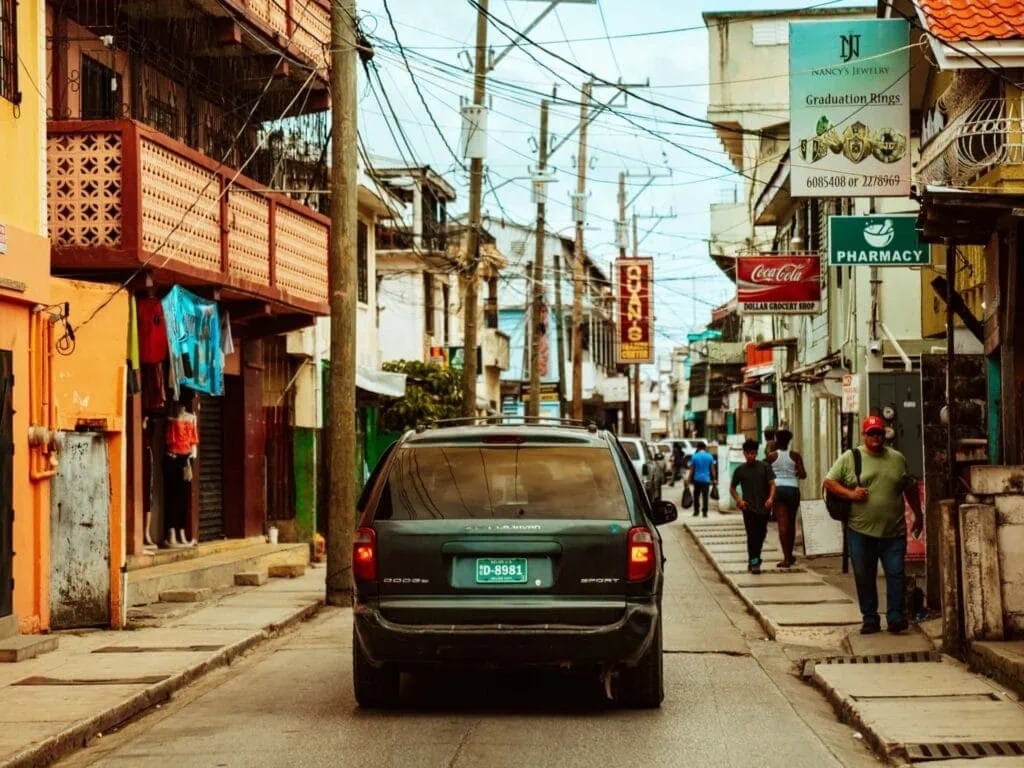
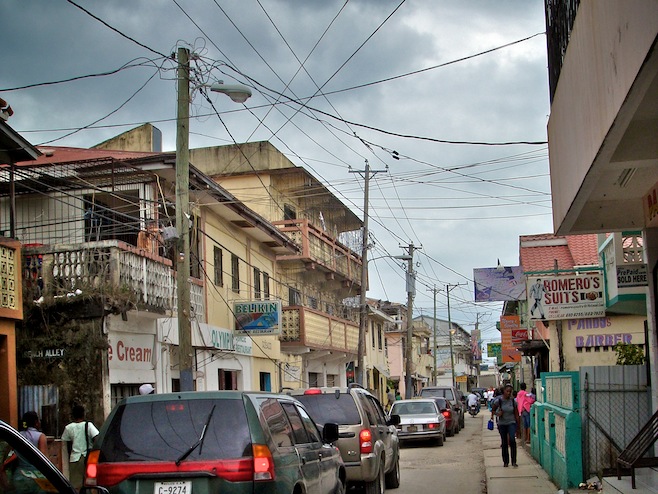
By 5 pm the crowds dispersed so Easton and I once again claimed the whole place as our own, we bathed in the solitude, with the only other guests being the scores of iguanas patrolling the docks. We made a trip into town to purchase a new alternator for Maiatla as the old one was acting up. Our cabbie took us on a little tour of Old Belize city in an effort to locate an ATM. The buildings were obviously of the British colonially era all in various states of disrepair. I was surprised to see many of what the cabbie told me were homeless people, a condition brought on by a rampant drug problems. As we drove along he pointed to an emaciated old man leaning against a lamp post. “That fellow there”, our cabbie stated, he was my high school principal but he got into crack- cocaine. To look at him it was hard to imagine that the dirty withered up old man was once a respected professional within the community.

The cabbie needlessly went on to say that we didn’t want to be in this part of town at night.

I saw a travel warning which read: Violent crime is also a major concern elsewhere in the country, including in Belmopan. Belize has one of the highest per capita murder rates in the world.

Drug and human trafficking, organized crime and street gang activity is prevalent. Violent incidents are frequent, including: murders, armed robberies home invasions, muggings sexual assaults.

This notice applies to many of the Central American counties and after being chased by Pirates off the coast of Honduras, I am very well aware of these facts. For those who missed the Pirate post, see December 2019. Being ever vigilant is the key. But here in Belize, the safest place to be is on a cruise ship, a resort or offshore in the islands, which is where we were about to head.

After two days at the dock it was time to head out, but not before taking on some more fuel. We had been doing more motoring then I had originally thought so I decided to suck it up and fill the tanks.

We again muddied the waters as Maiatla plowed her way through the mire before reaching open water. The Blue Hole was only 40 miles away as Boobie bends a wing, but we would have to weave our way through over 8 miles of the barrier reef and then around a large atoll that was still in the way, so we will take two days to make the trip. It was a beautiful but windless morning as we motored out past three cruise ships headed in to disgorge its passengers for another day of site seeing.

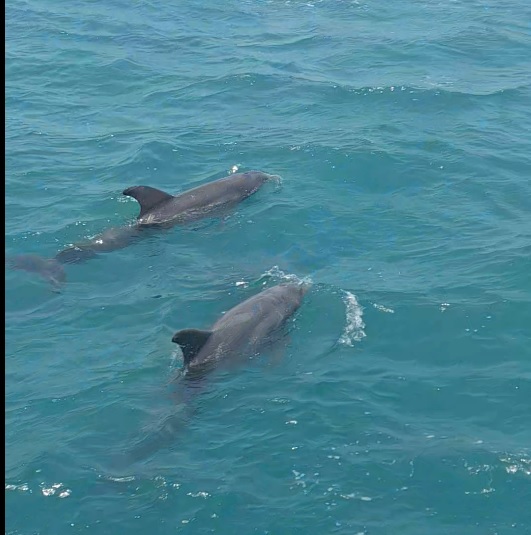
 The channel through the barrier reef is well marked and wide so we had little difficulty. It was a bit deceptive as to look around all you see is ocean with little indication that if you happen to water off course you would slam into an unseen reef. We weren’t the only ones in the channel heading out to see as we were joined by a pod of dolphins who came by to say hello.

By noon we had successfully navigated the reefs to sail off into the open ocean. The wind filled in from the east so it was a great sail out to Turneef Atoll which in its own right was reported to be one of the best dive sites in Belize, we are about to see for ourselves as we plan to find a place to anchor for the night and do some snorkeling.

Turneef Atoll is a national park which is 27 miles long by 10 miles wide and virtually anywhere around the island would be a great place to dive. I chose an anchorage on the southernmost tip, where there is an abandoned lighthouse and a small ranger station ashore.

We found good holding in 10 feet of water and we soon had our gear on and hit the water. There was a coral reef that extends off the point which proved to be incredible. The water temperature was 28C so a wetsuit was not necessary, but I would always ware one to protect my skin from cuts from the sharp coral. We even had a curious nurse shark that hung about. We worked our way around the point where we discovered, thermals spilling into the sea. The water became hazy as hot fresh water mixed with the cooler salt water of the sea. I do not know how hot the water became but it was so hot that it was very uncomfortable so we moved further offshore to cooler temperatures. We would make two sets of dives off the reefs as well as take a high-speed dinghy ride past the ranger station up into the mangroves and lagoon. We met a couple of ranges in a boat coming out of the lagoon, the cheery chaps invited us to the station to use their internet to check emails and the weather reports.

It was a beautiful collection of tiny islands connected by mangrove trees with cannels leading off in all directions. There were several abandoned fishing camps which were fun to explore. I wish we could have stayed a month on Turneef, but the prospect of my bond being seized if we overstayed our welcome was now looming large. The following morning we up anchored and set our sights on Lighthouse Reef and the Blue Hole which was now just 15 miles away.