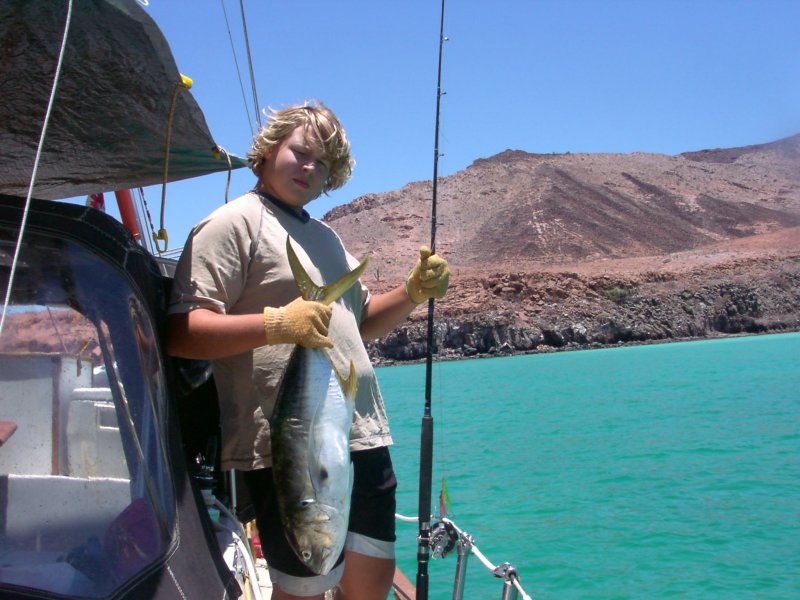
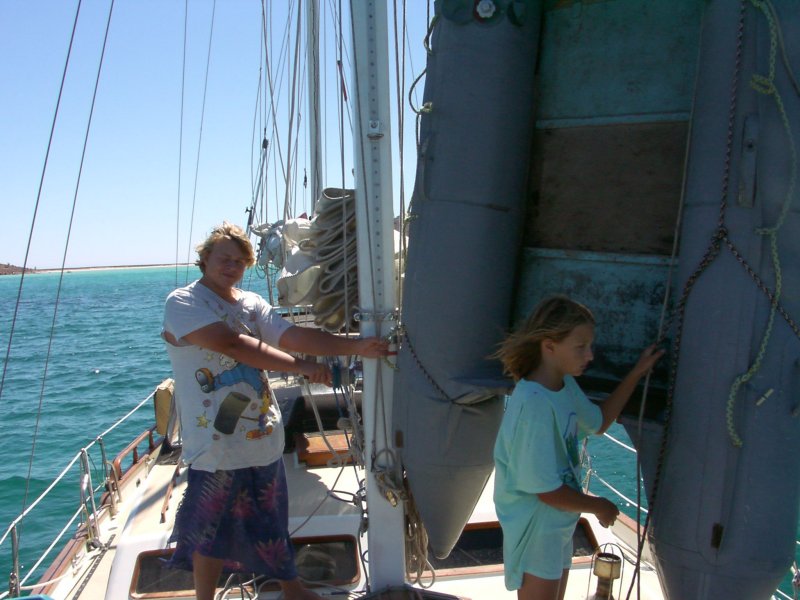
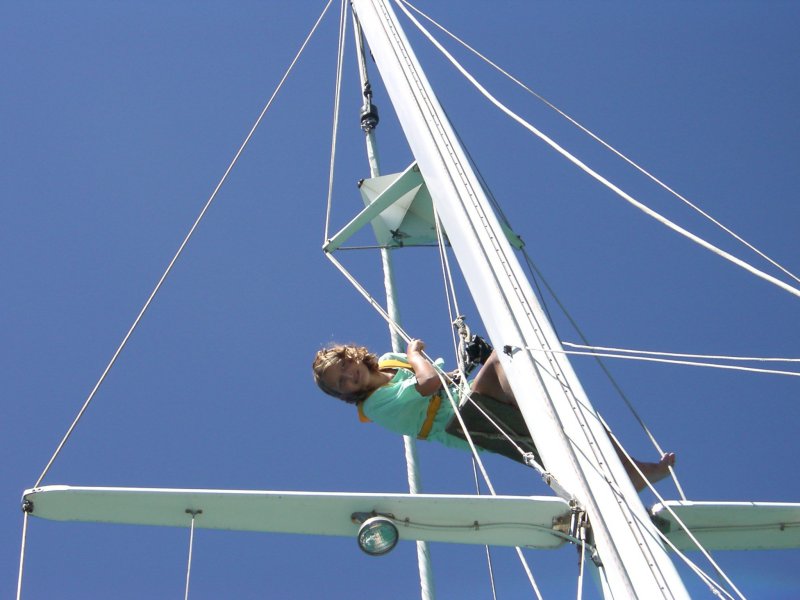
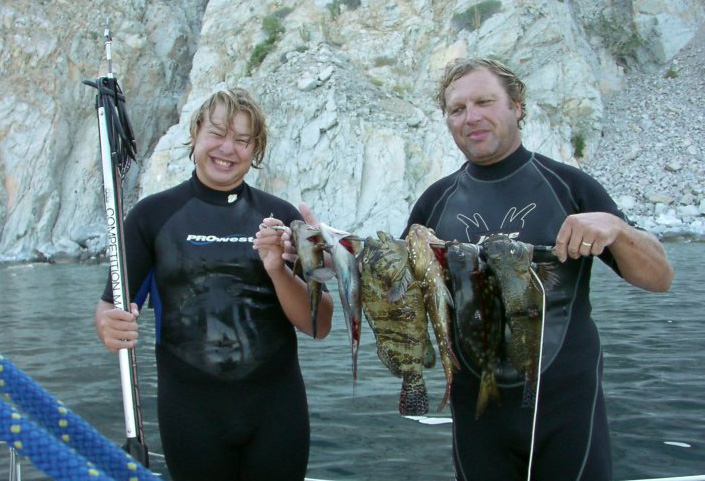
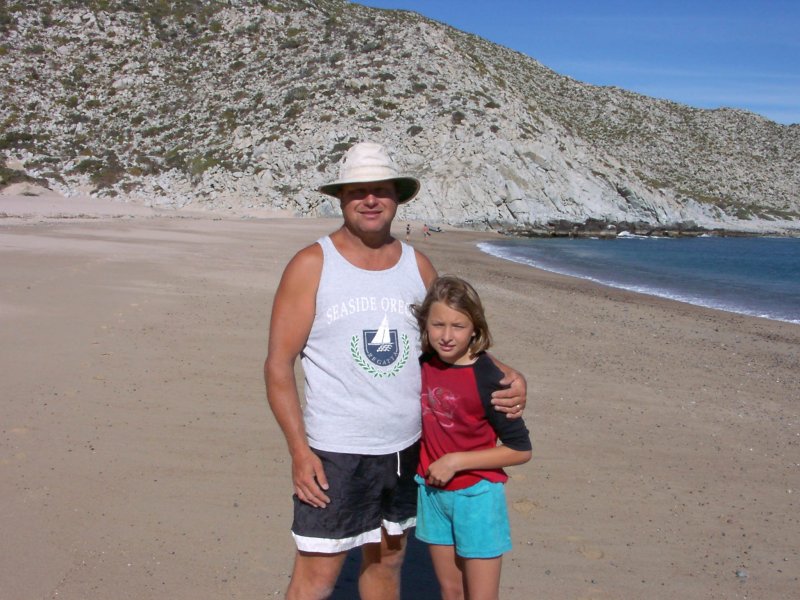
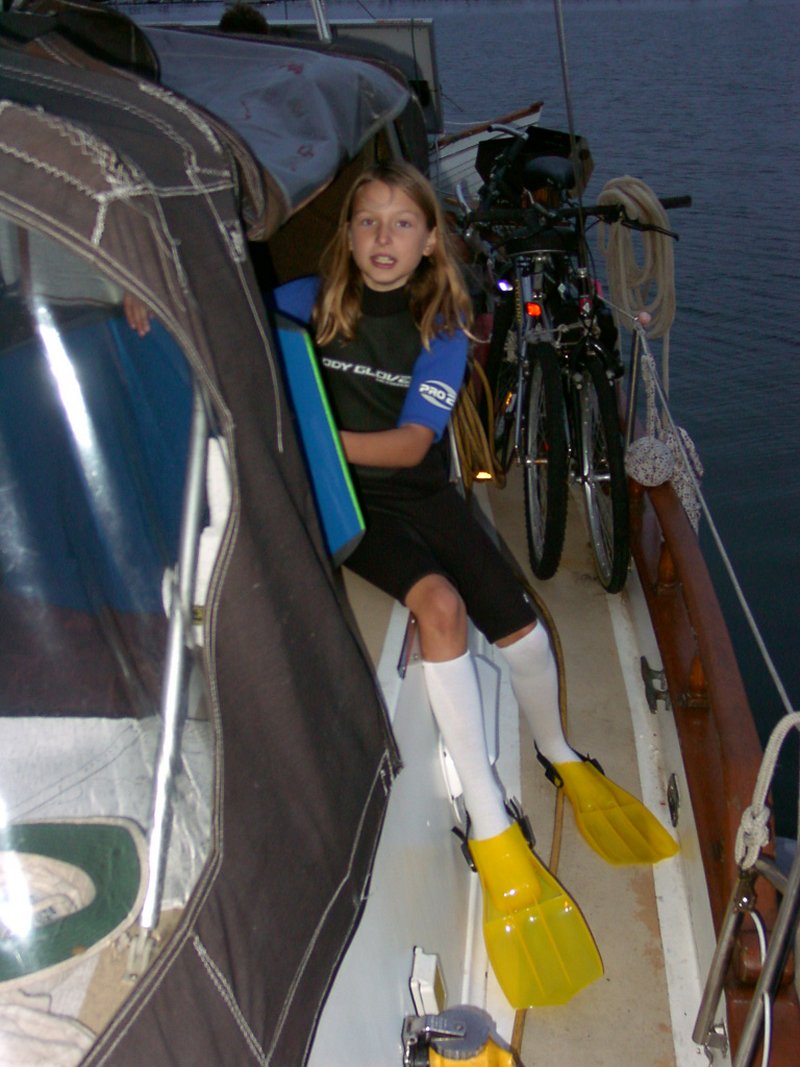
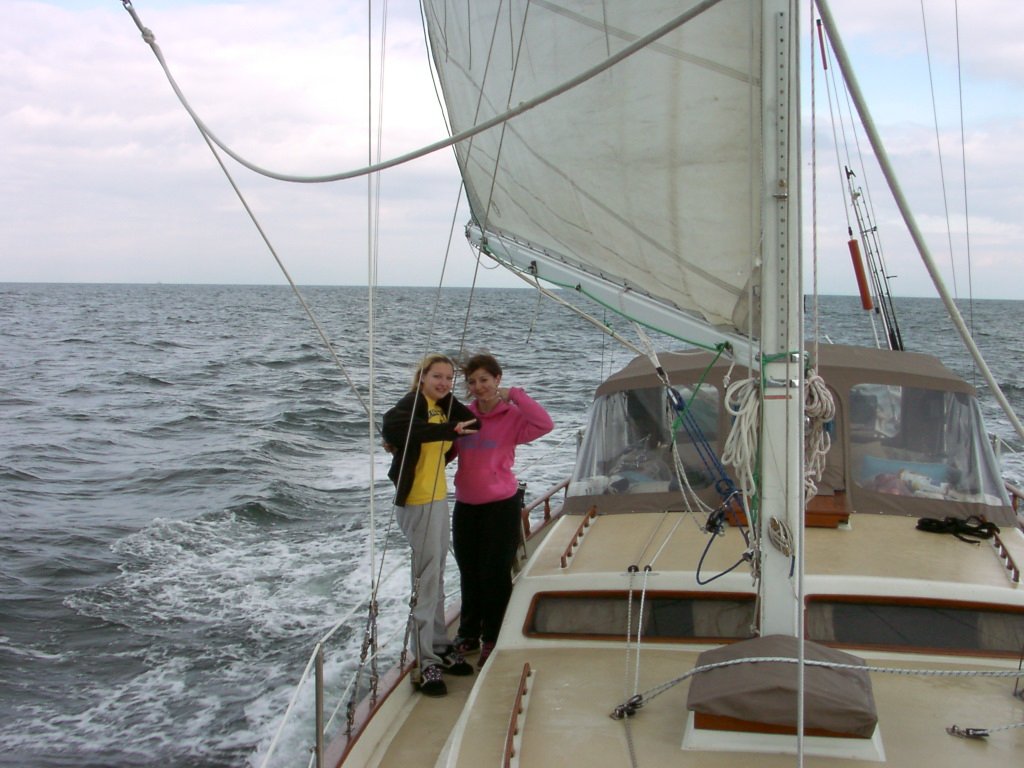
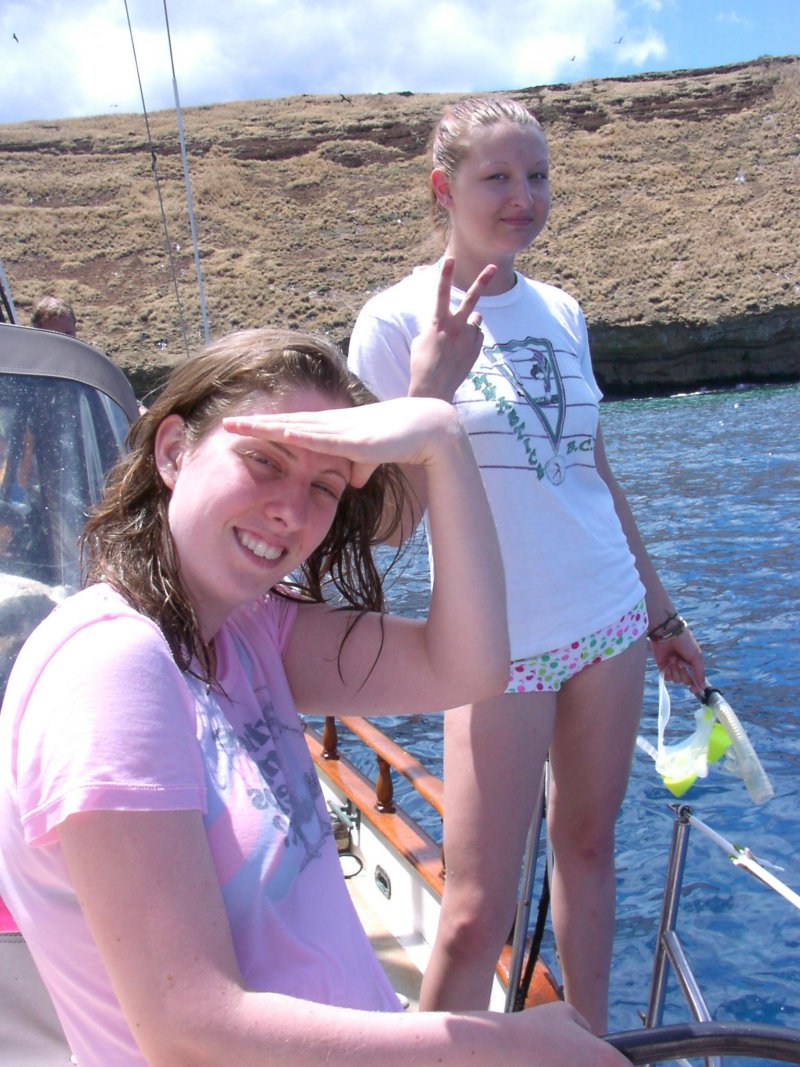
I can best illustrate as to what I was up to in the summer of 2020 by showing you the press release of our voyage.
For immediate release
VANCOUVER ISLAND, BC
A group of Vancouver Islanders have teamed up together to sail around Vancouver Island, covering close to 800 kilometers through some of the most beautiful coastal scenery in the world.
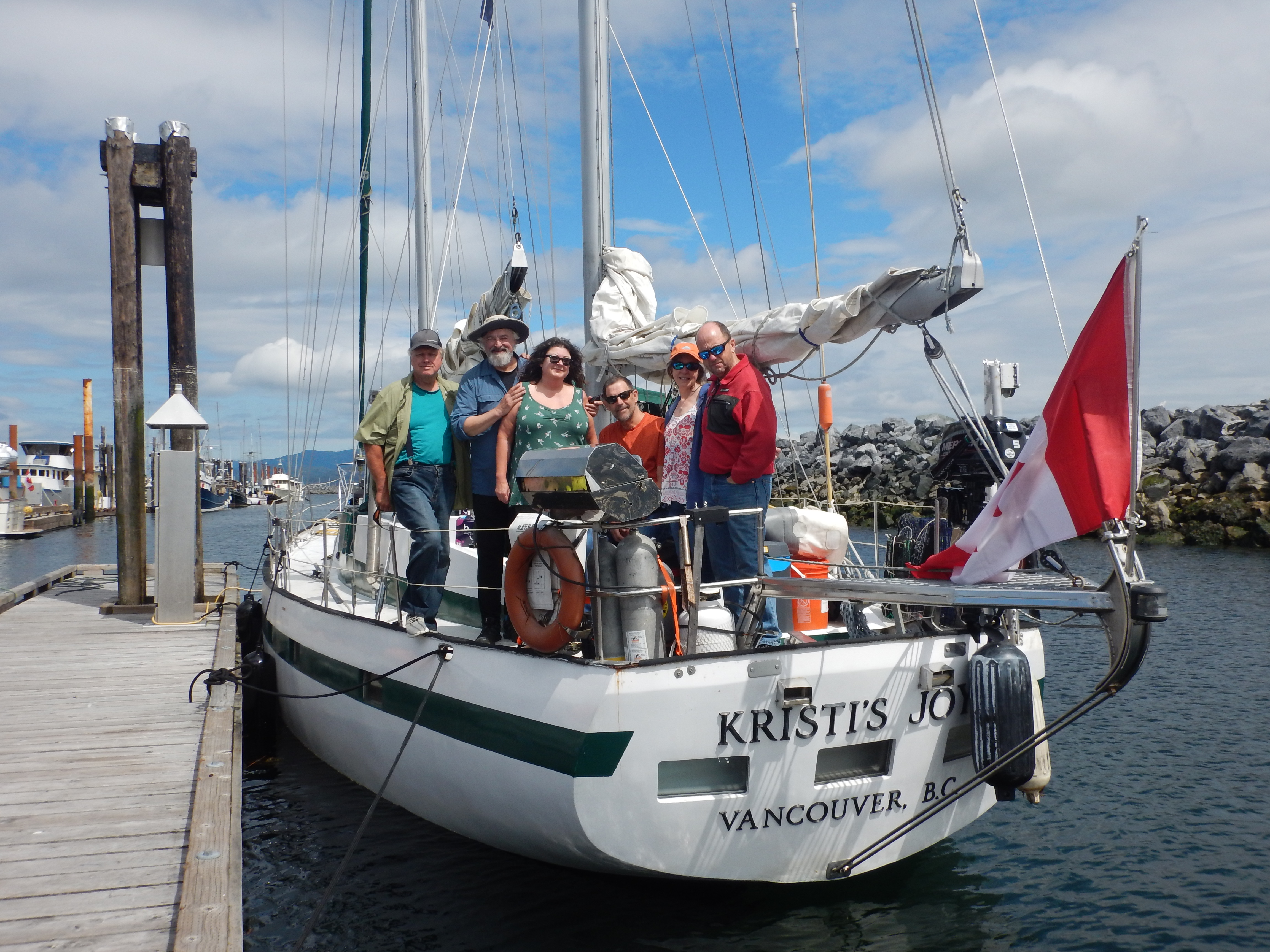
The crew aboard, a 65-foot ketch, SV Kristi’s Joy home based in Ladysmith, BC will depart out of Nanaimo in early July and return to Ladysmith in mid-August.
The team aboard is made up of videographers, writers, geologist, divers and blue water sailors.
The circumnavigation marks the first leg of a three season expedition to journey in the wakes of previous explorers such as Captain George Vancouver, Captain Cook and the Sir Francis Drake who plied these waters as early as 1578.
The early pathfinders opened the sea routes for Europeans to settle Vancouver Island, paving the way for fur traders, whalers, commercial fishers, coal miners, prospectors and lumberjacks, all drawn from around the globe by the bounty of Vancouver Island, leading to the development of the British Columbia as we know today.
Our voyage through history also relives the life and struggle of the nearly 50 First Nations who have inhabited this great island for over 10,000 years before the appearance of Captain Drake. The team will visit abandoned indigenous communities watched over by the spirits of Elders, as well as interviewing contemporary leaders of the indigenous People.
Shipwrecks, spawning salmon, killer and Gray whales, Black and grizzly bears. Old growth coastal rain forests, remote deserted isles and forgotten settlements will be documented.
The corporate teams leading this Vancouver Island documentary consist of Vancouver Island based TERRA MARINE ADVENTURES of Nanaimo, who is using their vessel Kristi’s Joy as lodging and a recording platform. S.V. MAIATLA and AJ’s INDUSTRIES, authors and publishers of Seafaring Adventure Literature, and TAKE 5 PRINT AND DIGITAL MEDIA publishers and video producers. The consortium intends to produce a series of documentaries and books showcasing Vancouver’s Island history of land, sea and peoples.
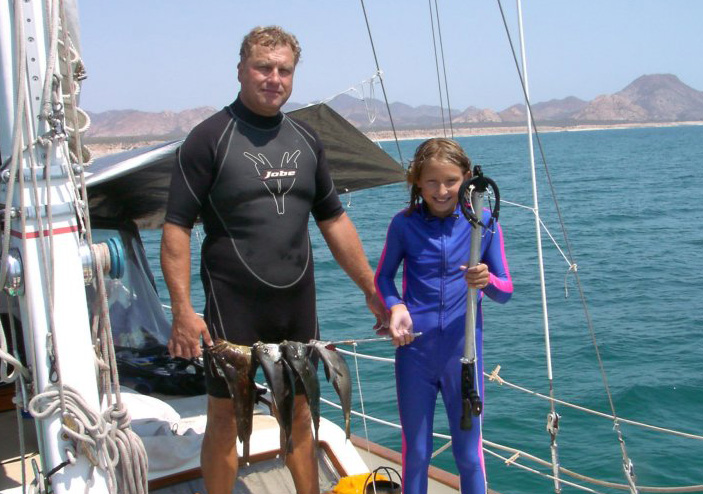
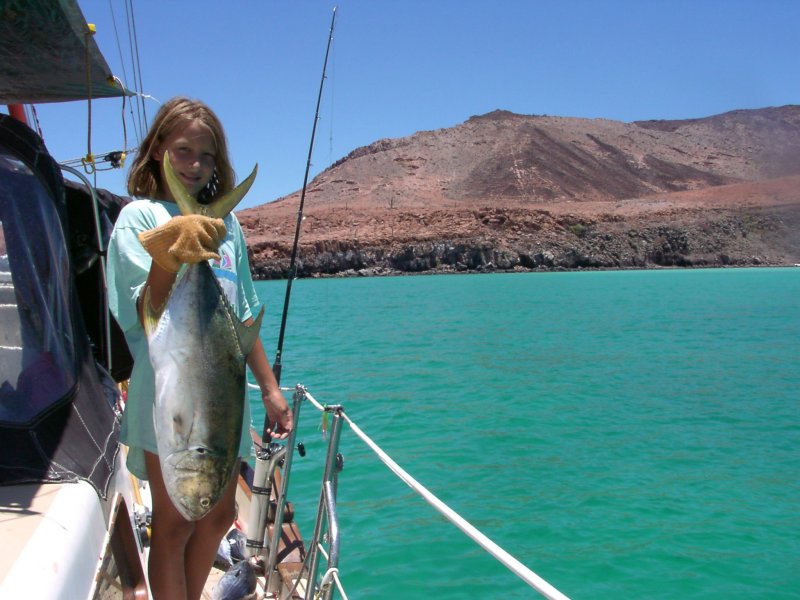
Due to obligations to our consortium, many of the video and photographs, both topside and below the water I captured are not ready for public release. However I can show a sampling of what is to come.
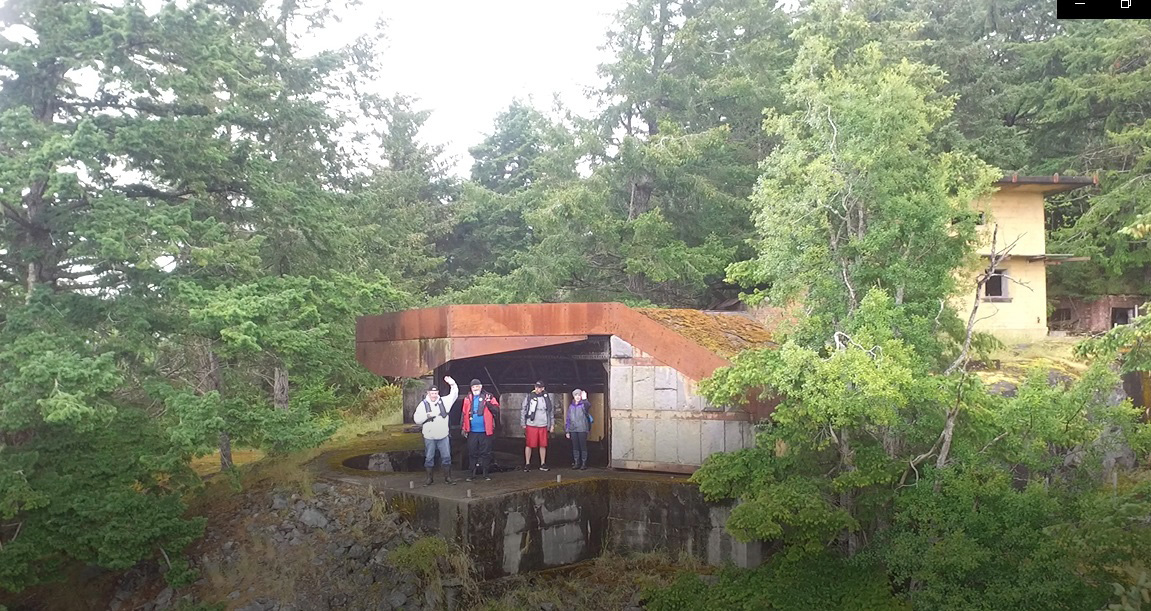
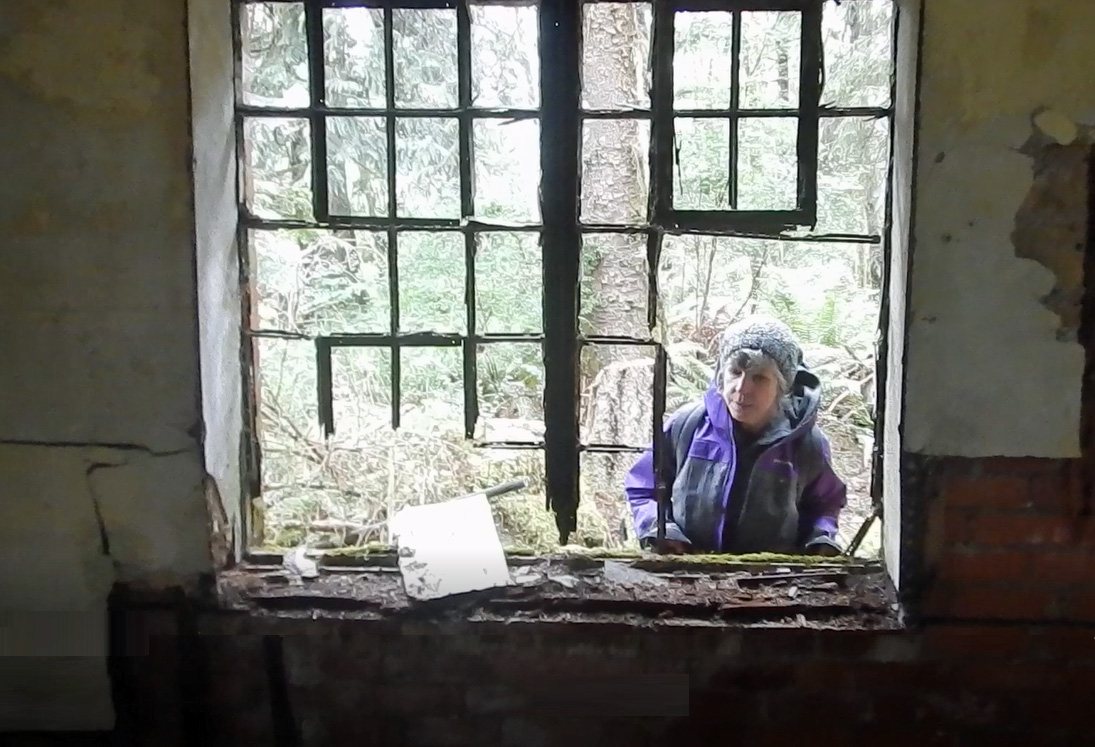
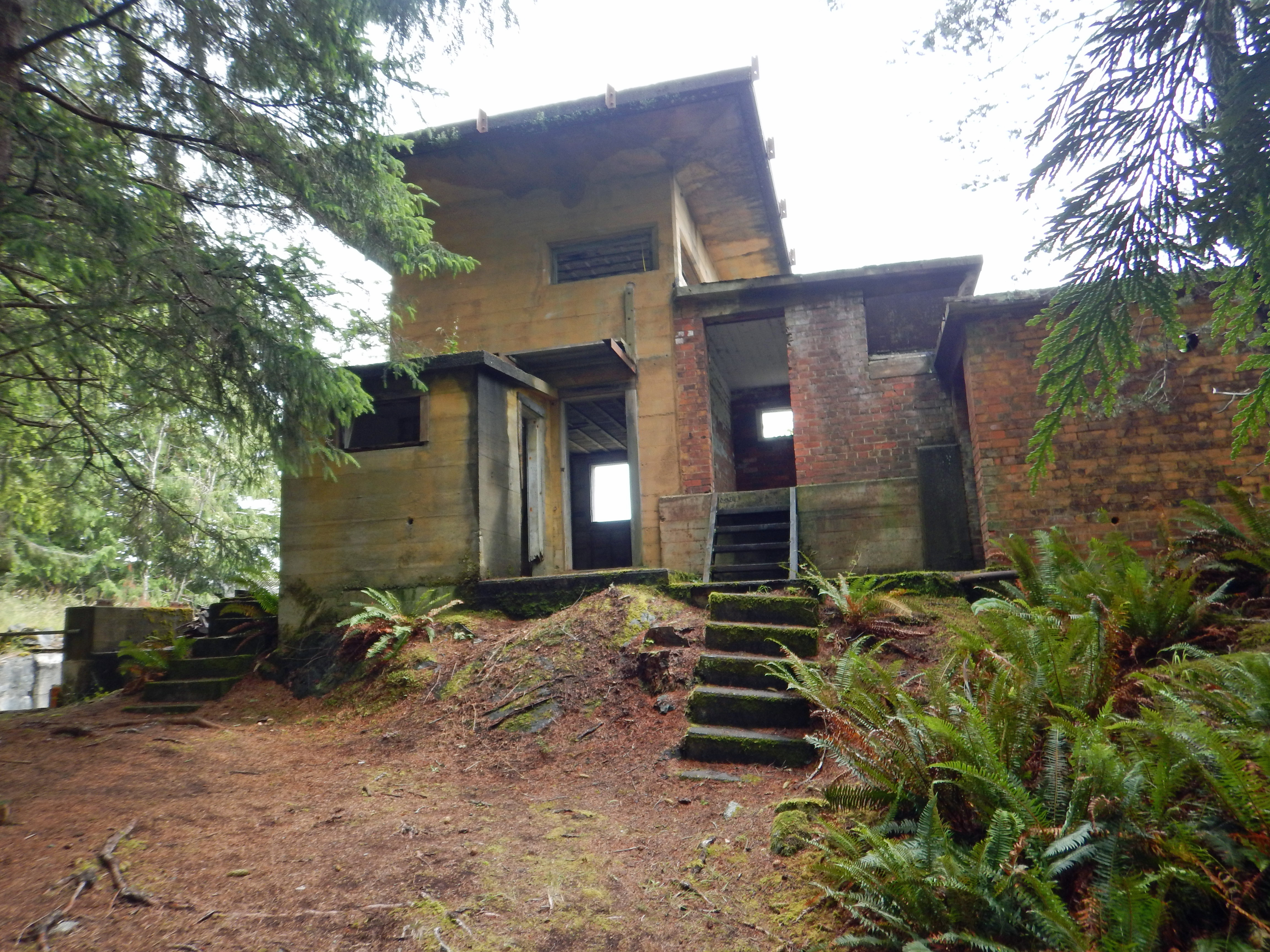
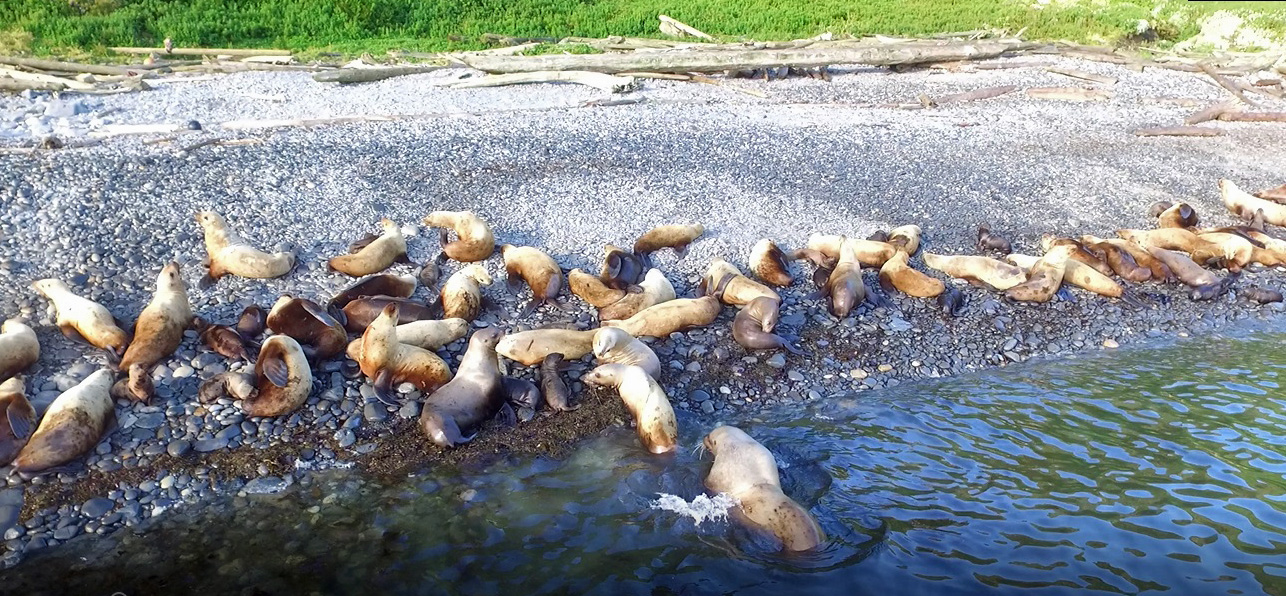
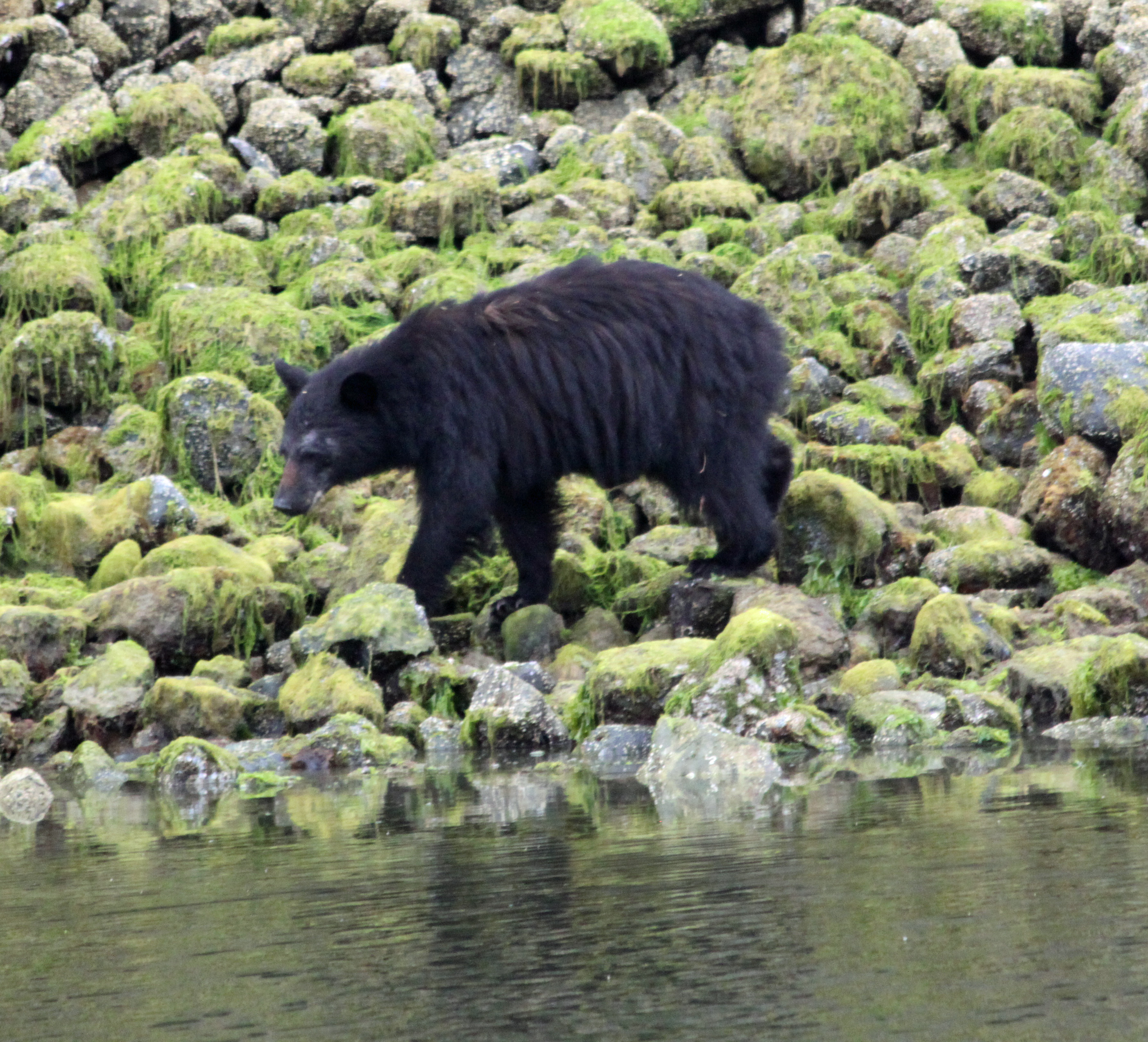
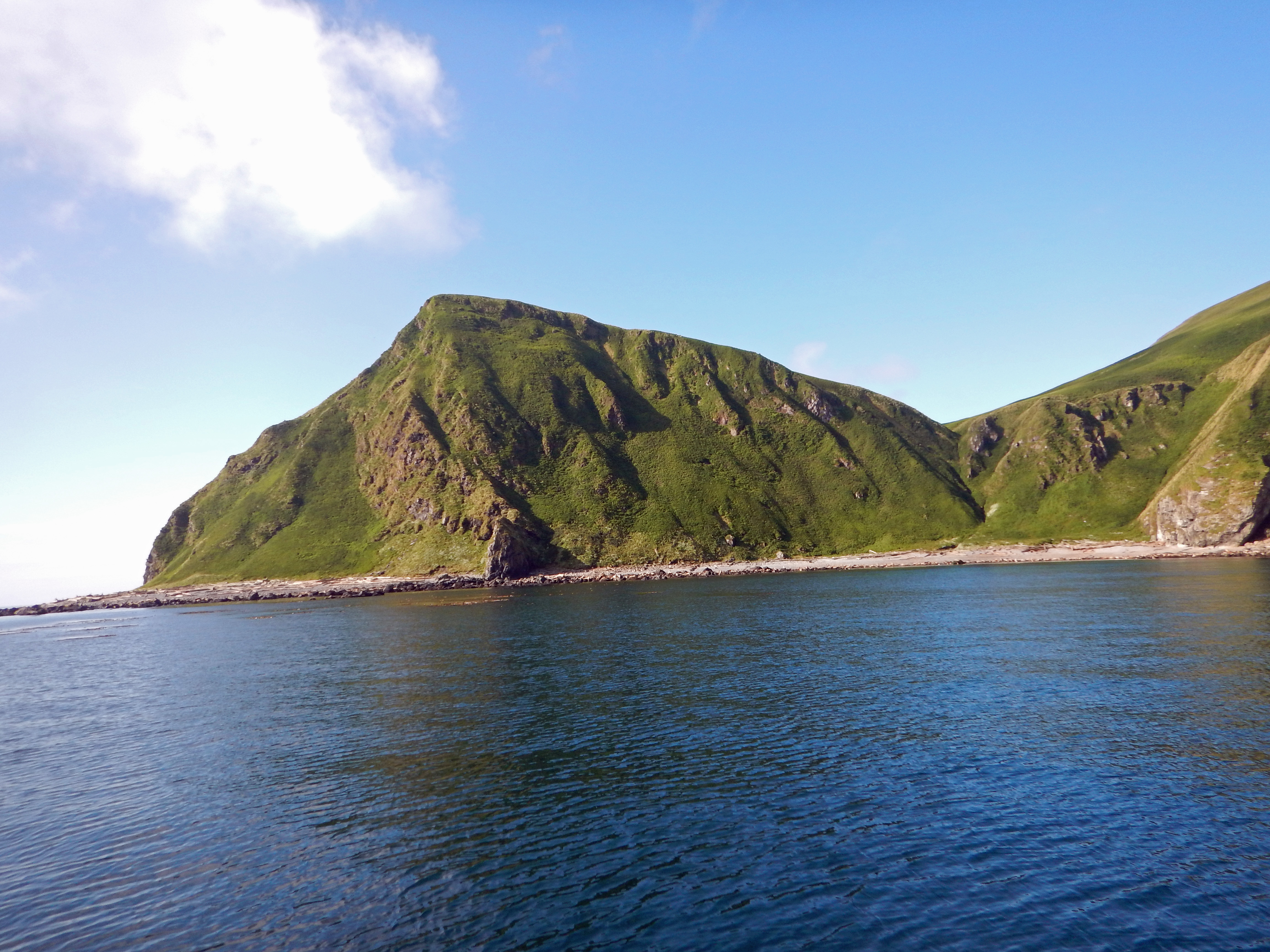
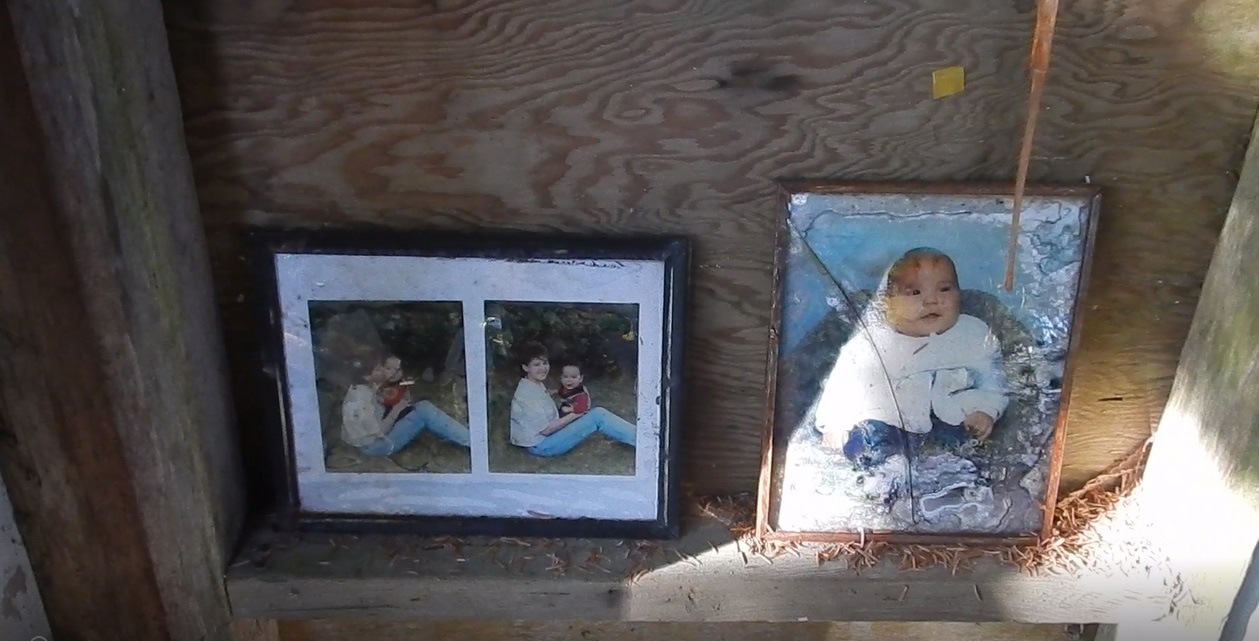
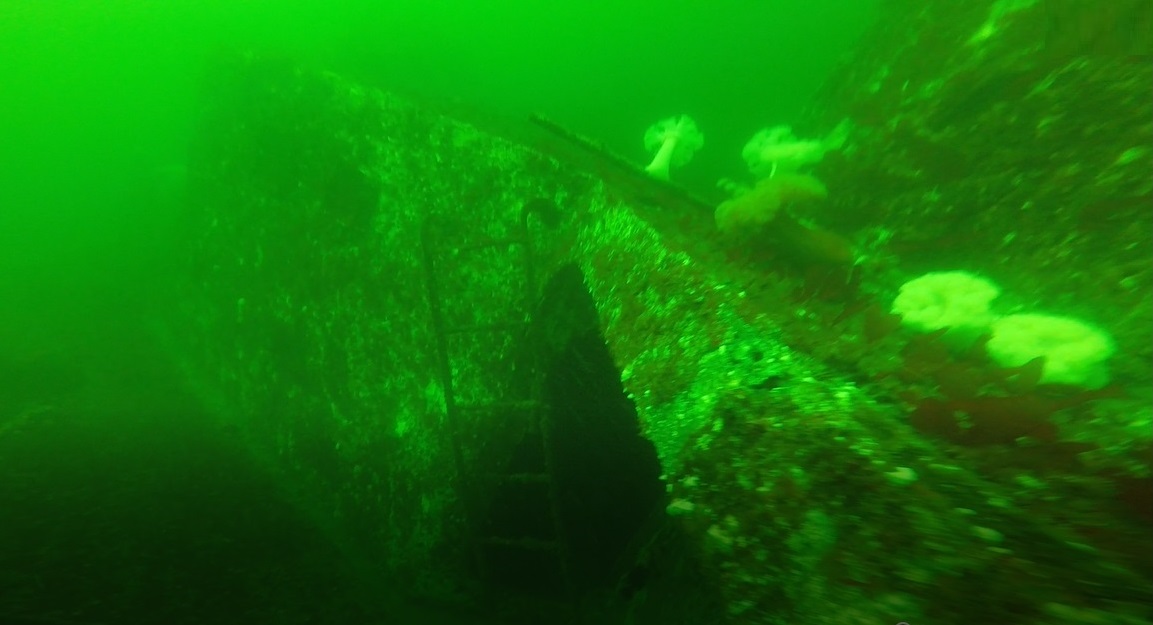
For more information and Pictures of our Voyage check out SV-Kristis-Joy Face book Page.https://www.facebook.com/SV-Kristis-Joy-109338090970840
Typical of many a voyage, things rarely go to plan but it was a fascinating and challenging voyage. Despite spending months in Preparations and and maintenance of the boat, our voyage was fraught with mechanical break downs. Not to mention that on the isolated and rugged west coast, we suffered through two separate groundings of Kristy’s Joy either of which not for the ingenuity of the captain and crew the vessel would have surely been lost. As it was she sustained serious structural damage both above and below the waterline. ( I have this story earmarked for publications in various Yachting magazines)
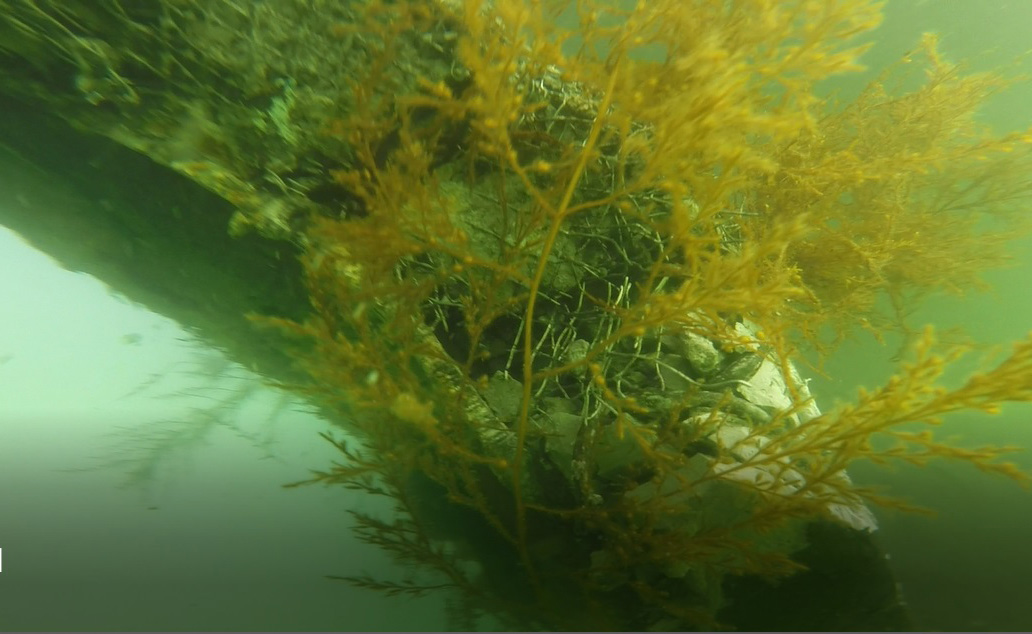
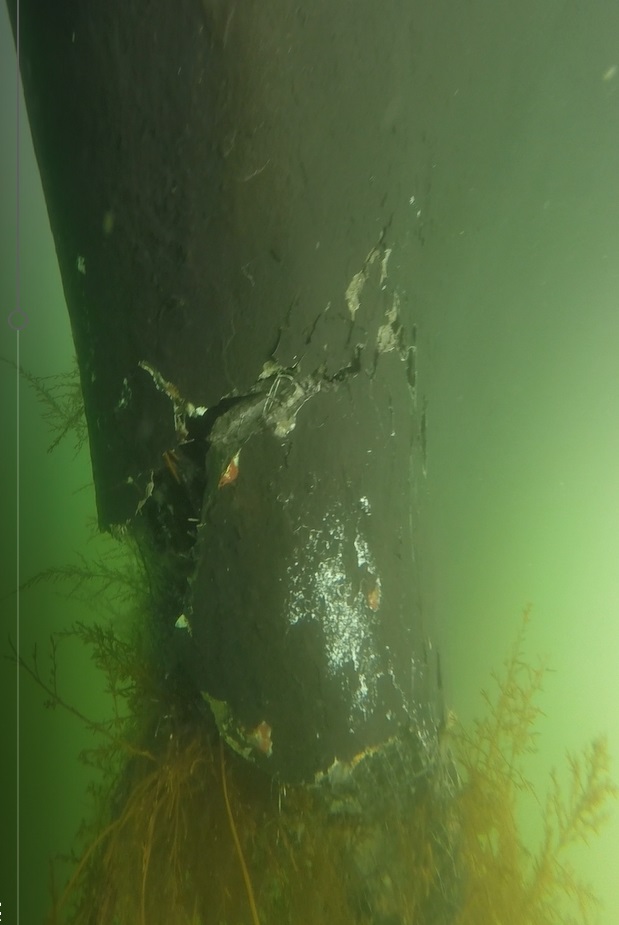
Aside from the magnificent wild and sea life encounters, exploring remote and desolate islands, we were enveloped by the almost mystical history of the indigenous peoples of the B.C. coast.
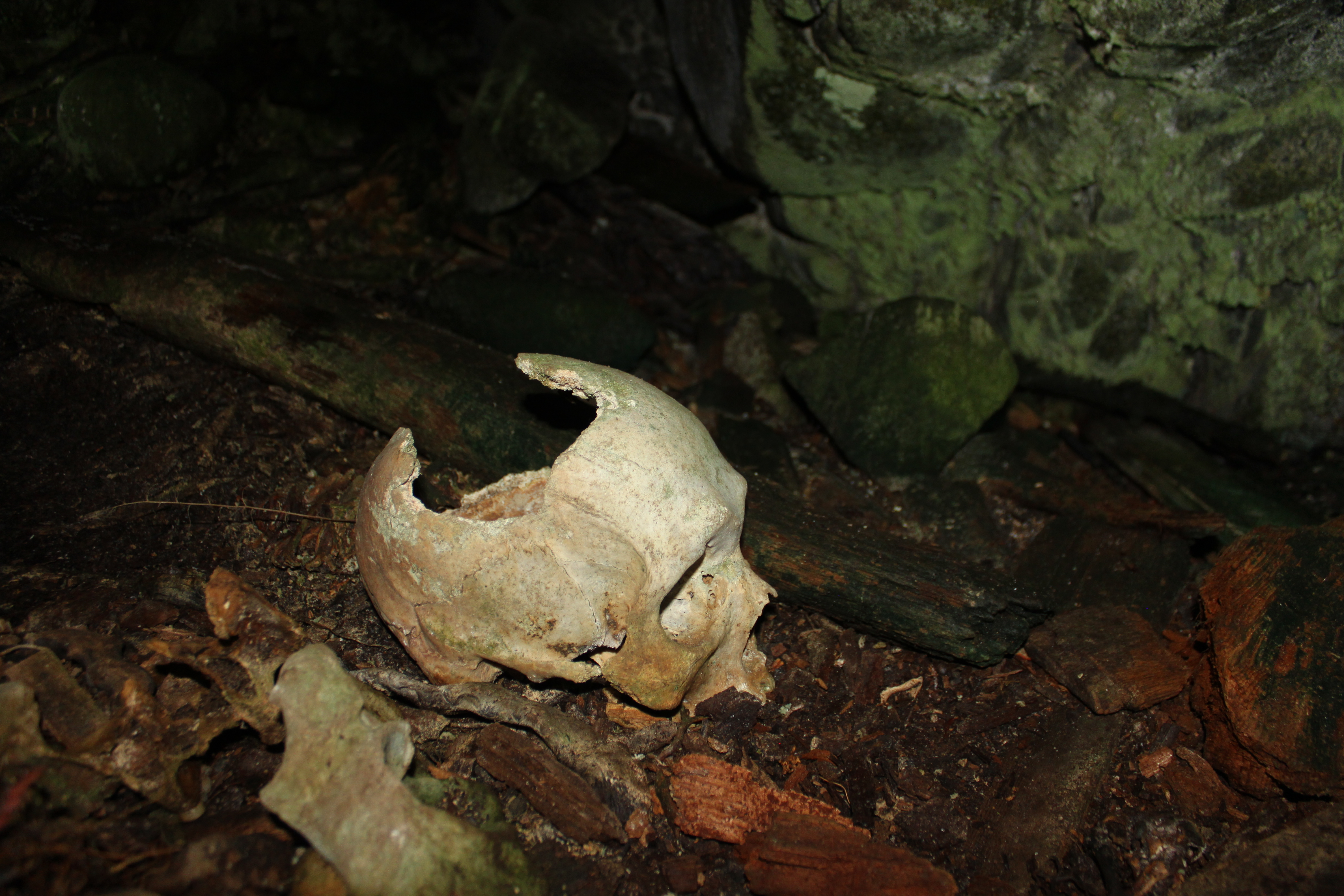
However due to covid19 restrictions our interaction and planned interviews were curtailed to a later date. However were were fortunate to be able to explore many uninhabited Indigenous sites around Vancouver Island. It was during one of these shoreside exploratory that I stubbled upon and cave with dozens of long diseased occupants. With the greatest of respect and with apologies to the occupants I napped a few photographs the existed leaving all as we had found them. For obvious reasons we will not disclose the geographic location of this particular cave, but the detains of its discovery by us will be addressed in our Completed documentary of this voyage. As well as being featured in books I’m present engaged in writing.
This recent discover of an ancient burial cave was not my first, so for those of you who can’t wait for the movie, here is the story of my first encounter in 1985 with those who have been interned in the belly of Vancouver Island.
WHALES SHIPWRECKS AND SKULLS
By
Andrew Gunson
The briny scent of the low-tide bit into our nostrils leaving the taste of the sea upon our lips. We cautiously crawled along with only a solitary flashlight to pierce the inky depths of the cramped, chilled cave. It almost appeared as though it were raining inside as water oozed through small fissures to drip with eerie echoes into tiny iridescent pools.
The floor of the one and a half-meter diameter tunnel felt spongy under my knees as I crept along. My flashlights beam reflect off the glistening stone only to vanish as if sucked into the blackness of the rocky walls.
Tom, who was close on my heels, was just saying something about this being a bad idea when we round a slight bend. Slowly panning the light in front, I froze as I came face to face with a human skull guarding the path. The hauntingly vacant eye-sockets stared at me from a jaw-less bronze colored skull, sending a reluctant shudder through me, bristling the hairs on the nape of my neck.
I was stunned, had we found an ancient Indian burial cave? Or just some hapless fisherman who had crawled in the cave seeking shelter, perhaps after wrecking his boat on this storm-ravaged shore. The only way to know for sure was to crawl on deeper into the bowels of the island.
It was the summer of 1985 when I traveled to Barkley Sound on Vancouver Island’s, rugged West Coast with the Underwater Archeological Society of British Columbia.
Our team of fifteen divers was to survey and recover artifacts from the 235-foot sailing vessel, The ERRICSON, which was driven ashore on a rocky island one stormy November’s night in 1892. Fortunately, and to the delight of the team we were accompanied by Allen Edwards and his cameraman from BC TV, to film a mini documentary on our discovery of the virgin historical wreck and the subsequent recovery of artifacts.
The morning of the fifth day on the wreck site broke as beautiful as anyone could imagine, a stark contrast to the overcast and choppy condition of the previous days, which plagued our diving operations.
Tom Upton and I spent part of the morning working on the deepest section of the wreck, which lay in just over thirty meters of water on a barren sandy slope. The dive was uneventful; however, the visibility was poor due to a heavy plankton bloom making it difficult to work as I drew the sketches while Tom measured up the ship’s massive rudder as it lay upon the bottom.
After burning up our bottom time, we slowly finned our way upward through the corridor of exhaust bubbles breaking the surface not more than twenty meters from the salvage boat. I gave Tom the thumbs up, then peered towards our tender as she gently rolled on the oily swells.
To my surprise, the cameraman was perched precariously on the boat’s rail. He was filming us bobbing cork-like in the sea while the rest of the salvage team were waving frantically, shouting and pointing to the water behind us. Puzzled, we spun around but saw nothing save for a patch of ominous foaming water that spread to encircle us.
It wasn’t until after returning to the boat did we learn that a large gray whale and her calf had leisurely swum through the tiny cove. Apparently, as they arched their tails high into the air to dive, we unwittingly popped up right behind them, evidently just missing the mother’s massive tail flukes as she gently slid from sight leaving hardly a ripple to tell of her passing.
As we took a lunch break, our charter boat skipper regaled us with tales of the indigenous peoples. Stories of tribal wars, cannibal dances, savage massacres and secret burial caves with Indian chiefs laid out in ornately painted war canoes. The “sacred burial sites”, as he told us, were plentiful in the Broken Island Group, if you knew where to search.
With time on our hands until our next scheduled dive, a few of us accompanied by the BC TV news team took to the herring skiff. With adrenaline running and ignorance as our guide we headed for a likely looking island.
We grounded the skiff on a picturesque scimitar shaped beach and immediately separated to begin clawing our way through the matted Sala shrubs and thorny blackberry bushes. Logic dictated that a secret burial cave would have a hidden entrance. So, for the next hour, we scoured the island, every nook, cranny and crevice.
Exhausted and with torn, bloody hands, I finally conceded to defeat and slid down the muddy embankment to land back on the beach. The rest of the team was already waiting by the skiff and from their expressions, I knew that they had no-better luck than I.
While marching along the sandy beach, I heard a feeble call from behind me. It was the cameraman who was poised at the water’s edge and he was pointing at a small opening in the rocky wall just above the high tide mark. With a bemused smirk, he asked matter-of-factly, “Is this it?”
Remarkably, the hole in the rocks was in plain view and visible from the boat. Somehow, in our rush to be discoverers of ancient worlds, we had all missed it.
As I was the only one to have brought a light, I was unanimously volunteered to crawl in and check it out. I grabbed Tom and instructed him to watch my back and with more than some reluctance, we disappeared ferret-like into the earth.
While crouching in front of the human skull, it took several minutes of animated and colorful discussions between Tom and I before we decided to press on. So, with great care as to not disturb the skull, I slid past and burrowed on another ten meters or so with torrent scenes from “Raiders of the Lost Ark” flashing through my head.
Suddenly, the ceiling of the cave sloped upward and for the first time, I was able to stand erect with only a handful of centimeters to spare. I said nothing as Tom first pushed my legs aside who then grabbed my jacket sleeve and with a grunt, hauled himself to his feet.
The seemingly incessant rain had ended with the black dirt floor surprisingly dry. I panned the light about the bulb-shaped cavern that was perhaps five meters in width. A stifling musty acrid odor filled the room, seemingly robbing the oxygen from my lungs.
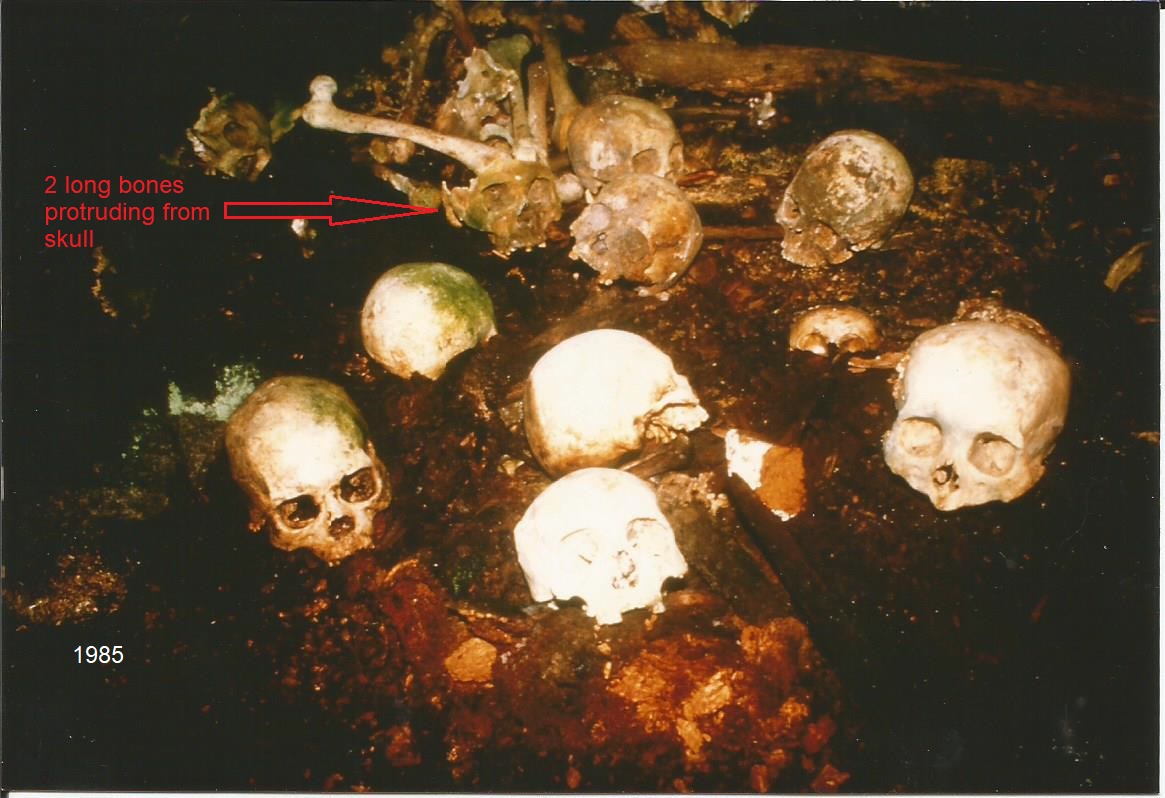
Neither of us spoke as we struggled to come to grips with what we had blindly stumbled into. It was like our minds refused to acknowledge what our eyes were seeing, leaving all of our senses numb. The floor was littered with hundreds of long bones scattered around a score of human skulls and in the back, propped against the wall was evidence of more recent usage.
In the feeble light, the decaying remains of what appeared to be a roughly hewn cedar coffin lay collapsing. One side of the box was crumbling away and cradled inside was a human skeleton, clothed in now tattered rags. Tom, who was still clinging to my sleeve first muttered something about an ancient curse, then he was gone.
Alone, I nervously I fumbled with my camera as I apologized for the intrusion to the tomb spirits and promised not to disturb anything as I flashed away. I burned up a roll of film then quickly did a head count, quite literally, I counted twenty-one skulls and skull fragments.
Oddly, in the center surrounded by the others as if holding court, was a large skull. Its cranium was missing and sprouting from the brain cavity were two long bones that swept back not unlike a mountain goat.
There were obvious signs of animal scavenging which would explain the scattered condition of the skeletons. An animal more than likely was responsible for us meeting the sentry in the tunnel. It probably abandoned its efforts of trying to remove the head from the cavern after rolling it part way down the tunnel only to get it stuck in a rut. A grisly thought.
After reaching the light of day, Tom and I were heralded as heroes as we recounted our adventure. Surprisingly, no one else, including our inquisitive news team wanted to venture in, yet all seemed content in taking our word for what we had discovered.
A week later, back in Vancouver when I had the film developed, I thought that perhaps the curse Tom had mentioned while we were in the tomb may be at work. Disappointingly, out of the thirty-six photographs I had taken, all save one was ruined; perfect pictures of nothing but a strange, unexplainable darkness as if the flash had failed to go off, yet I know otherwise.
The sole surviving photograph plainly depicts several skulls scattered about. It’s the only evidence I possess to verify my story. However, after giving it some thought, perhaps the spirits allowed me to keep just one photo in appreciation for the respect we had shown and for keeping the location of their burial cave a secret.
Barkley Sound lies on the southwestern edge of Vancouver Island, just a short drive from the city of Victoria, the Capital of British Columbia. The entrance to the sound, which is laced with hundreds of tiny islands, is over twenty miles wide and has been a death-trap for countless ships seeking the entrance to the Juan de Fuca Straight which lies due south.
The area is fearfully known to mariners as the “Graveyard of the Pacific” and for over two hundred years, the sirens of the alluring coast have mercilessly dashed countless ships and their crews upon their serrated shores.
The European presence on this seashore, is but a flicker in time when compared to that of the indigenous peoples of the coast. For millenniums, the Nootka, Makah and the roving Haida Indians all have thrived among the isles cast upon the emerald sea. The richness of their history is only rivaled by the majesty of dense stands of yellow cedar that once matted the hillsides and sprawled to challenge the water’s edge.
However, with the arrival of Juan Perez in 1744, the indigenous people began to fall as fast from disease as the magnificent stands of cedar fell to the lumberman’s axe. Little remains of the societies that once rivaled the Aztec’s in cultural expanse and the Roman empire in diversity.
A few pictographs next to bone white middens and scattered burial caves are all that remain of once flourishing societies. Today, much of Barkley Sound is protected and lies within the Pacific Rim National Park.
The ruggedly isolated beauty appears today to visitors much as it did for Lieutenant-Commander James Cook, who in 1778 sailed the H.M.S. RESOLUTION past this lee shore in a vain search for the elusive Northwest Passage.
Today the protected waters of the Broken Island Group are a paradise for sea kayakers, sports divers and yachtsmen alike. In addition, for backpackers, the West Coast Shipwreck Trail enchants as well as challenges even the most experienced wilderness hikers.
Andrew W. Gunson.
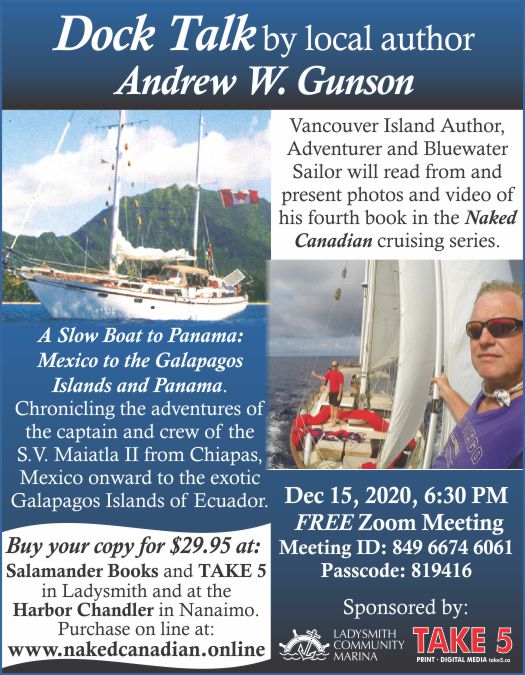
Don’t forget that this is Pacific Standard Time! Looking forward to seeing all my old cruising friends in the Audience.
PS I know this blog posting is out of sequence as this all occurred prior to our Pirate encounter but I thought some would enjoy the story. Cheers
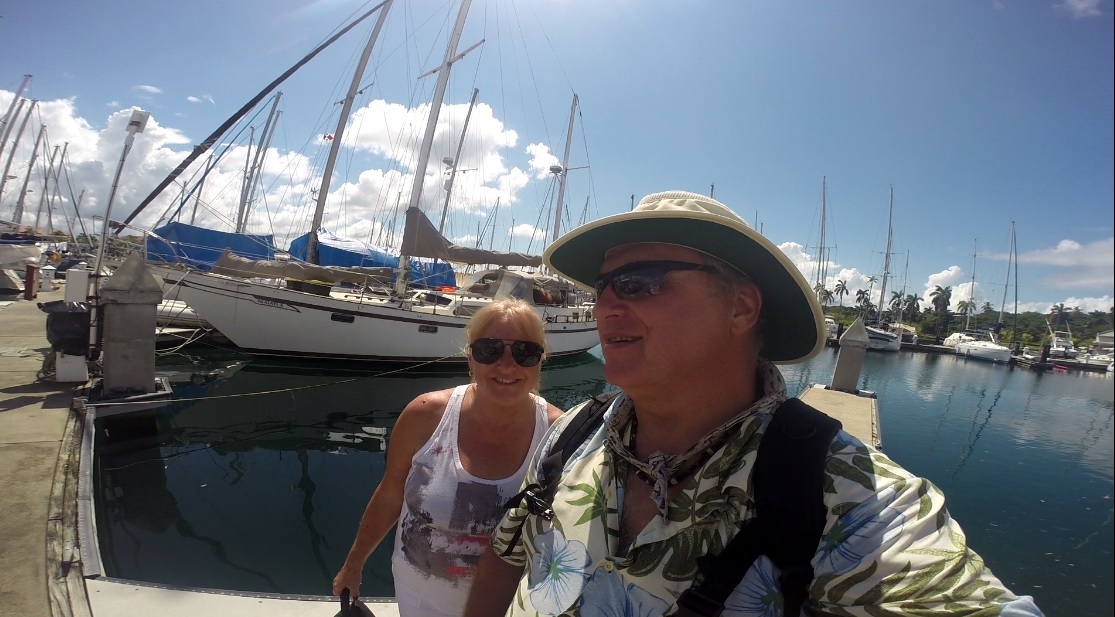
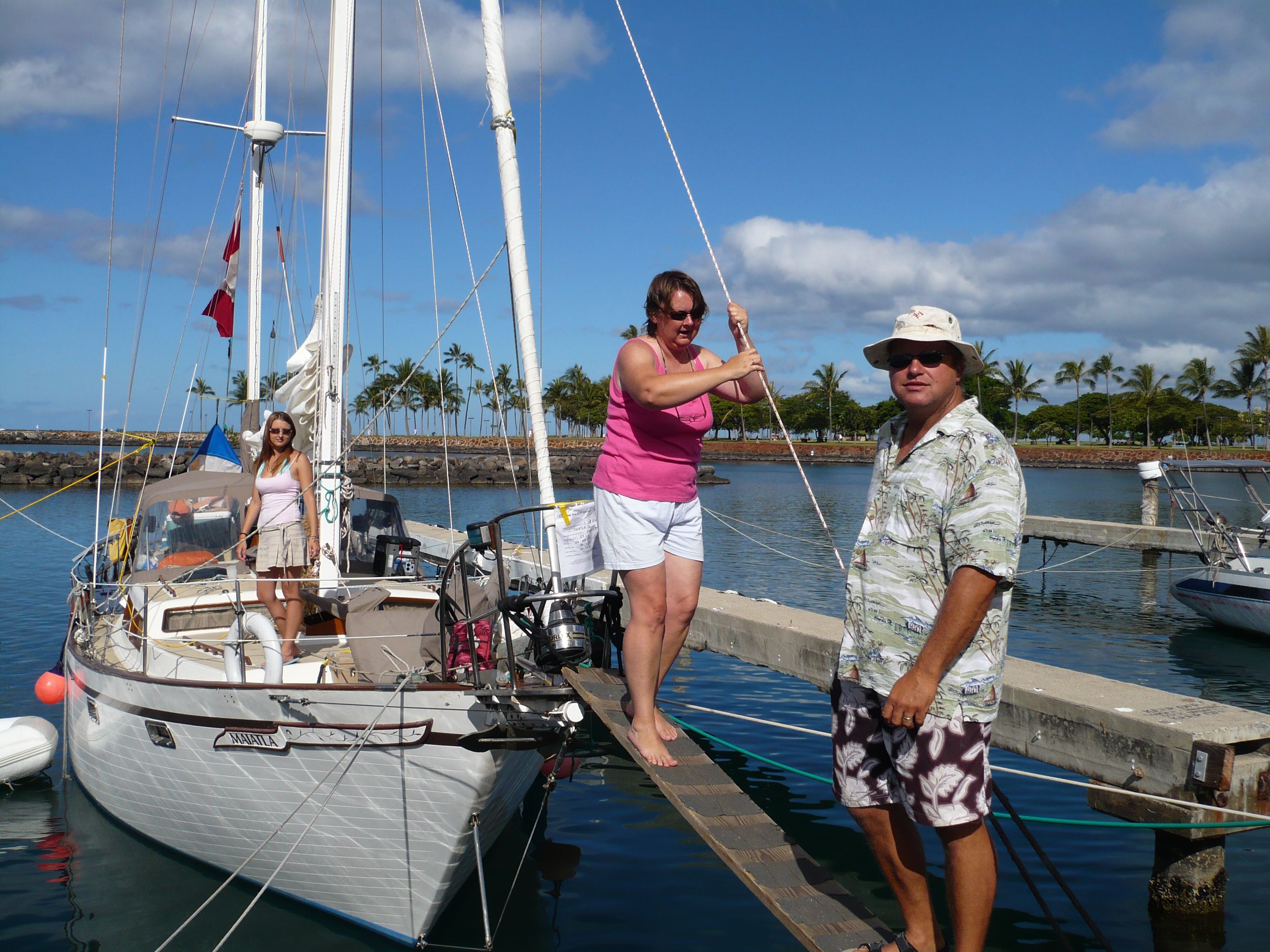
Jackie and I leaving Maiatla to head off into the jungle
It was late in November before I was able get back to Panama and our beloved Maiatla to prepare her for another cruise. Shelter bay Marina by Colon on the Caribbean side of the Panama Canal has been the boats home for the past three years giving us an opportunity to visit the nearby and very beautiful San Blas Islands.
After long discussions with Janet we decided that it was time to move on so we turned our attention to the Rio Dulce River in the heartland of Guatemala. Choosing the Rio Dulce was easy as the climate and in particular the heat was somewhat tamer than in Panama. (Janet found the Heat in Panama unbearable)
Also the Rio was also reported to have some good trade’s people for boat repairs and was cheap by comparison. It had been 10 full years since Maiatla’s last refit with the last six years being driven hard in the tropics which were now evident by her blistering brigthwork and ever-increasing mechanical failures. The old girl needed/ deserved some TLC so it was time.
Janet was not up to the ordeal that would be the boat prep nor was she into the long slog up north so she opted to stay at home until the boat arrived at its final destination. My usual crew members were not available but I did manage to coerce my elder sister, Jackie into giving me a hand for which I was gratefully appreciative but if Jackie knew what lay ahead she would have been wise to have stayed at home.
I had an aggressive schedule with hopes of getting the boat ready for sea in less than a week, which may have been wishful thinking on my part as the boat had been sitting for 9 months without being started. We would have our work cut out for us. While Jackie set about cleaning I took on the mechanical chores which started with replacing the boats entire engine batter bank as the smart charger must have had a brain fart as it fried all the batteries. Replacing the huge D8 batteries was a chore as they were buried deep in the bilge, a hard to access spot resembling a crypt.
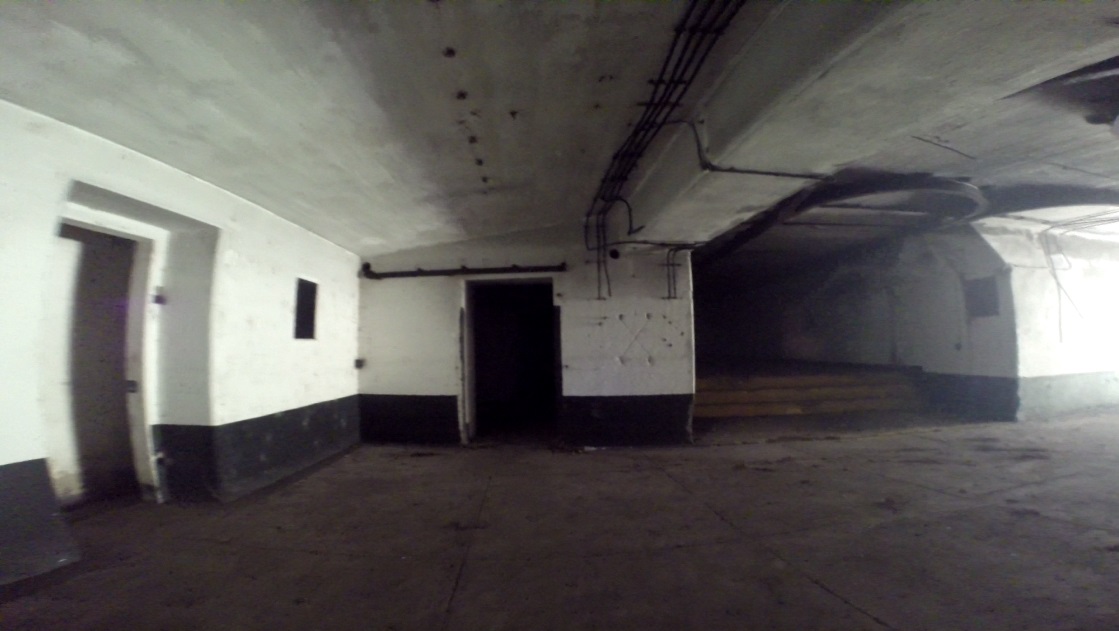
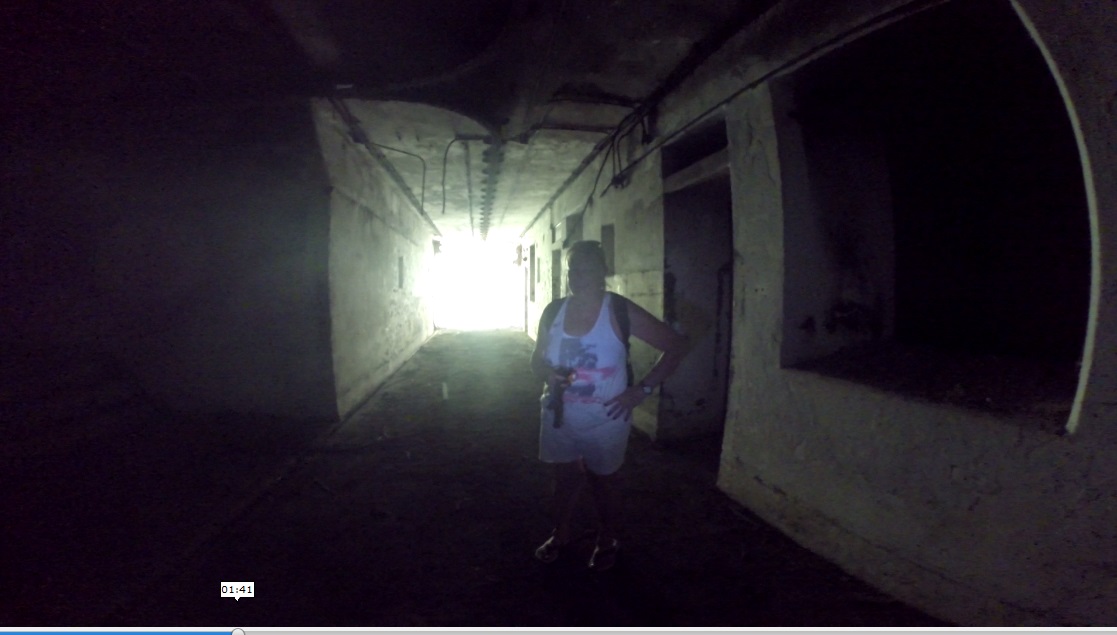
That done came an oil change with new filters all around. With great relief the engine started with little prodding. It was a hard week but it wasn’t all work, we took frequent swims in the pool while treating ourselves to rum drink in the restaurant. We also took time to venture into the jungle to explore the remains and ruins of the abandoned American fortification that were now hidden by jungle. Construction of the fortification of Fort Sherman began in 1912 with the intent of protecting the entrance of the new Panama which was still under construction.
The Fort would grow to house thousands, with up to 9000 infantry and airmen taking jungle survival and combat courses. The fort was final abandoned in 1999 when the canal zone was turned back over to Panama. The fort has long since abandoned with the jungle rapidly reclaiming the land. But with a bit of bushwhacking there is much to be discovered.
One day in the heat of the noonday sun we headed for the bush to see what we could find.
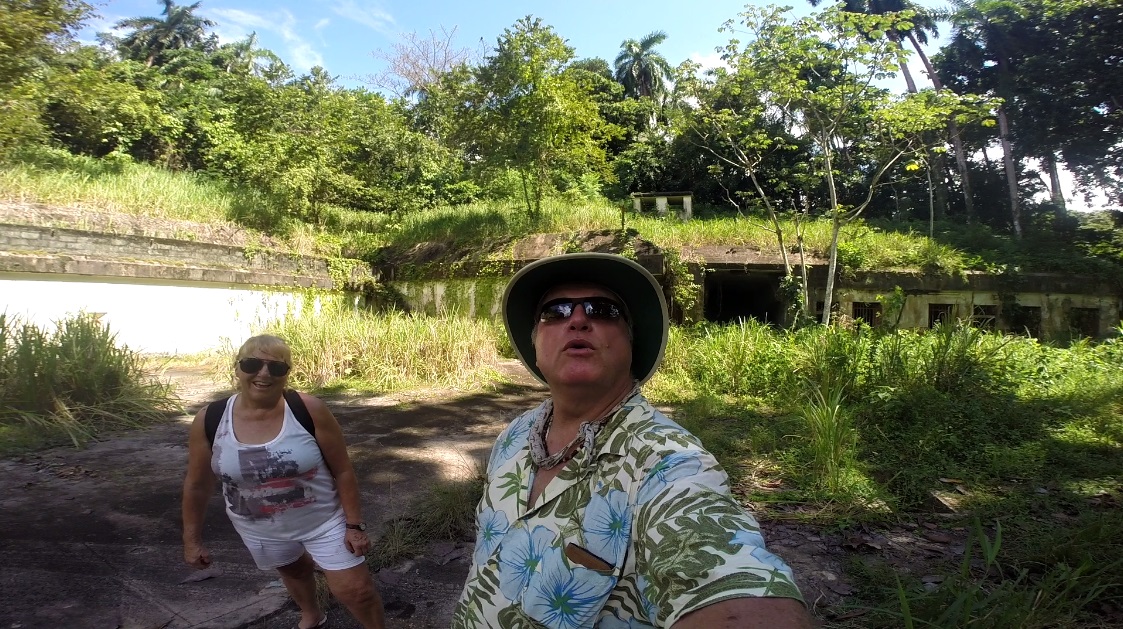
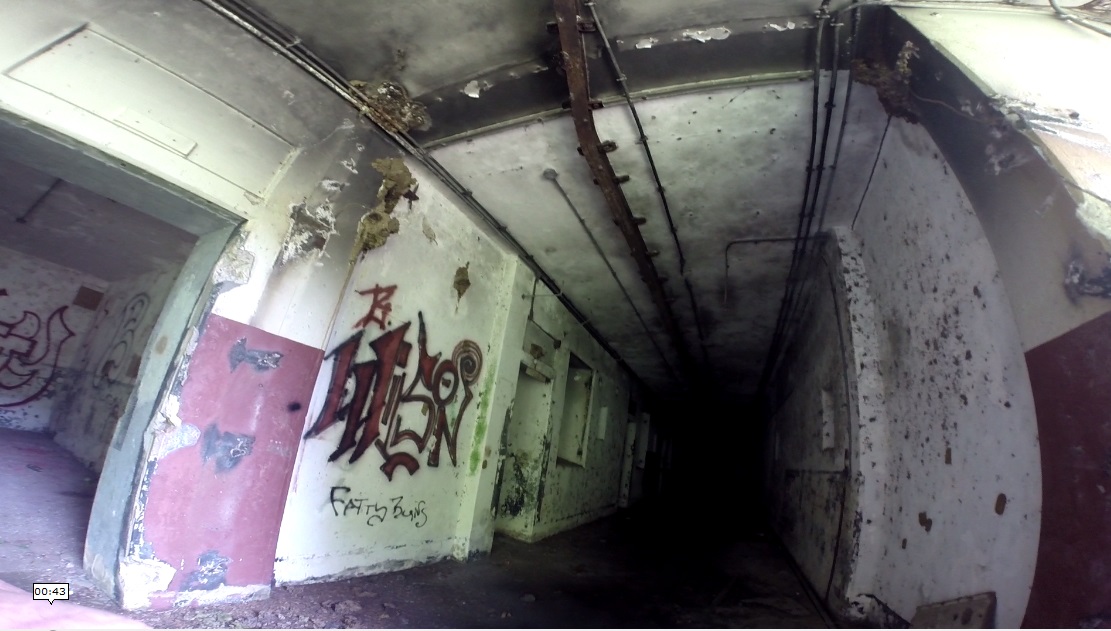
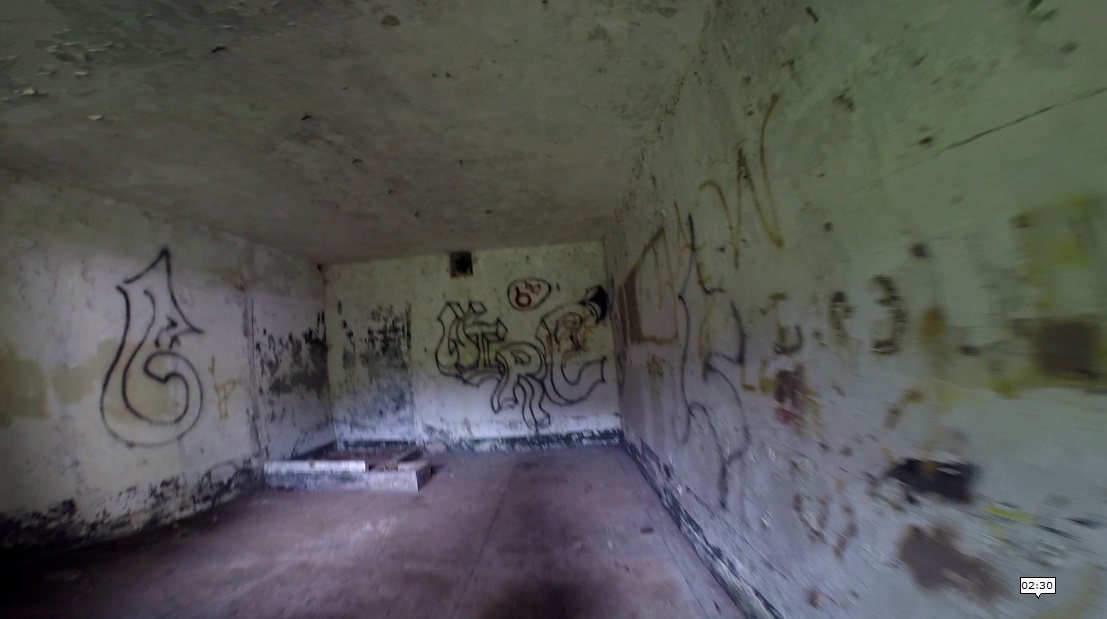
Bunkers in the hillsides.
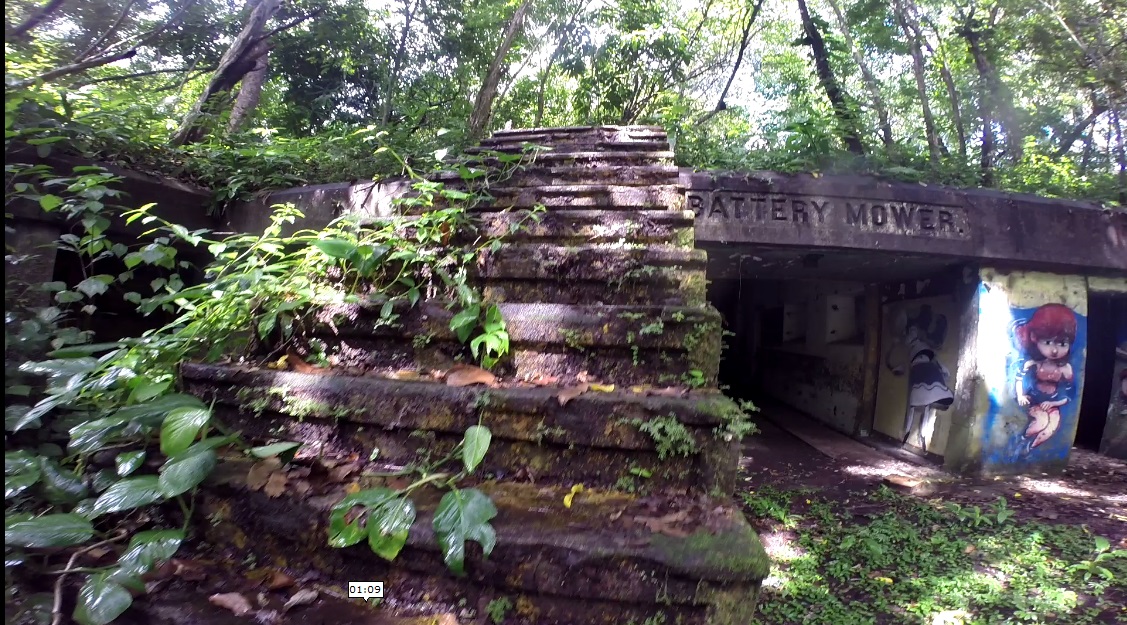
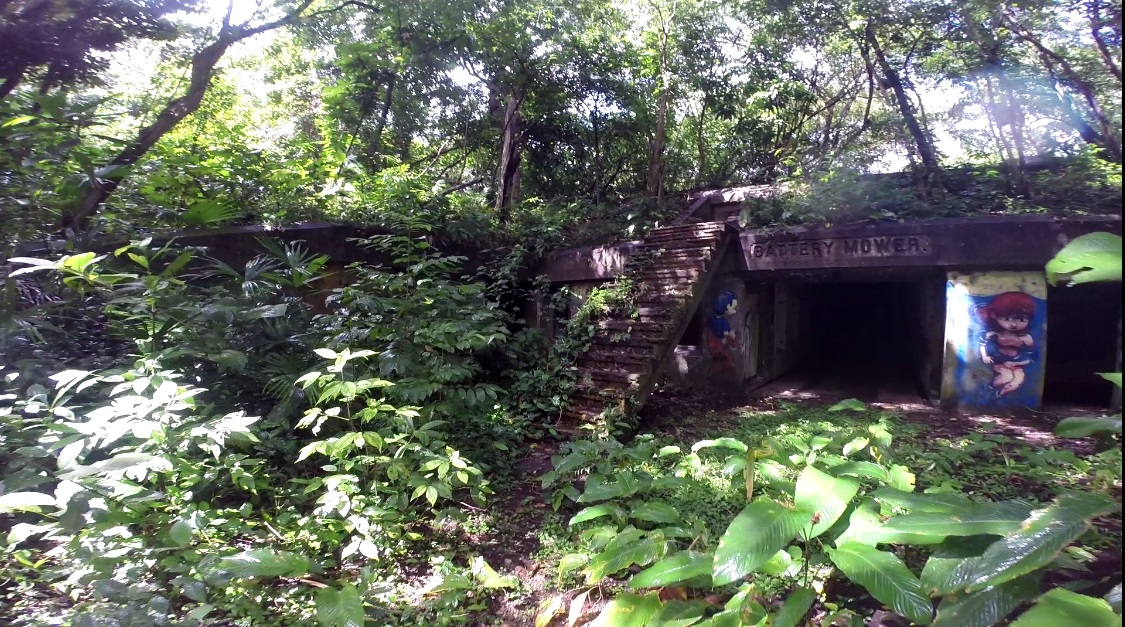
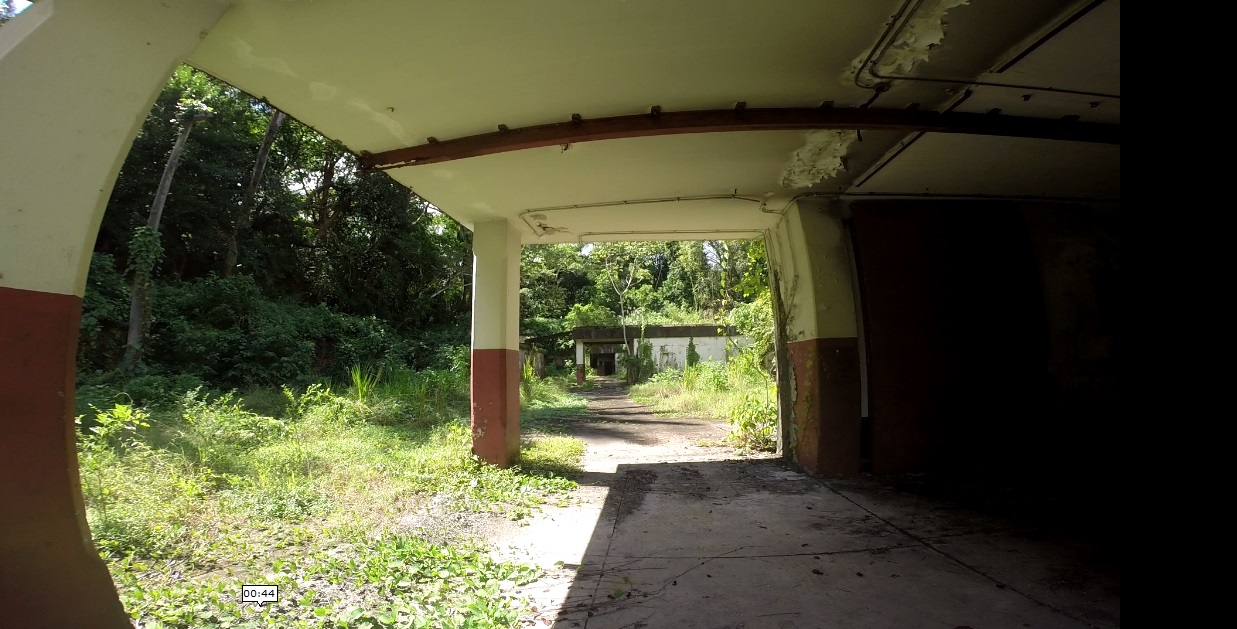


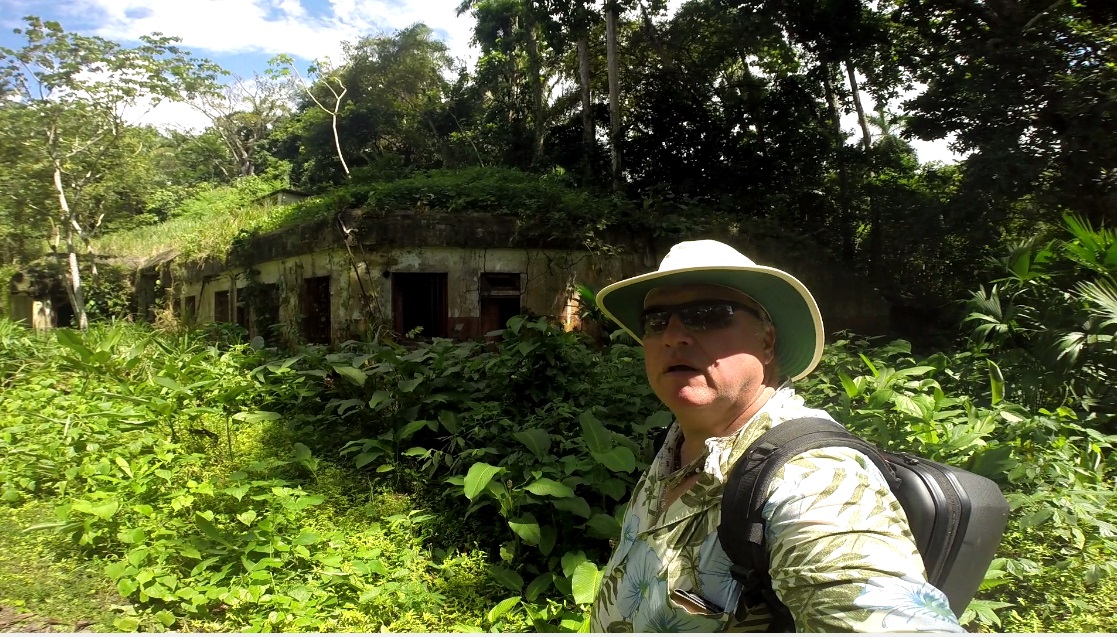
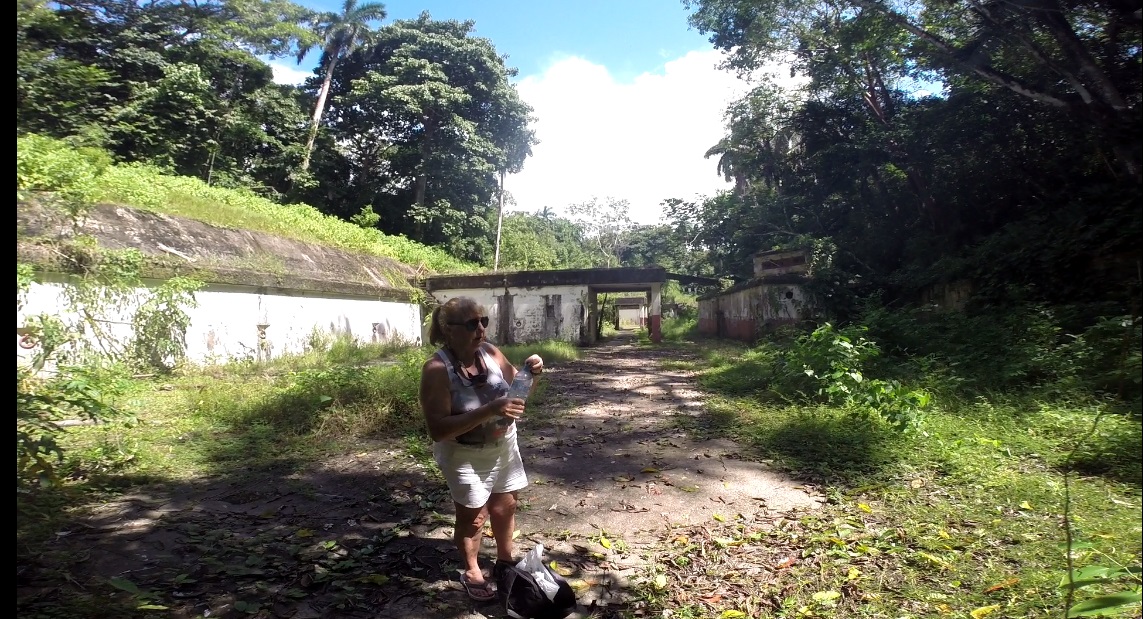

You can enter the underground labyrinth but we had to be wary of the bats. And Rats!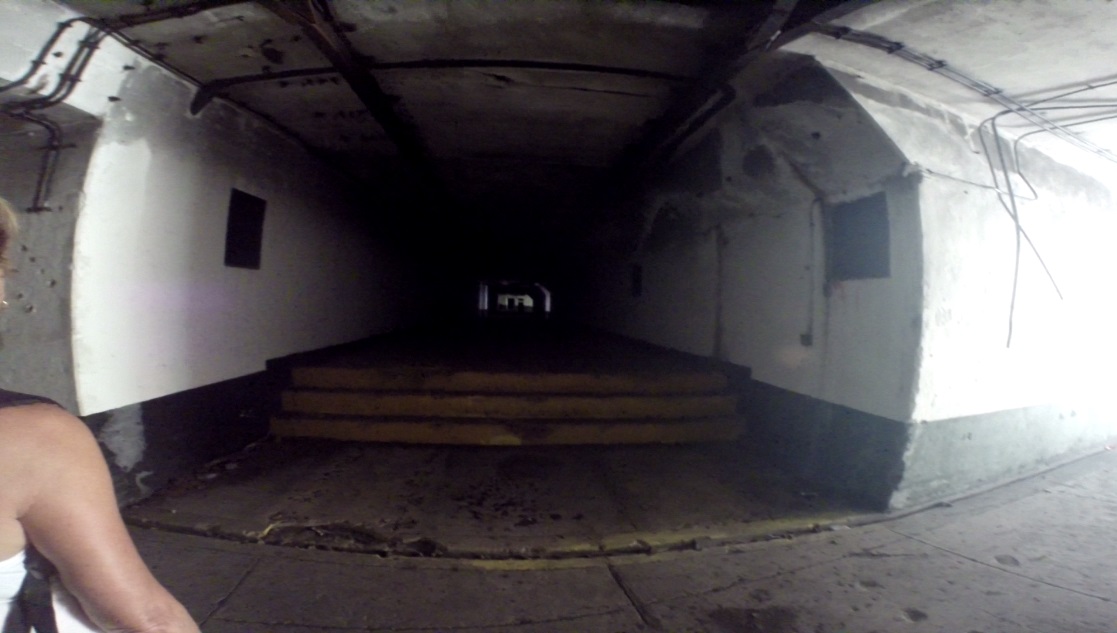 You can walk for city blocks underground.


A Little book signing at the TIKI PALAPA , cruisers lounge in Fantasy Island Marina Roatan.
When we departed Isla San Andras Colombia on December 2, my birthday, we were met with high winds and big seas forward of the beam. It was a rough slog up wind but the boat was sailing well. I intended to sail due north for a day before turning to the North East so we could swing wide of Gorda Bank, shared by Nicaragua and Honduras.
Aside being a prolific fishing bank it has been the site of many recent pirate attacks launched against small yachts. I planned on passing the bank a good 90 miles to the east in hopes of avoiding any ugly encounters. It was a plan previous cruisers employed with success so it should work for us. A full day and a half out of Andras I altered course to the North East but the seas were so big, they slammed into our bow, the force of which nearly brought the boat to a stop.
To keep our speed up I started the engine and continued to motorsail on our course.
It was a wet and rough ride but all was going well, that is until the engine quit. We laid the boat off the wind to keep up our speed. Jackie kept the boat moving and standing watch while I crawled into the engine hot engine in an attempt to restart the engine. But after several hours of changing fuel filters and bleeding the fuel system of air, I failed. The engine was dead. and I suspected that the fuel injector pump was the culprit.
Under normal circumstances I would not have been too concerned as we were a sailboat after all and I had no doubt that we would reach our destination on Roatan in another 3 days or so. But the problem was that the course we were now forced to sail would take us across the Eastern end Gorda Bank and reported Pirate waters.
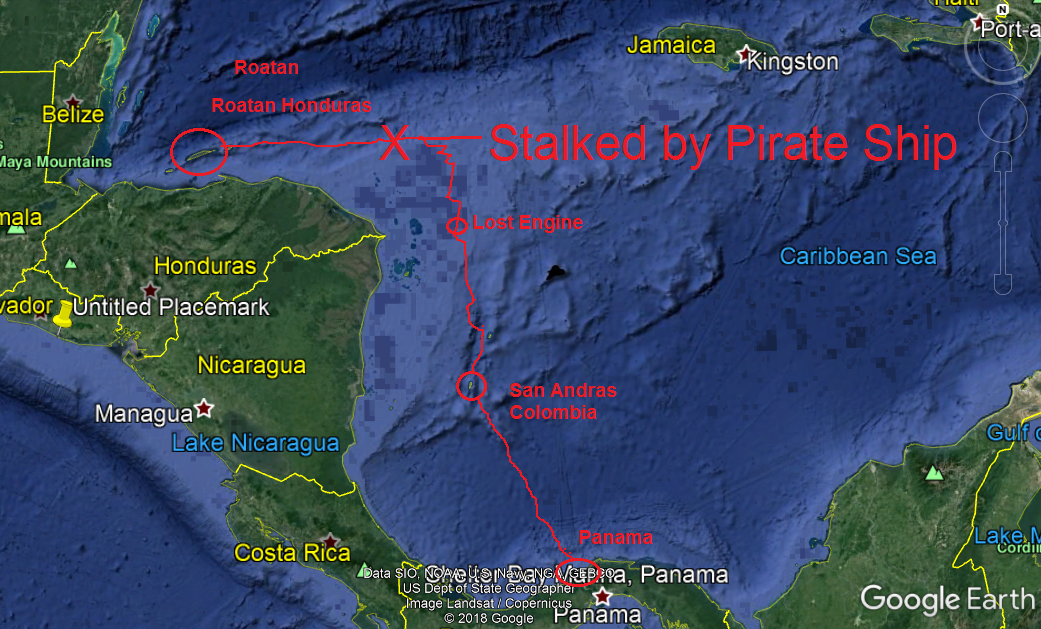
Other than turning around and retreating back to San Andras, we had no other option than to carry on. Jackie and I had a discussion as to our best course of action, we decided to carry on. Our timing was such that we would spend two full days and three nights in Pirate waters and I was thankful that the mostly moonless nights that would help conceal us.
Our first day off the bank was uneventful, that is if you don’t count the thunder squalls that seemed to be hounding us. Whenever we sited a fishing vessel we tack back to the east to beat our way around the vessel before resuming our course while praying that we had not been spotted.
We sited a total of 13 fishing vessels in the first two days and if any had seen us they gave us no mind. It would be the longest three days of my life as I seldom left the cockpit, choosing to sleep all curled up in the corner as Jackie took the helm.
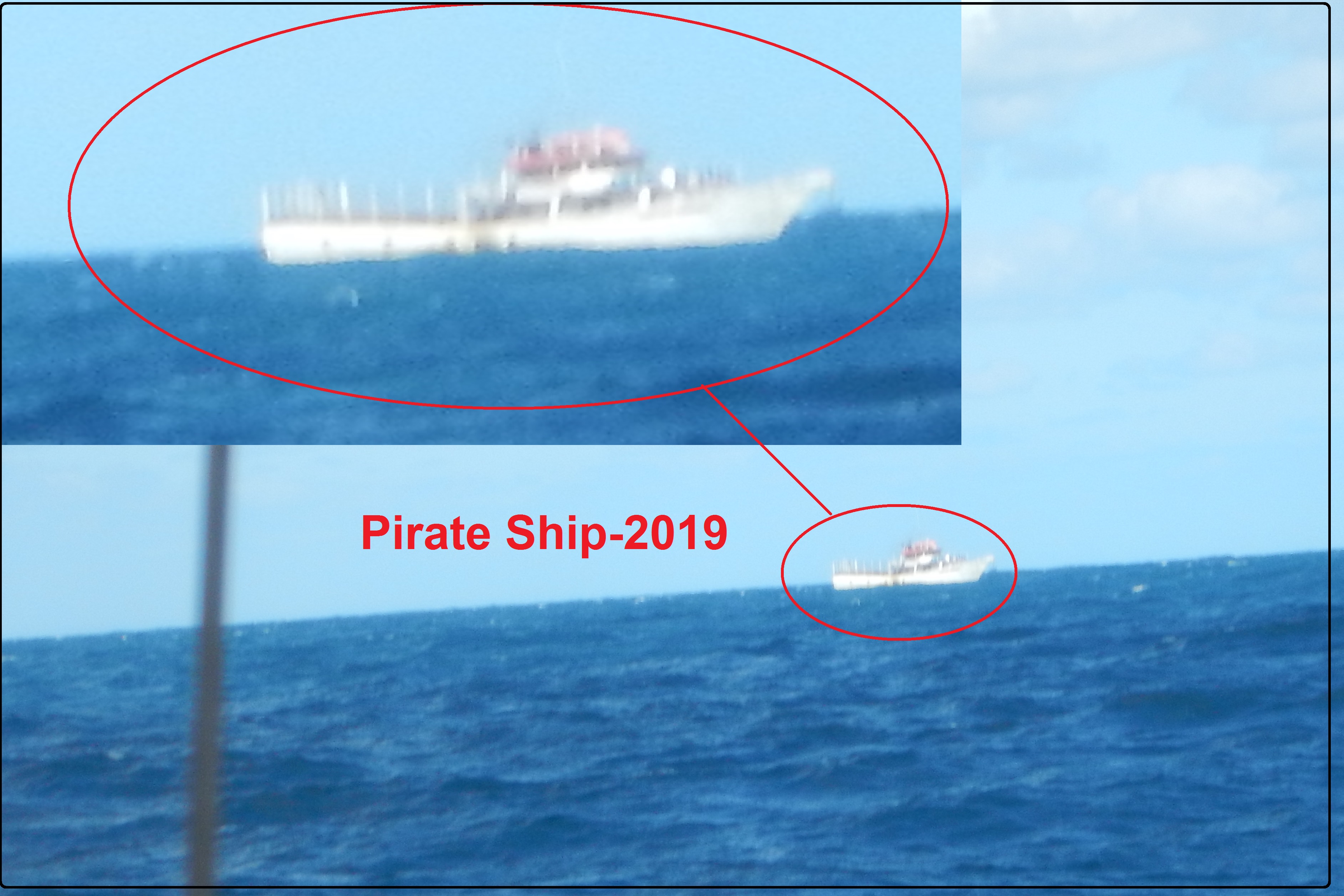
A little after noon on our second full day off the bank. I spotted a large fishing boat that appear some 3 miles off our port bow. It was moving fast as it crossed our bow and I was relieved to see that it appeared to be carrying on to the north. I watched it intently through the binoculars as it passed and just when I thought we were in the clear. The fishing boat made a tight turn, pointing his bow towards us, then it came to a stop.
We were hoping that he was just fishing but after a closer look, I could not see any fishing gear, nets or people on the aft deck. I suddenly felt sick to my stomach. The fishing boat drifted down to us then fell in line astern of us about a mile back. We altered course several times and each time he matched our heading and speed. This went on for almost an hour and I was now sure that he had his sites on us. But he did not approach, so I said to Jackie, “I bet he is waiting for another boat to arrive before he boards us.
I was so convinced that we were a target that I got on the radio and broadcast a “MayDay” with our position and that were about to be boarded by pirates. Surprisingly I received no radio response. ( was later told that the Pirates were probably Jamming my radio call by broadcasting music at the same time) We did hear music several times.
About an hour and half after all this started I spotted a second vessel, again about 3 miles out running flat out and on an intercept course with us.
“Well it looks like his buddy has finally arrived Jackie and I think we are about to get boarded!” It was looking like that, one boat would attack from behind while the other cut us off. There were two, 45 foot to 60 foot steel fishing boats closing in on us.
In preparation for what appeared to be the inevitable, I dropped down below to hide some of my valuables. Monies were split up and my good navigational computer was hidden. If the boat was stripped and they let us be, I would need a means of navigation as we were still 180 miles from anywhere.
That done I went back on deck to find that both boats were closing in and fast. There was little to do other than wait till they came in range then I would have a decision to make.
As I peered forward past the second fishing boat I sited a dark shadow on the horizon. It was another vessel, it was a big container ship. A flood of relief filled me as I snatched up the radio microphone. The officer of the watch answered right away and I quickly told him of our situation while describing the Pirate ships and there relative positions.
Upon siting the ship the two fishing vessels turned back to the south and headed off at full throttle. Within 15 minutes the great ship passed between Maiatla and the pirates. I made a full report to the ship’s officer who then said that he would notify the authorities.
Our relief was short lived because as fast as the ship had arrived, it disappeared over the horizon leaving us again engine-less and alone in Pirate waters. Thankfully the wind was still blowing strong over our stern.
It was a long three hours till sunset, time I spent with eyes glued to the horizon fearing that the pirates would return. I was never so happy to see a sunset as I was on this night. It was another mostly sleepless night in the cockpit for Jackie and I but when dawn broke, a land mass became visible directly ahead. It was Isla Gunaja, the eastern most island of the “Bay of Islands” Honduras.
During the night we departed the Pirate waters. But we had a new problem, the wind was failing and we stilled needed to maneuver through the reefs of Roatan and into French Cay where we had a dock waiting for us. We would spend another night at sea, sailing/drifting at half a knot on a glass smooth sea. By 2 pm on our 6th day at sea we found ourselves being towed the last two miles into the harbour where we took a dock at the Fantasy Island Beach Resort and out came the rum!
Over the many years of which we have sailed about, I have often been asked, (often jokingly) “Have you ever seen any Pirates?” up until now it has always been an emphatic, No! Guess I can’t say that anymore.
In the next couple weeks I will be posting more details of this entire voyage with pics on my blog for anyone who is interested. Jackie and I are now safe on Roatan making boat repairs and thanks to the rough seas, there are many.
I and would also like to say that despite all the foul weather and have to attempt to our run pirates, my sister Jackie was stoic throughout. I was lucky to have her along on this voyage.
Fair winds all.
Andy and Jackie.
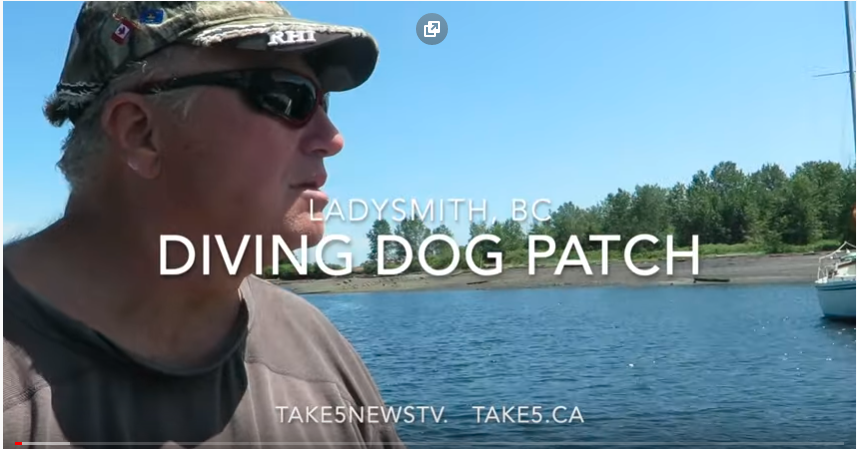
Earlier this year I was approached by the Vancouver Island magazine, TAKE 5 to undertake an underwater survey of the old industrial harbor of Ladysmith BC. Being a diver and wreck hound dating back to the late 1970’s, I could not resist.
The area has long been an industrial harbor exporting coal commencing in the 1890s and then it was the site of a copper smelter firing up in 1902. Since then the harbor has undergone a radical transformation from a heavy industrial port to commercial fishing then to recreational harbor.
Over generations the use of the waterways has changed but what hasn’t changed, until recently, is man’s proclivity to see the oceans and waterways as a garbage dump. It was far too easy to discard whatever was not needed into the salt chuck as it would be instantly devoured. It was a convenient arrangement as the garbage was out sight, to settle into the sands of the ocean floor and in time to be consumed by the dissolving properties of the waters and ultimately flushed out by the tides.
Of recent, Ladysmith Harbor, or as it is locally known as the “Dog Patch,” by either circumstances or by choice has become home to a score of individuals who live aboard barges, sail boats or converted fishing boat. These individuals live a lifestyle foreign to most shore side dirt dwellers, but they live a life no less appropriate as there is a long history of communal floating along the B.C. coast
My diving expedition was to determine how man’s activity over the previous 150 years has impacted the marine environment and what, if anything should be done about it.
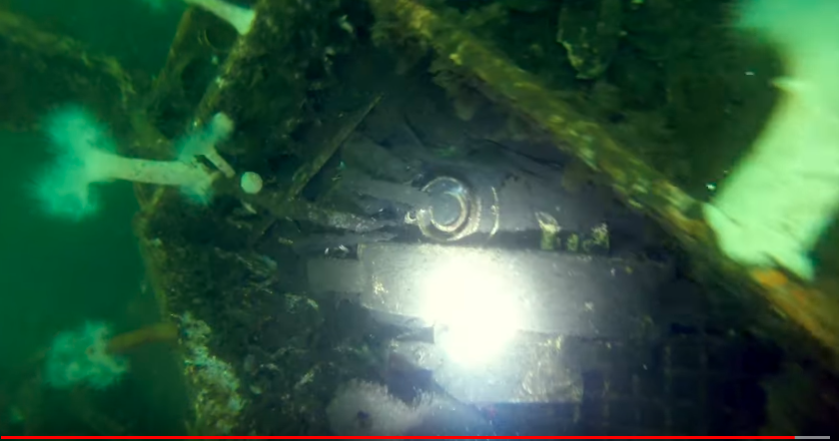
Take 5 produced a video of my expedition to uncover what lay below the surface of Ladysmith’s waters and I encourage my followers to watch. But to surmise what I found is best described as a paradox as it is life and death intertwined. The video link is at the bottom of this post.
There is no doubt that in the early years, man’s industrial activities in the bay left behind a legacy of a toxic seafloor, a substrate consisting of coal dust and noxious copper mining tailings, all disguised, cloaked in sediment from shore side development. The harbor bottom is a moonscape, a dead zone incapable of sustaining life.
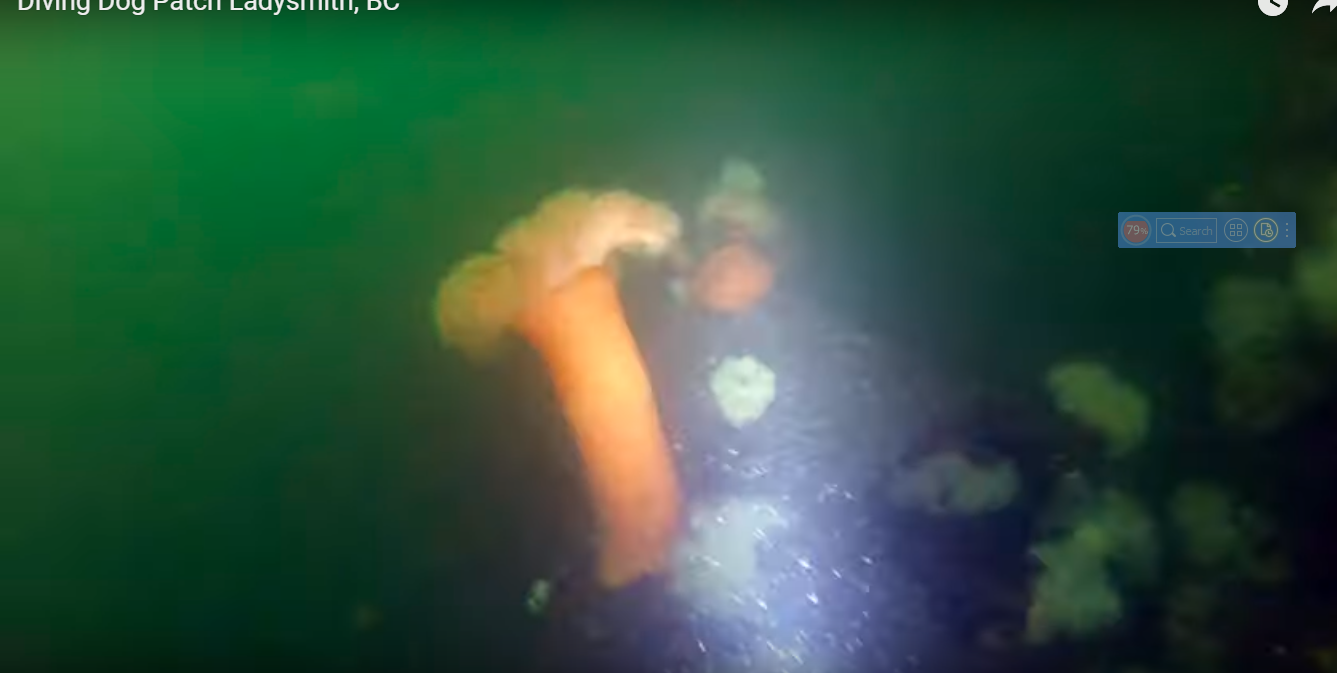
Then came alone the commercial fishing era which, was more ecologically friendly but still brought its own blight upon the waterways. In the early year’s fish entrails, motor oil, worn out netting, gear and sewage was regularly discharged into the harbor, typically alongside the boat while at dock. Often boats sank along the docks either due to storms or neglect, all of which, excluding oil and sewage, I observed in my dives.
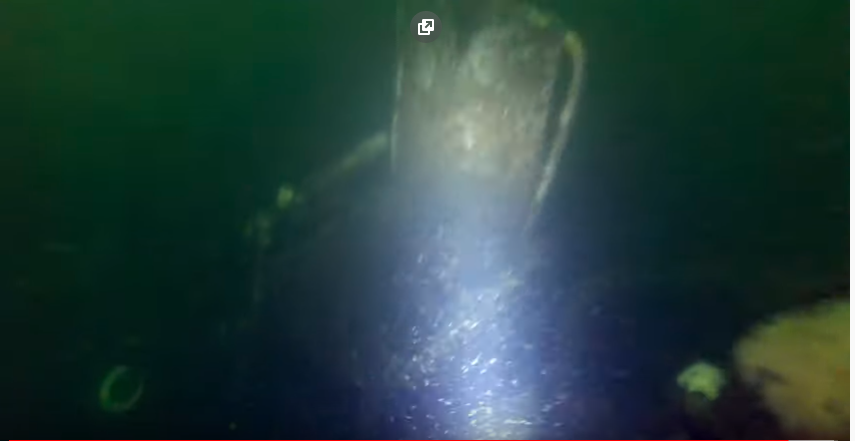
Still of all the human activity the harbor has endured over the last century, the least impact has come from the contemporary users and current live-a-boards, the houseboat people who now reside within the “Dog Patch.”
During my dives I was surprised to find little in the way of domestic garbage, trash which appeared to be intentionally thrown overboard. As to the sewage issue and whether it was more than the environment could absorb, I cannot say.
As a commercial diver I had a direct hand in the construction of the sewer outfalls for both the city of Victoria on Vancouver island and that of the Ganges Harbor pipeline on Saltspring Island. Sadly two of countless lines responsible for discharging tens of millions of liters per minute of semi-treated sewage into the sea along the BC coast. The degree of pollution contributed to local Dog Patch by residents would be debatable.
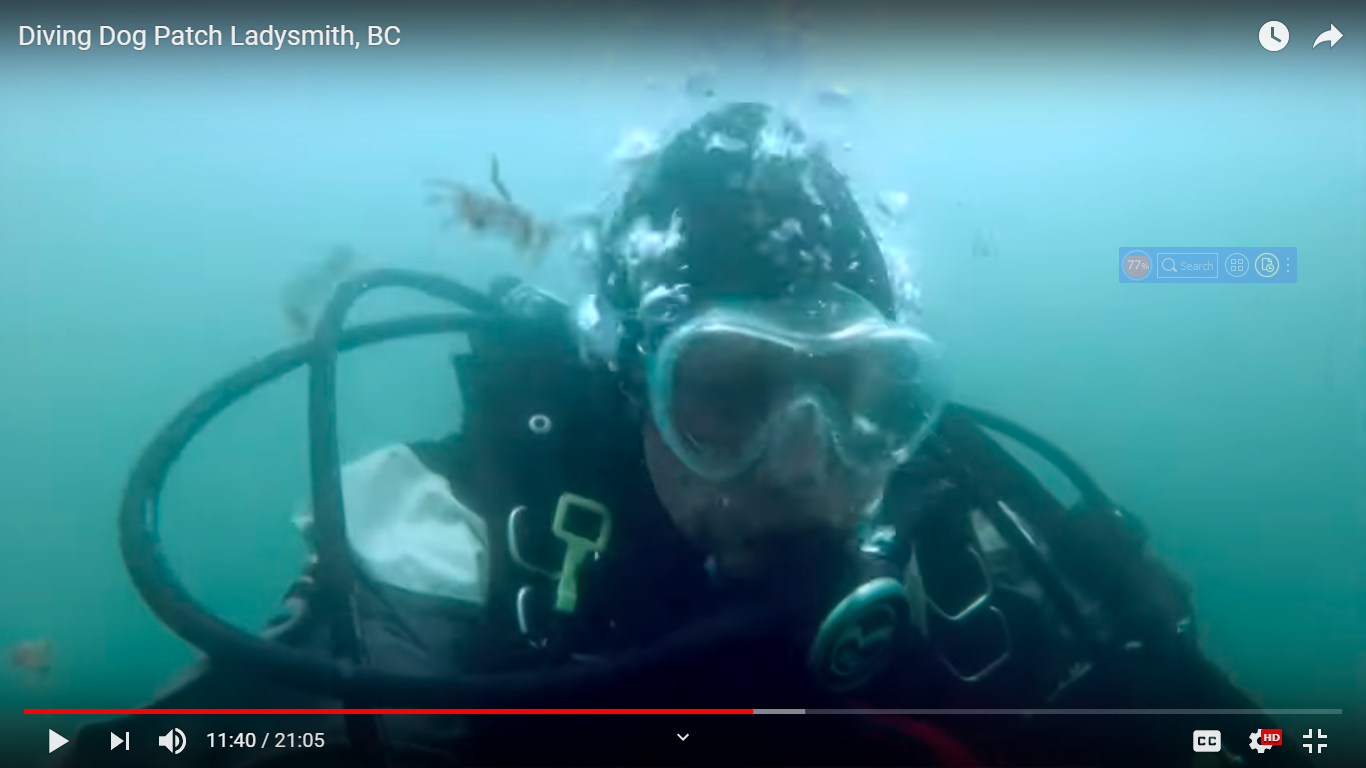
What remains below the waters at the Dog Patch is concoction of shipwrecks and industrial debris all of which has provided a perch upon which marine life has since flourished.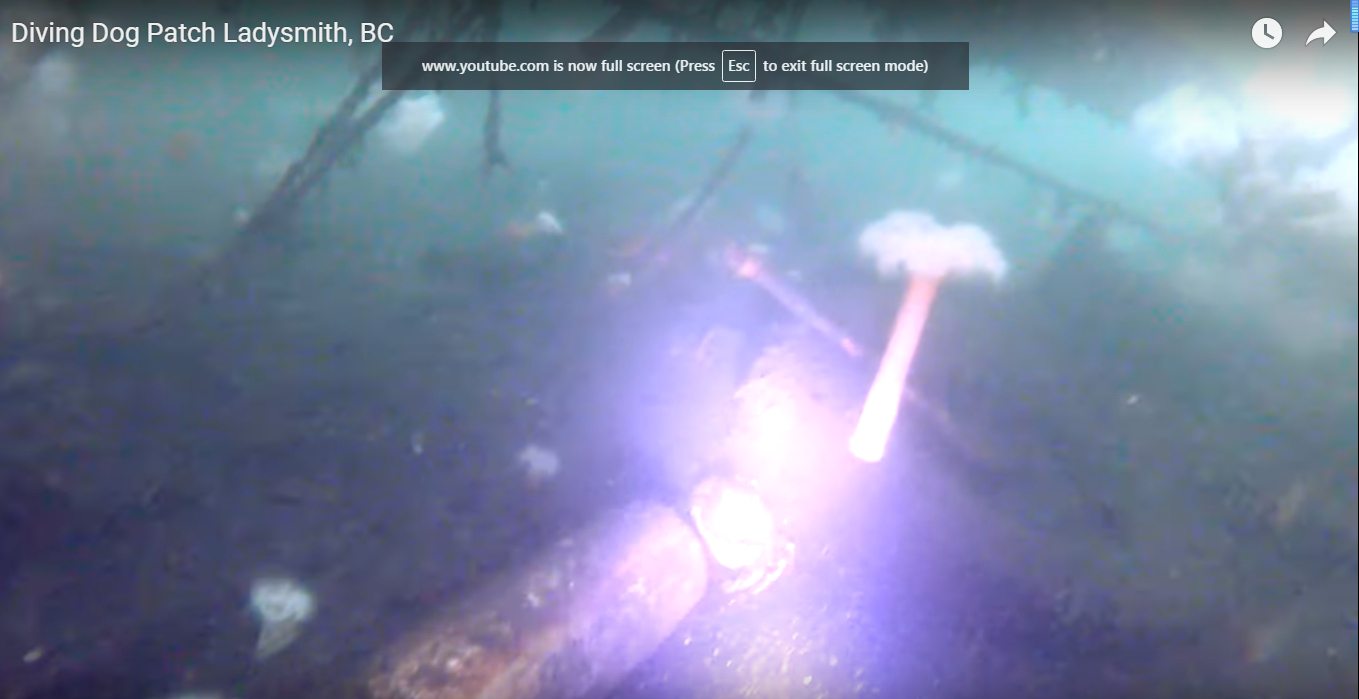
Upon the otherwise desolate bottom of the “Dog Patch” there is an odd assortment of human jetsam, on which mother ocean has grasped the opportunity to create an oasis of life, a garden surrounded by a desolate, inhospitable landscape/ Seascape? The effluence of the industrialized twentieth century killed all life within the bay, but after the demise of the localized industrialized industry, life has regained a foot hold, fighting to flourish upon the industries very bones. And its winning!
Larry and I prepared to depart for the San Blas Island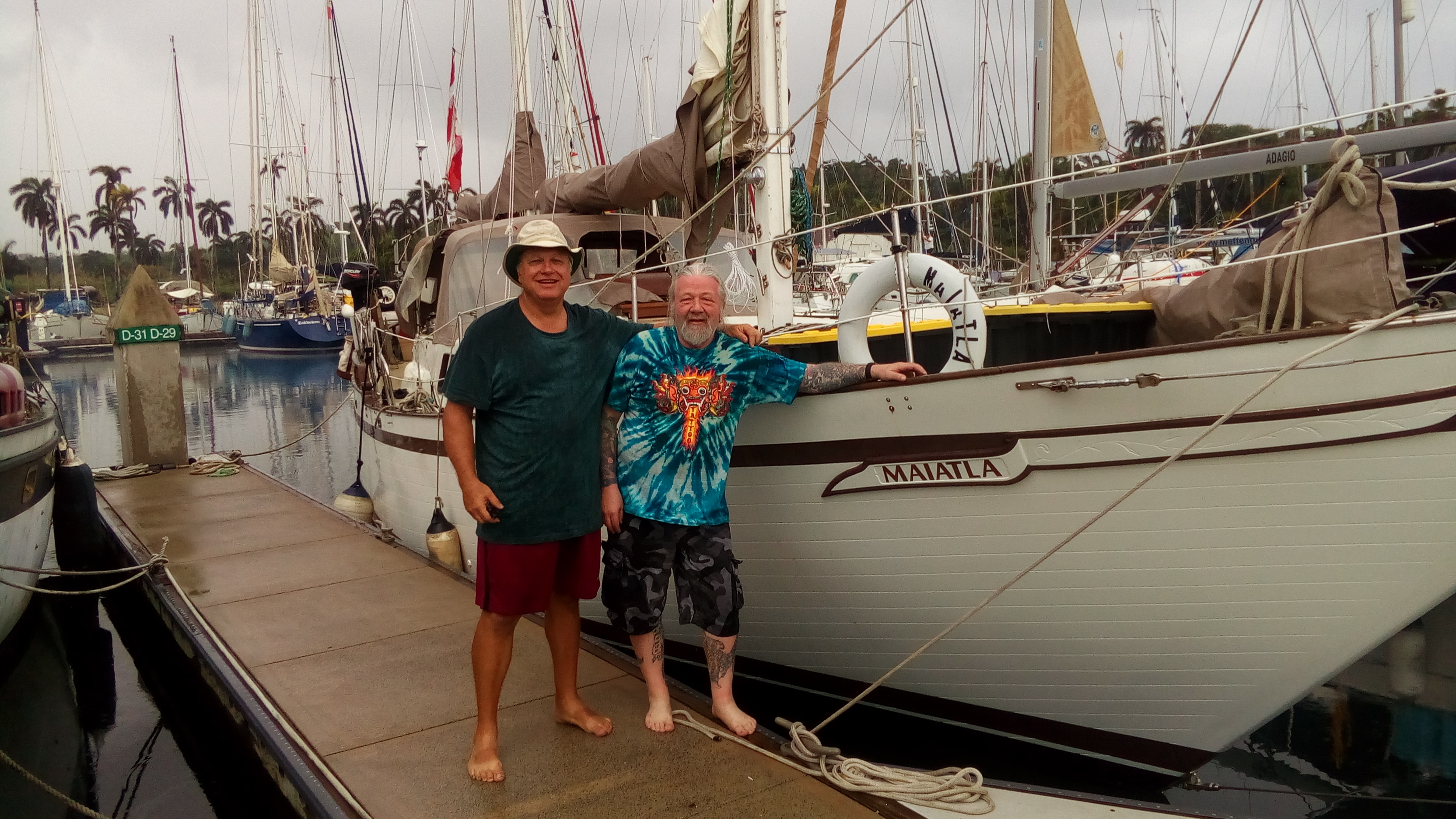
Well it hasn’t been a great sailing and cruising year for Maiatla. Our beloved boat is still in Fort Sherman marina in Panama where we have been since early 2016 where we bedded her down after completing our Mexico to the Galapagos Islands and Panama cruise. That was a great and eventful voyage which is now the subject of our newly released book, Slow Boat to Panama: Mexico to the Galapagos and then Panama, which became available on Amazon in November of 2018.
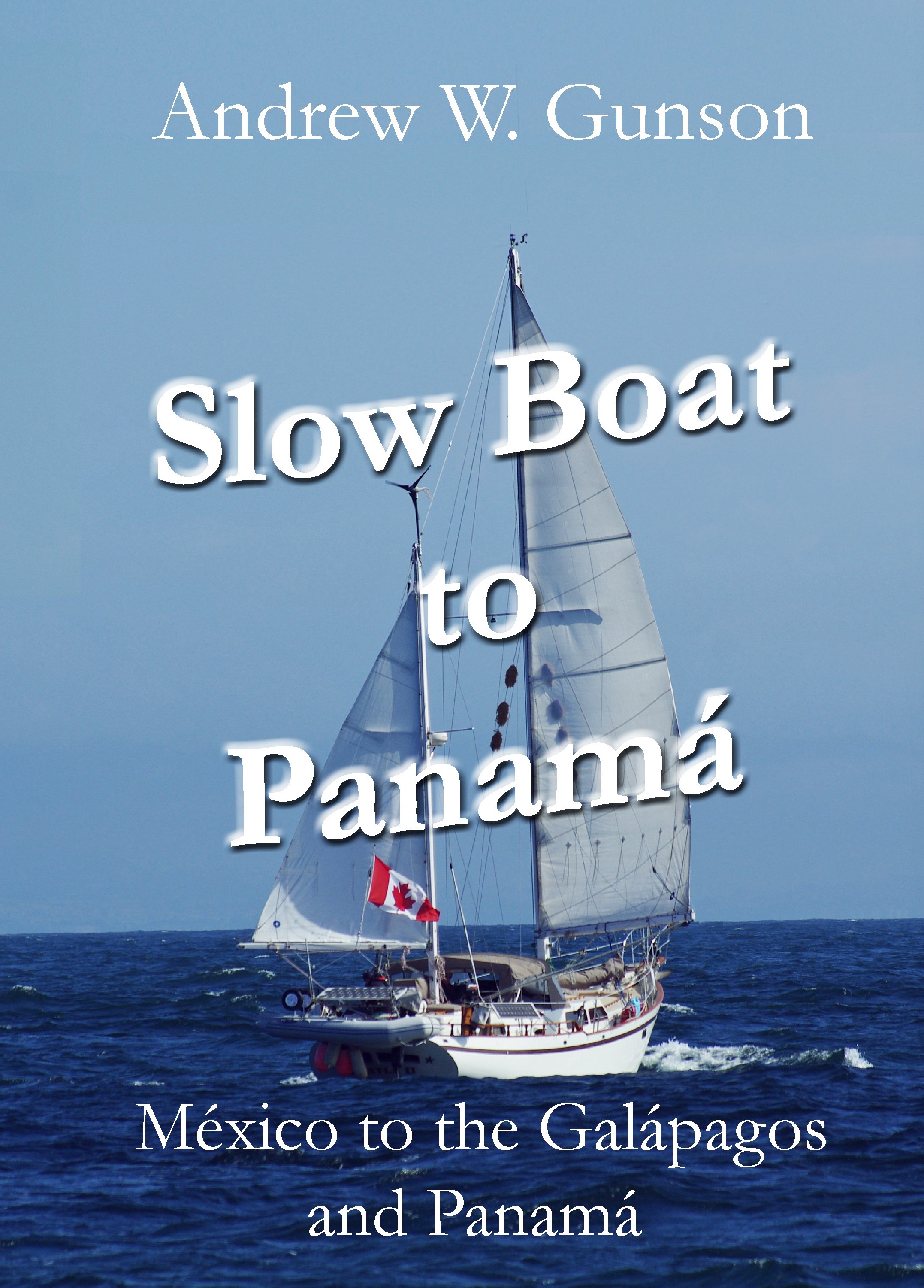
Due to work commitments and some family health issues our time aboard has been limited to 9 weeks over the previous 12 months to perform some much needed maintenance while sneaking in a couple getaways to the remote San Blas Islands.
The past 6 years driving the boat hard in the humid tropics has taken its toll, expanding my list of repairs and refurbishing. Some of our main issues include but are not limited to the following.
Leaking Engine raw water pump.
Leaking Hydraulic steering pump.
Bearings failing in the head sail roller reefing.
VHF radio not transmitting.
Leaking port holes in aft cabin with broken dogs (latches on 4 ports) which require re-welding.
Electrical short in navigation lights.
Cockpit dodger needs replacing.
Electric flush toilet, pump seized.
Holding tank masticator pump seized.
All the sails are in need of some re-stitching and repairs- Some chaffing.
Bottom needs anti-fouling paint with new sacrificial zincs on rudder and drive shaft.
The wind Generator stopped working on this voyage and will either need rebuilding or replacing.
And if all of the above was not enough, there is some dry rot at the top and bottom of both main and mizzen mast which will require cutting out and rebuilding of these sections of Maiatla’s Spruce spars.
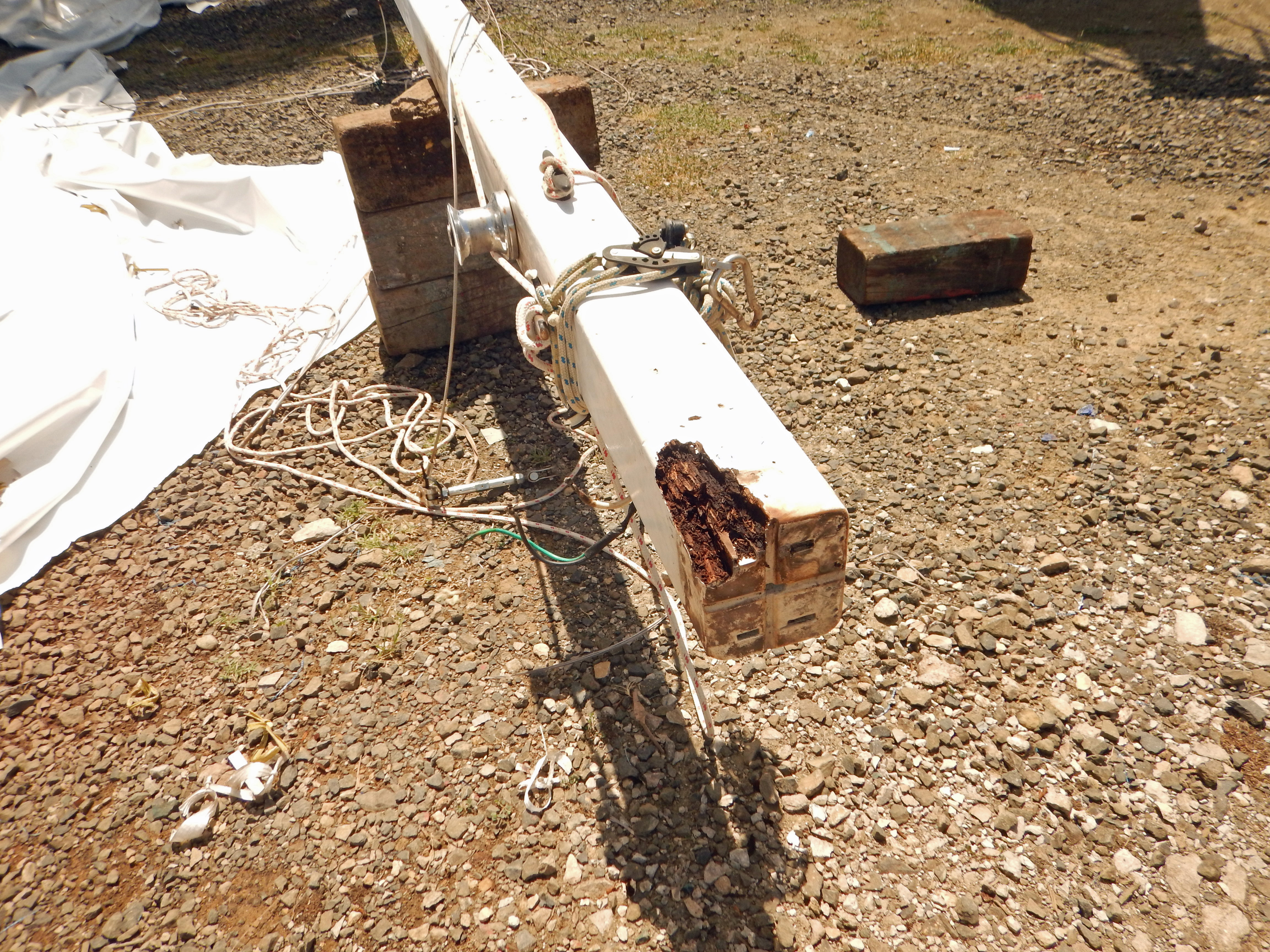 Rot in the bottom of the mizzen mast.


Also while inspecting the rig, I discovered cracks in the masthead tangs which the shrouds attach too. The tangs will required re-welding if I don’t want the mast to fall down. The above list is not comprehensive, but just some of my major projects. Welcome to long term cruising and performing boat repairs in foreign ports.


My first visit to the boat was in the early part of 2018 and I was fortunate enough to have a friend, Rick Veters accompany me to help tackle the repairs which included the removal and repair of the mizzen mast as well as the painting of the bottom of the boat. Fortunately when we left the boat in early 2016 I had the boat hauled out of the water and shrunk wrapped and had a dehumidifier installed to combat the mold. When I saw the boat again after almost two years, she was in surprisingly good condition. After a good scrub with soap and water, inside and out she was quickly ready to move aboard. Now livable the real work began.


The last pic is the completed main mast repairs.
Rick and I spent 4 weeks working on the boat then managed to get her to the point we were able to head out to the islands for a little exploring, rum drinking and R&R. The repairs went well and we had a great time doing it.
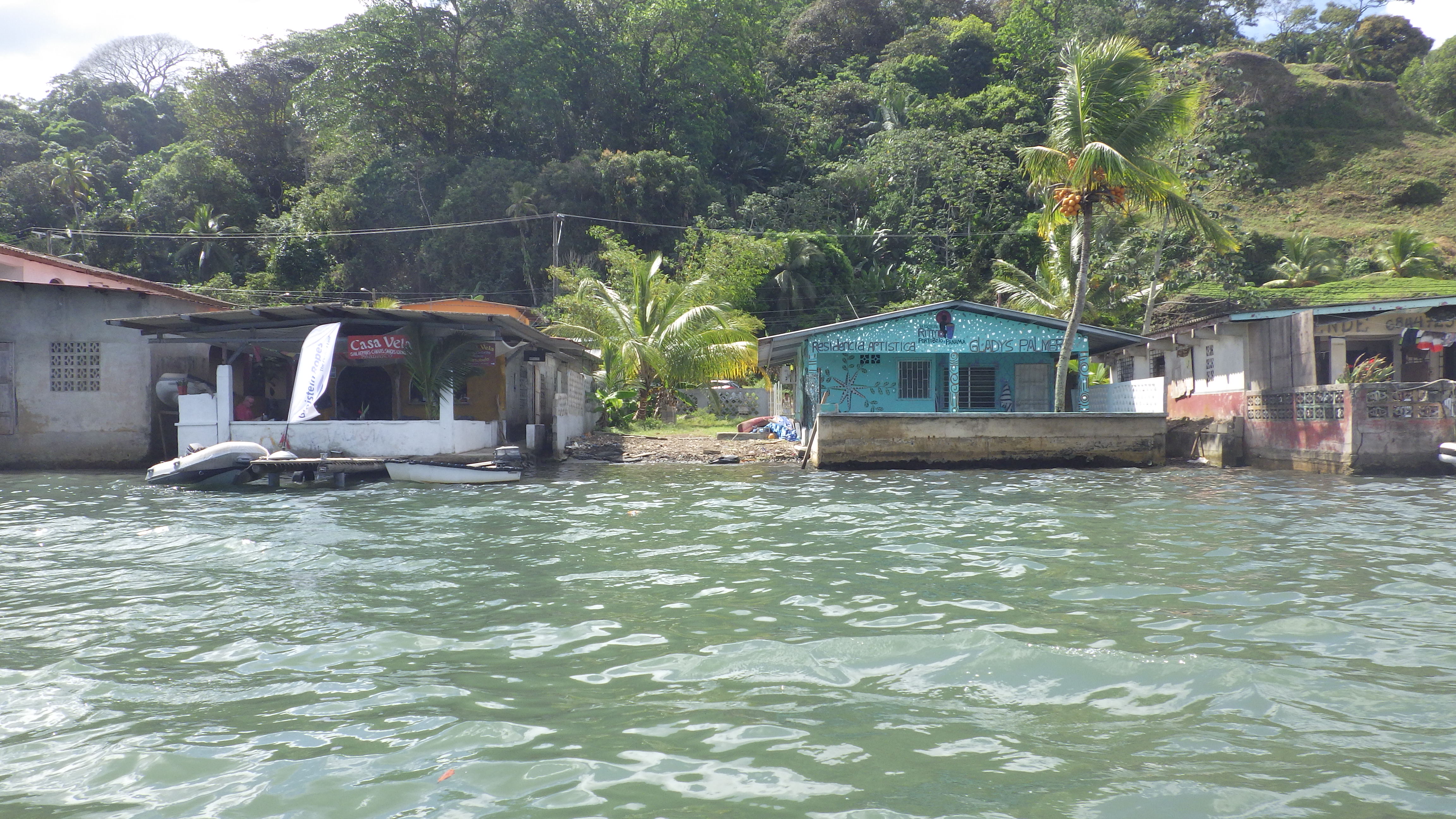
The 500 year old fort at Puerto Bello.


9 months later I again returned to the boat to carry on with the repairs which included this time the repair of the tall main mast. I spent the first 3 weeks alone in Panama working away but later a friend, Larry Berg joined me to lend a hand and to accompany me on another voyage into the magnificent San Blas islands. And again there was lots of rum.
In Puerto Bello we signed a flag and presented to the cruisers bar. Great hang out.


With most of the major project now completed we are planning on departing Panama to sail up north some 900 miles to the Rio Dulce in the country of Guatemala where we will sail up the river into the jungle where there is a marina where we can leave the boat for the up and coming hurricane season. The voyage will take 3 to 4 weeks with planned stops at a pair of offshore islands owned by Columbia. Isla San Andres and Isla de Providencia.
The San Blas Islands, 350 islands spread out over 700 sq/miles of ocean. (* percent of the islands and cays are uninhabited.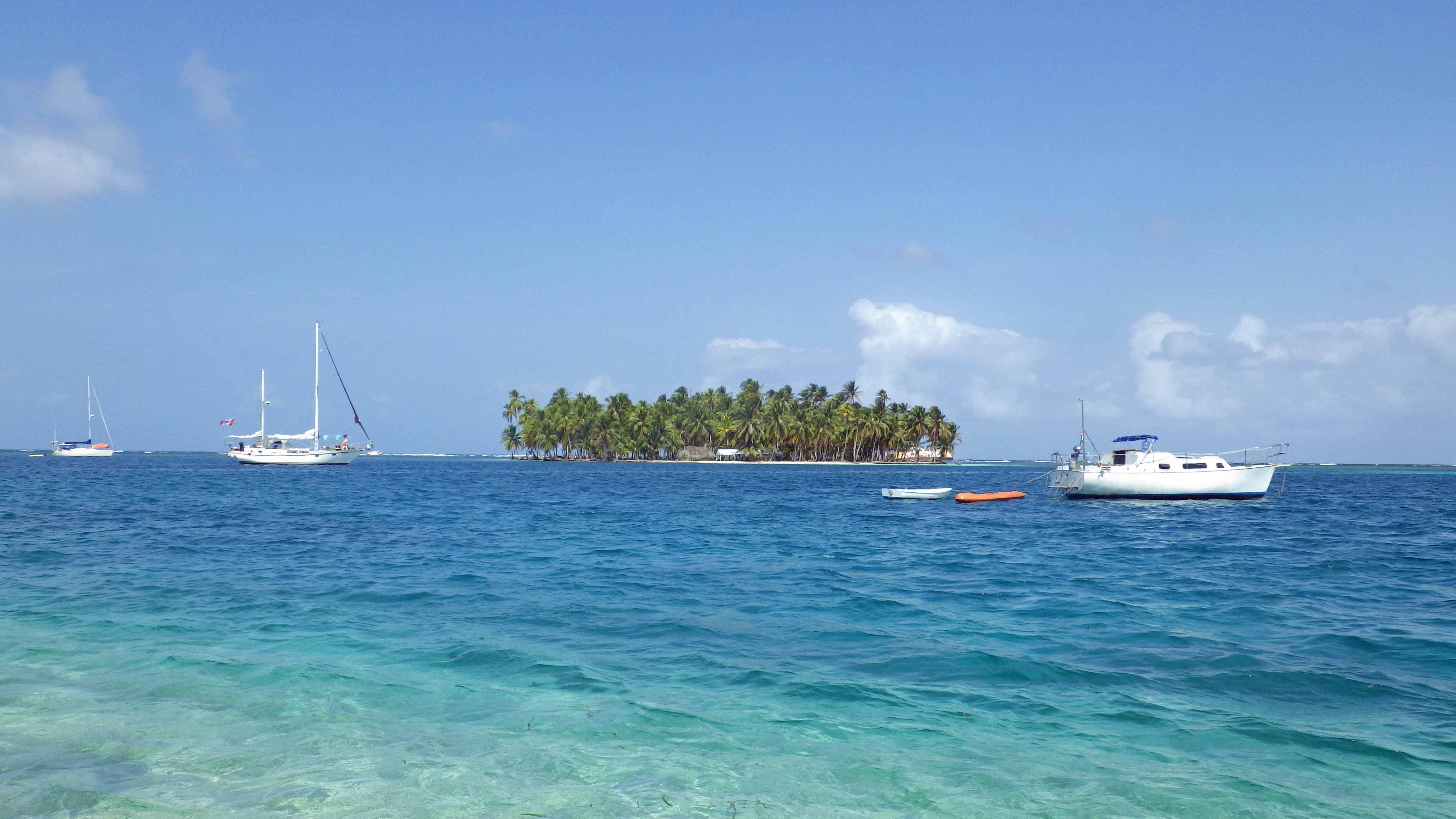


The week before mine and Larry’s intended sail to Puerto Bello and the San Blas Islands, some local cruiser were attacked, just 20 miles up the coast from us. I was of course concerned and like everyone else in our marina, anxious to hear the detail and to see if any arrests would be made. See blow the details of the attack as posted on the cruisers website- NOONSITE.
DATE: 2019-01-13 21:30
Country Name: Panama
Location Detail: Portobello
EVENT: Robbery
HAND: 2
Stolen Items: Currency, personal electronics
SECURED: Unknown
DETAILS OF ARMED ROBBERY:
A private yacht with 3 of 7 crew onboard was approached by 6 men armed with handguns, using the pretence of selling water at 2130 HRS. They boarded aggressively and hit one crew member in the head with a gun and then spent considerable time ransacking the boat, terrorizing the crew that was made to lay on the floor all the while the armed boarders repeatedly yelled “cocaine, cocaine”. Cash, phones, computers and electronics were taken. Jewelry was left behind, no drugs were (found) onboard.
Coincidentally, the yachts tender, with the 4 remaining crew returned to the boat, which hastened the thieves’ departure without making further direct contact. A full police report was made, to local police and Aeronaval.
CSSN NOTE: Attempts to board other yachts in the anchorage were made this same night most likely by this same group of armed thieves. One later boarding (the same night) was only deterred when the owner’s large dog made its presence known on deck (see details below).
DETAILS OF ATTEMPTED BOARDING:
A panga with 4+ men attempted to board a cruising yacht anchored in the bay at around 2300 HRS (the same night – January 13th). Surprised, the owner came on deck and responded aggressively verbally, and was only able to dissuade the hostile boarders when his large, 60 lb. dog came on deck. Holstered pistols were visible to the captain.
After departing the panga lit up and then attempted to engage with another nearby yacht. The owner spoke Spanish and after much angry yelling the panga departed. Earlier this same night a cruising yacht was boarded by armed men, and the occupants’ pistol whipped and robbed at gun point.
While at the marina, one night I shared a few rums with the crew of a 130’ schooner that had just made the run from Mexico to Panama and they told me of their encounter with Pirates off of Nicaragua. As it was told to me, they said when they were about 20 miles off shore, sailing fast the two men on watch spotted on radar a small boat some miles ahead that was crossing their path but instead of carrying on the boat came to a stop directly in front of them and appeared to be waiting. No lights were visible ahead so the crew sounded the alarm and quickly all 8 crew members were on deck. Two armed with shotguns.
The 130 Schooner that was stalked by Pirates.


The captain ordered that all the deck lights be turned on so they could see if anyone attempted to board. They said it was a tense few moments when a 30 foot boat, all paint black materialized out of the night. The boat was dead in the water but inside they could see six men, all dressed in black wearing balaclava masks. The pirate boat, perhaps seeing the crew of the schooner ready to repel boarders with force, watched as the schooner sailed on. It was obvious that this black boat and its crew were not fishermen and apparently up to no good. The mate of the schooner later said to me, “we could have done a lot of people a big favor if we had just opened up on them with the shotguns!”
Pirates have been raiding the Caribbean for centuries and they are still here.
Despite the apparent danger of further attacks, Larry and I decided to go ahead with our plans to visit Puerto Bello and then on to the islands for a couple of weeks of snorkeling on the magnificent reefs and explore the islands that are home to the friendly Kuna Indians. As time would prove, we would evade all pirate attacks and have a wonderful time of it before returning to Canada.
I would arrive back in Vancouver, greeted by a snow storm that immobilized the city forcing me to hold up in a B&B just 30 miles from home to wait it out. Larry’s trip home was better than mine. He was not greeted by a snow storm in Edmonton Alberta, just a -41C chill. I will take the heat of the tropics over the cold of the north any day.
Well that’s about it for now. I will keep you all posted of our preparations to head north.
Thanks for following.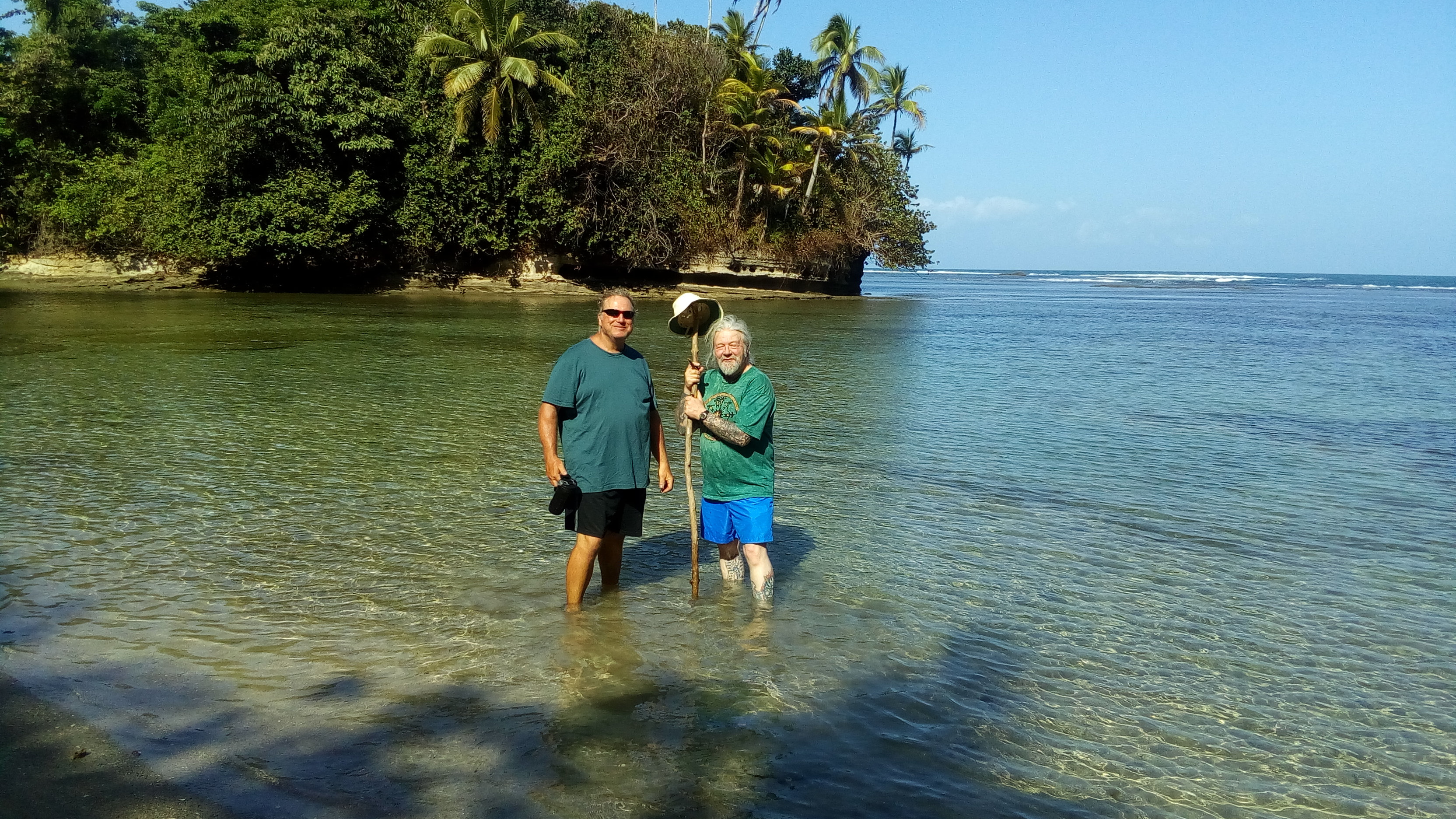
Vancouver Island Magazine, Take 5 and its owner and managing editor, Marian Sacht has been supportive of our voyages since 2012. However the magazines support has not been limited to publishing my writing endeavors about our travels. Marina has been an eager an active crew member on four of our voyages as we ventured down the coast from Vancouver Canada to the very heart of Central America.
Janet and I were fortunate enough to have Marina aboard Maiatla on our latest adventure to the Galapagos Islands of Ecuador. Aside from publishing a few articles that I had written of our travels, Marina produced and published on YOUTUBE a 12 part mini video series chronicling our voyage to the Galapagos. Click on the link at the top of this page and see the videos and visit Take 5 at https://take5.ca/take5-magazine/
I wish to thank Marina for her support and friendship over the years.
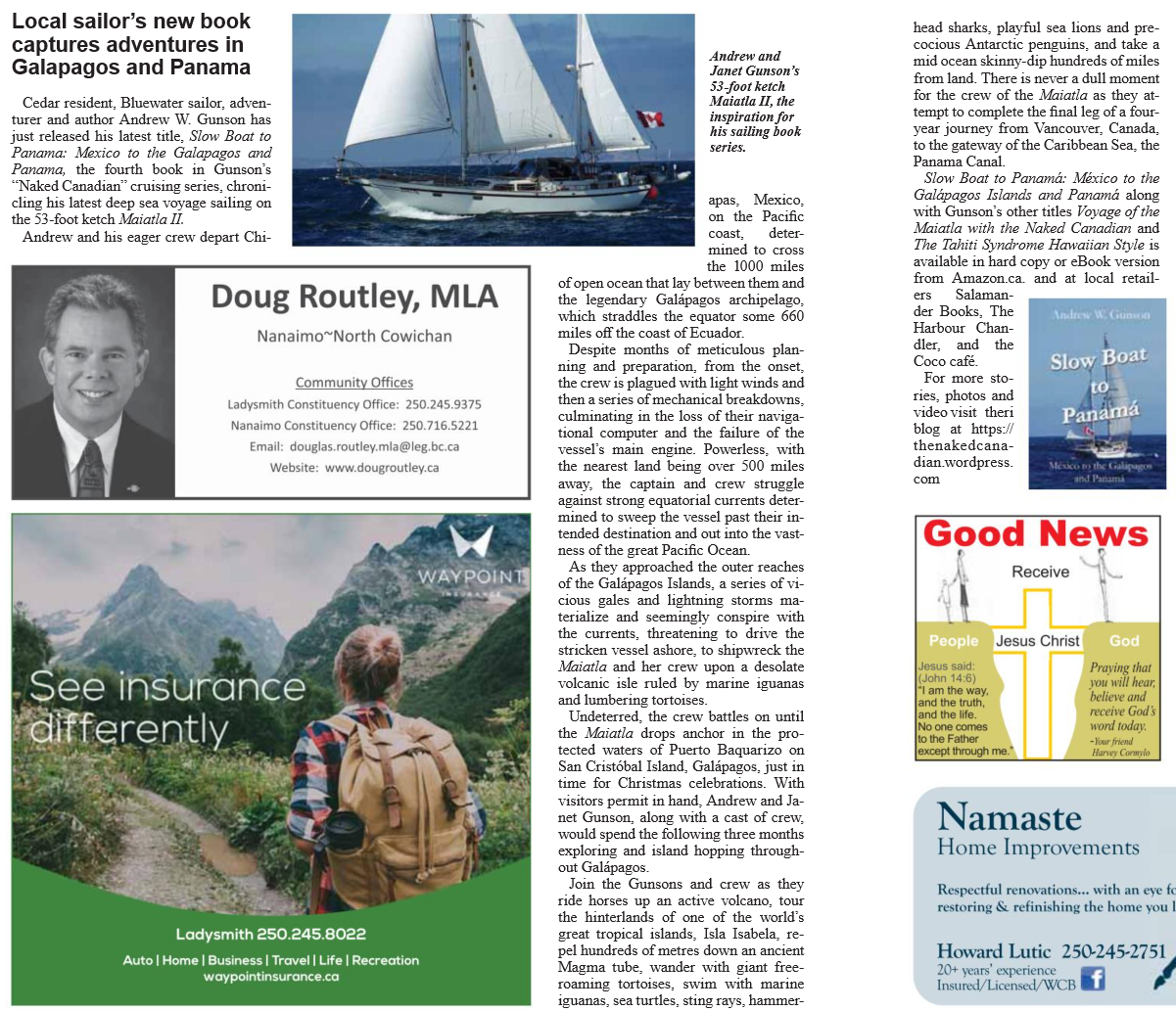
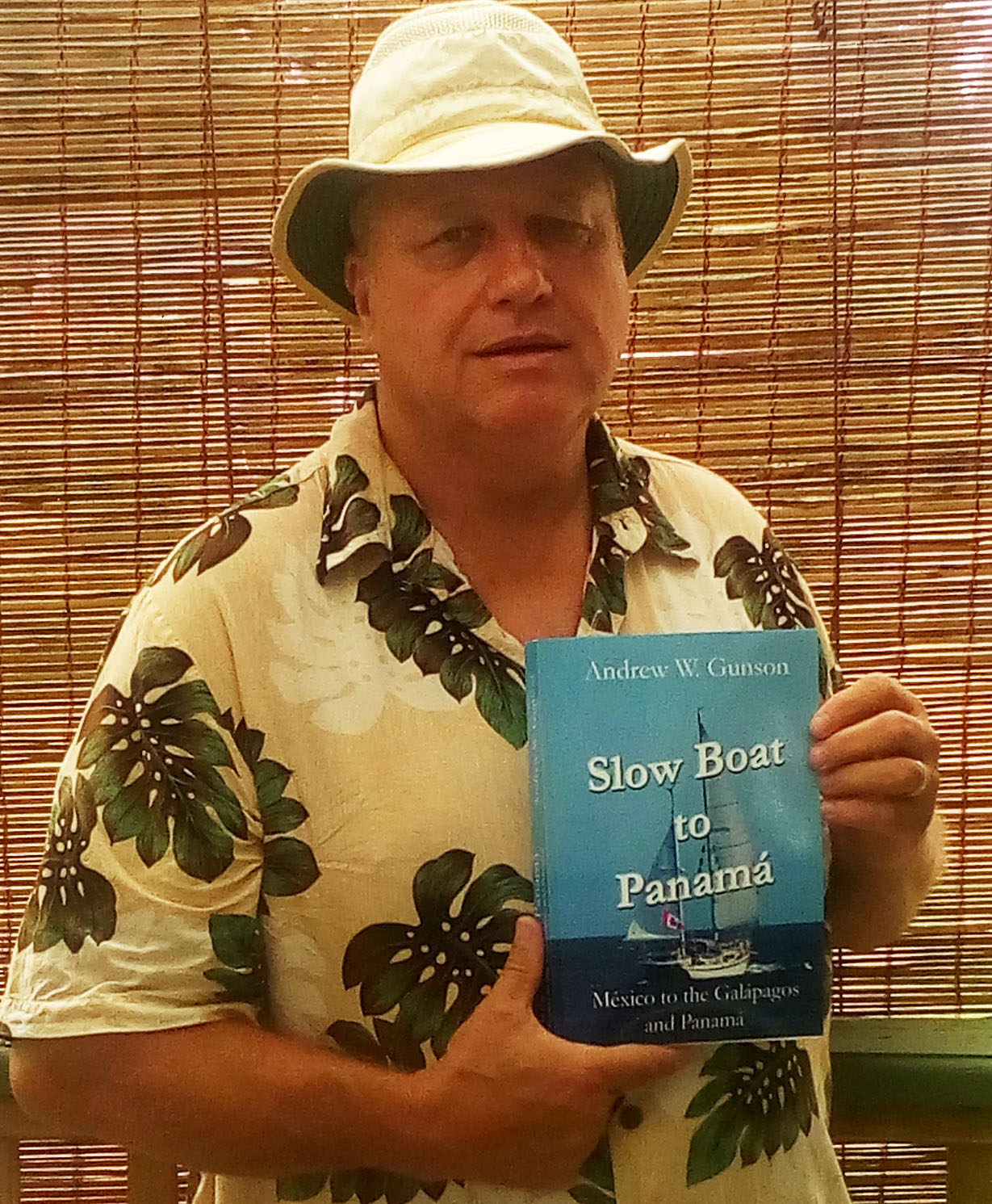
Vancouver Island, Canada, resident bluewater sailor, adventurer and authorAndrew W. Gunson has just released his latest title,
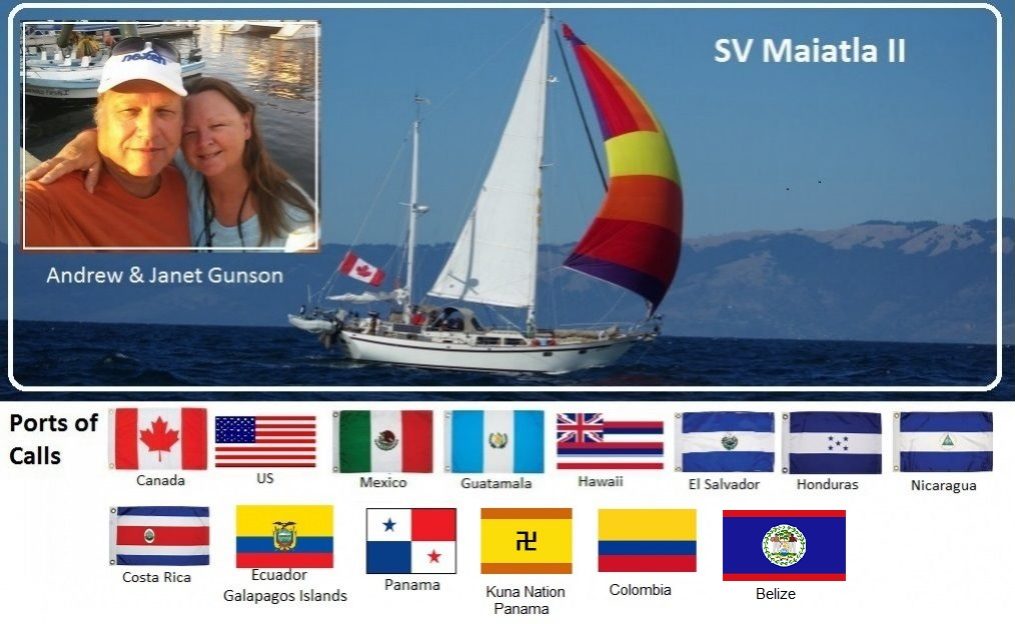
SLOW BOAT TO PANAMA: Mexico to the Galapagos and Panama. The fourth book in Gunson’s “Naked Canadian cruising series” chronicling his latest deep sea voyage sailing on a 53 foot ketch, Maiatla II, to the enchanted Isles of Ecuador’s Galapagos Islands.
Andrew and his eager crew depart Chiapas, Mexico on the Pacific coast, determined to cross the 1000 miles of trackless open ocean that lay between them and their intended destination, the legendary Galápagos archipelago that straddles the equator some 660 miles off the coast of Ecuador.
Despite months of meticulous planning and preparation, from the onset, the crew is plagued with light winds then mechanical breakdowns which would culminate with the loss of their navigational computer followed by the failure of the vessels main engine. Powerless with the nearest land being over 500 miles away, the captain and crew struggle against strong equatorial currents that seemed determined to sweep the vessel past their intended destination and out into the vastness of the great Pacific Ocean.
Then as they approached the outer reaches of the Galápagos Islands, a series of vicious gales and lightning storms materialize with the south-east winds which seem to conspire with the currents, threatening to drive the stricken vessel ashore, to shipwreck the Maiatla and her crew upon a desolate volcanic isle ruled by marine iguanas and lumbering tortoises.
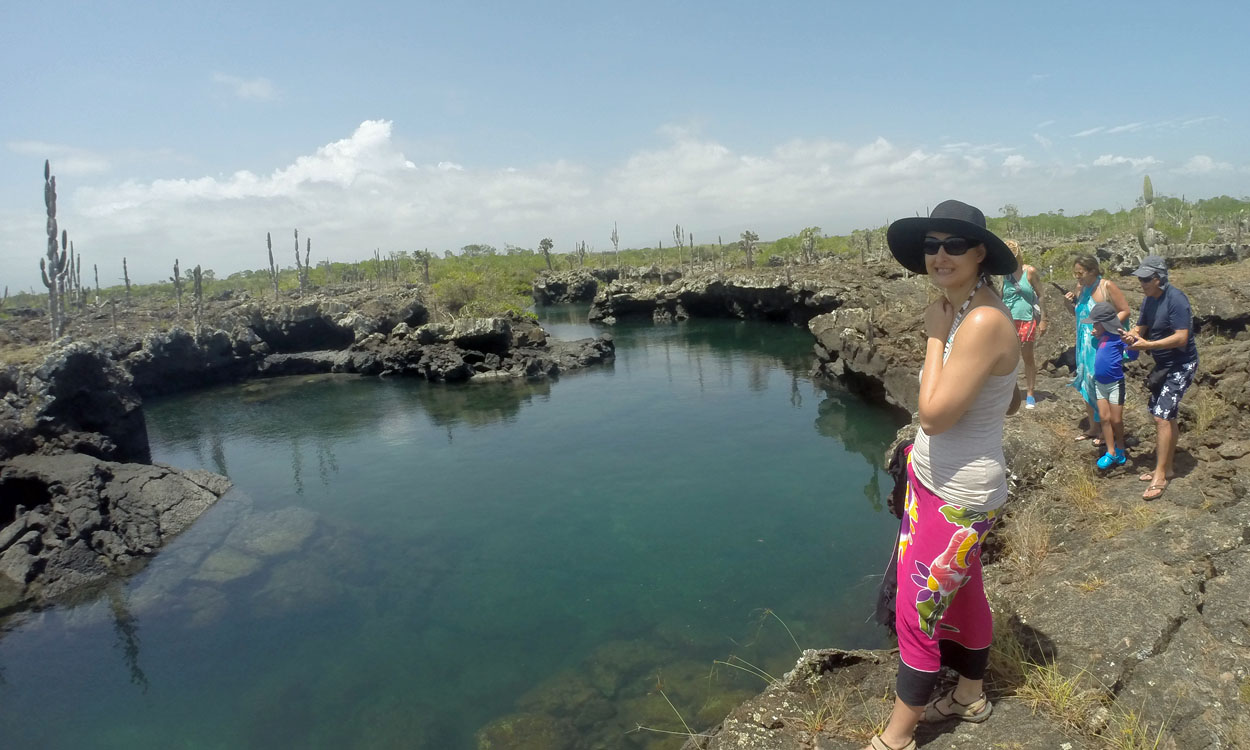
Undeterred, the crew battles on until a full 11 days after departing Mexico, the Maiatla drops anchor in the protected waters of Puerto Baquarizo on San Cristóbal Island, Galapagos, just in time for Christmas celebrations but there is little time for sightseeing as the vessel required repairs. With visitors permit in hand, Andrew and Janet Gunson along with a cast of crew, would spend the following three months exploring and island hopping throughout Galápagos.
Join the Gunsons and crew as they ride horses up an active volcano and tour the hinterlands of one of the world’s great tropical islands, Isla Isabela. Or harness up and strap yourself in as they repel hundreds of meters down and ancient magma tube. Wander with giant free roaming tortoises. Swim with black marine iguanas, green sea turtles, sting rays, hammerhead sharks, playful sea lions and precocious Antarctic penguins.
Take a mid ocean skinny-dip hundreds of miles from land accompanied by hundreds of friendly bottle nose dolphins and a pod of pilot whales. There is never a dull moment for the crew of the Maiatla as they attempt to complete the final leg of a four year journey from Vancouver Canada to the gateway of the Caribbean Sea, the Panama Canal.
Andrew and Janet Gunson have been married for over thirty years and have been liveaboard sailors and cruisers for almost as long. Their home of choice is a 53 foot center cockpit sailboat named Maiatla where for 10 years they lived and raised two children in various locations along the British Columbia coast while ranging as far south as Mexico and west to the Hawaiian islands, adventures that would later come to print in the Voyage of the Maiatla with the Naked Canadian and The Tahiti Syndrome Hawaiian Style.
Their most recent voyage commenced in October of 2012, which saw them departing Ladysmith harbour, Canada, bound southward along the Washington, Oregon and California coasts. Over the subsequent three years, they ventured further south on a quest, visiting México, Guatemala, El Salvador, Nicaragua and then Costa Rica. After a disastrous run-in with corrupt customs officials, and with his arm in a sling and a damaged boat, they fled Costa Rica during a gale to run 805 kilometres (500 miles) north up the coast, reaching the safety of Chiapas, México.
Slow Boat to Panamá: México to the Galápagos Islands and Panamá, is the tale of the continuation of this voyage, their fourth season exploring Central America—a journey which would prove to be their most thrilling voyage to date. 7”x10” paperback. 426 pages and 117 pictures and maps.
Slow Boat to Panamá: México to the Galápagos Islands and Panamá, along with Gunson’s other titles are available in hard copy or eBook version from Amazon.ca. or at your local retailers of nautical books.
Order direct from the Author and save! @ gunsonaj@hotmail.com
For more stories and pictures go on line and visit; https://thenakedcanadian.wordpress.com
 The Naked Canadian