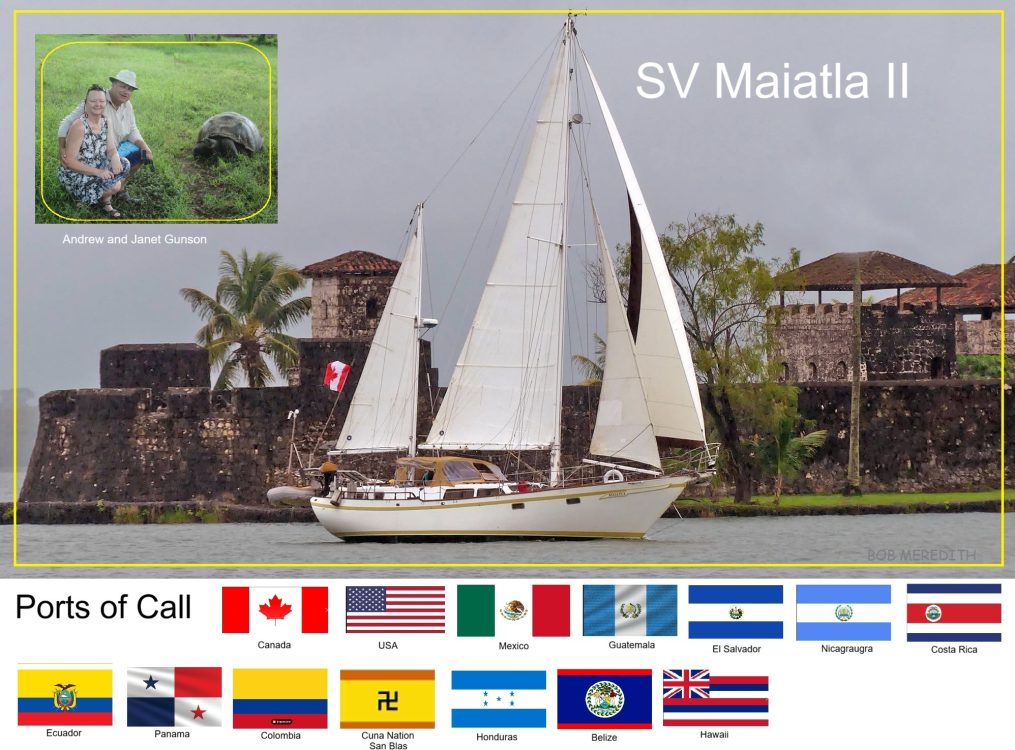
July 1st. My 200 mile solo voyage from Utila Honduras to the Rio Dulce in Guatemala, was mostly uneventful. The winds were good with a long-term positive outlook so I decide to take a detour through Belize and stop for a few hours to see some old friends in Plascencia. Chris and Shannon, a retired Newfie couple who live on Plascencia Caye. Their story is worth telling but that will have to wait for another post. After a quick diner ashore with my friends, I decided to take advantage of the favorable winds and a full moon, to make the final 46 mile run south to Livingston, Guatemala and the mouth of the Rio Dulce River. I departed at midnight, finding 15 knots of wind on a broad reach. Maiatla loved the heading and was clipping along nicely at 6 to 7 knots under her headsail and mizzen “Jib and Jigger” as we call it.
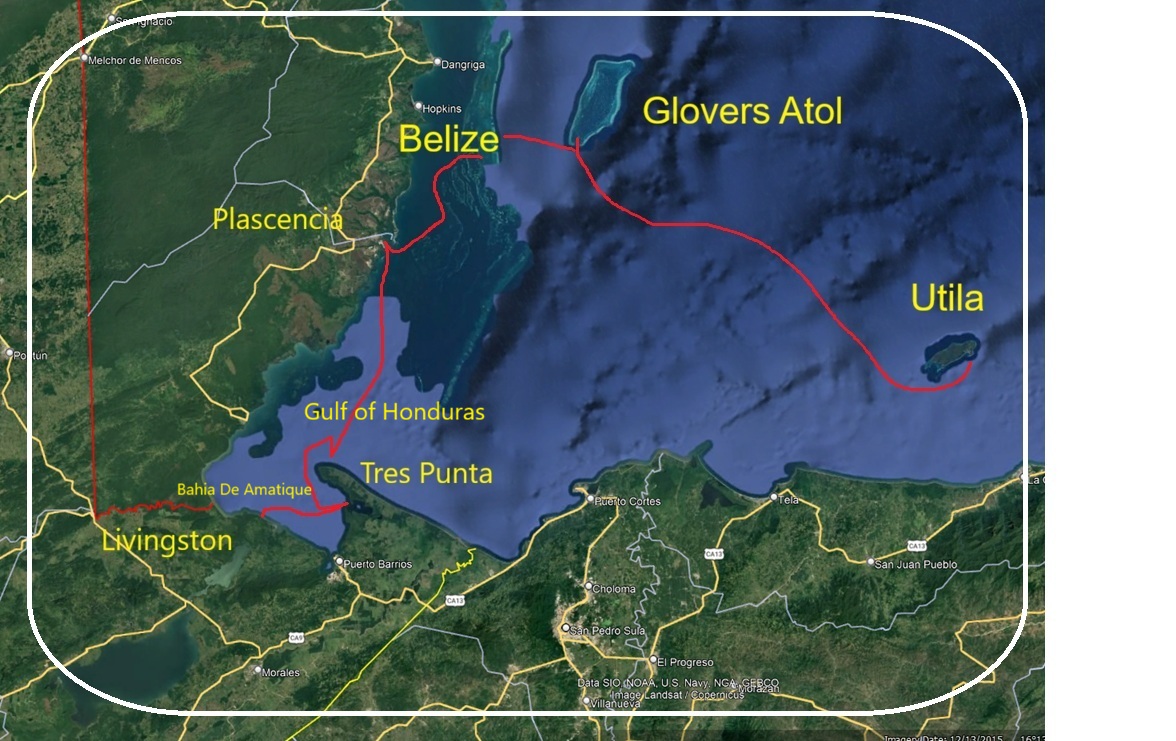
Maiatla’s course from Utila Honduras to Livingston Guatemala
The night was beautiful with a full moon peeking out from behind darting clouds while I, dressed in flannel pajama bottoms and a tee shirt, lay in the cockpit listening music. Around 3 a.m. lights appeared on the horizon, a cruise ship all alight. She passed 4 miles to my portside, heading to where I had departed just a few hours before. Shortly after, I noticed the high atmosphere was growing thick with moisture, creating a haze which is typical for this time of the year. We were a full month into the Caribbean hurricane season so the weather had to be constantly monitored. Lower down, just above the sea, thick black clouds scudded past as they fled in the direction the Guatemalan coast. The clouds piled up against the mountains and it wasn’t long before lighting commenced to slash across the horizon off the bow. Fortunately, it was a long way off and I wasn’t particularly worried.
Dawn broke in a spectacular fashion with reds and pinks dominating the palette. The scene reminded me of a sailor’s axiom that states “Red shy in the morning, sailor take warning. Red Sky at night sailor’s delight.” This should have been my first clue that I may be in for it. Cabo Tres Punta is a strip of land that protrudes into the Bay of Honduras while forming a great bay called Bahia De Amatique, its on the west side of this bay Livingston is located. Deeper in the bay is a large commercial shipping port with heavy freighter traffic so I would have to be on serious lookout for shipping from this point on. Sailing on, the wind dropped to 3 knots and backed to the west. After trimming the sails, Maiatla settled down and carried on towards Tres Punta. On this present course with the wind coming from a new westerly direction, I would not be able to clear the land without tacking the sails and heading back out into the Gulf, which would not normally be a problem as this is how it is done on a sailing vessel. With the new light winds coming out of the gulf, I would have to motor if I wanted to make the bar crossing at Livingston at high tide in about 2 hours. I decided to hold my course and approach Tres Punta and when it was time to tack away from the land, I would drop the sails and motor straight westward for Livingston. Apparently, the weather had other plans for Maiatla.
As we sailed along, the wind grew stiffer, over the next few minutes increasing to 12 knots, then to 28 and then straight on to 46 knots. Quickly I reduced the headsail and kept the boat driving at 7 knots, but I was charging straight for land and a reef. Still not overly worried, I decided to carry on, close on the land then tack back out while still being a mile of so offshore. Plenty of room, or so I thought. As I prepared the sheets for the upcoming tack, a heavy rain struck and when I glanced towards the land, it was gone. Tres Punta had been totally consumed by a white wall of rain and sea spume. It was a Line Squall. A thundercloud microburst.
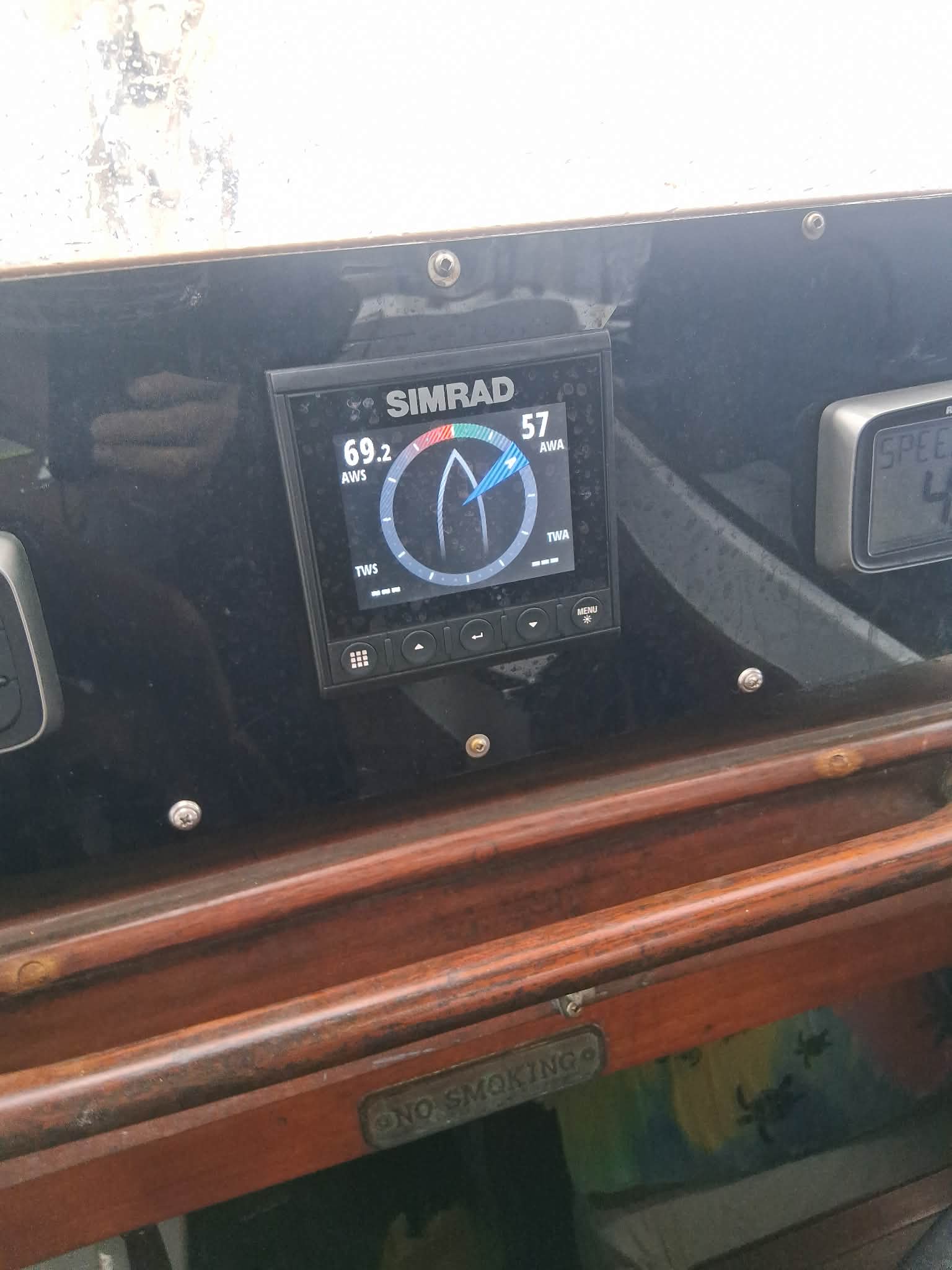
The AWS, Apparent Wind Speed is reading 69.2 knots with the wind on the starboard bow.
Enough wind to rip the ears off a snake!
I threw myself across the cockpit and began to furl the remaining headsail, but before I could completely douse the sail, a new wind struck with force and furry. It was all I could do to finish furling the sail as the wind tore at it. In what seemed like seconds later, the waves grew to perhaps 7 to 8 feet, creating a nasty cross chop as the new waves clashed with the old. Maiatla slammed into the waves while nearly throwing me off my feet. I fought to reach the helm seat and started the engine. In an attempt to turn into the wind, I pushed the throttle to the maximum while throwing the helm over hard. Behind me the mizzen was violently vibrating in the wind but it added the sail power I need to turn into the steep wind waves. If not for the power of the mizzen sail, I would not have been able to head up against the wind and waves.

The intense downfall pounded the decks, rain and sea water rushed across Maiatla s decks overwhelming the scuppers that fought to release the three inches of water that had already accumulated. Maiatla stalled as she came head to wind, the now useless mizzen sail shuttered, the rigging vibrated in a high pitch scream. I feared the sail would tear herself apart. At that moment, I glanced at the “AWS”, the apparent wind speed indicator, momentarily, I could not register what I was seeing. I stared at the instrument as the gusts shot past 70 knots, hurricane force winds. I don’t know why, but I grabbed my phone and snapped a picture of the instrument.
Checking the chart plotter, I could see that I had closed dangerously close to Tress Punta, which was still obscured by the rain. I had to put distance between Maiatla and the shore so I continued to turn to starboard and before I had even competed my turn, as quickly, as it struck, the wind began to subside as I motor sailed back out to sea. 10 minutes later the wind dropped down to 22 knots, but this time it stayed there. Maiatla was still at full throttle and for the first time since starting the engine, I heard it, it was an alternator belt screaming. “That’s all I need now”, I thought, to blow a belt and loose the engine. After throttling down, my world started to make sense once again. Without hesitation, I unfurled the headsail and killed the engine. I was again sailing fast, hard on the wind with the auto pilot engaged. From the time the wind first struck until this moment, was perhaps 20, 25 minutes, maybe a bit more. No time for fear.
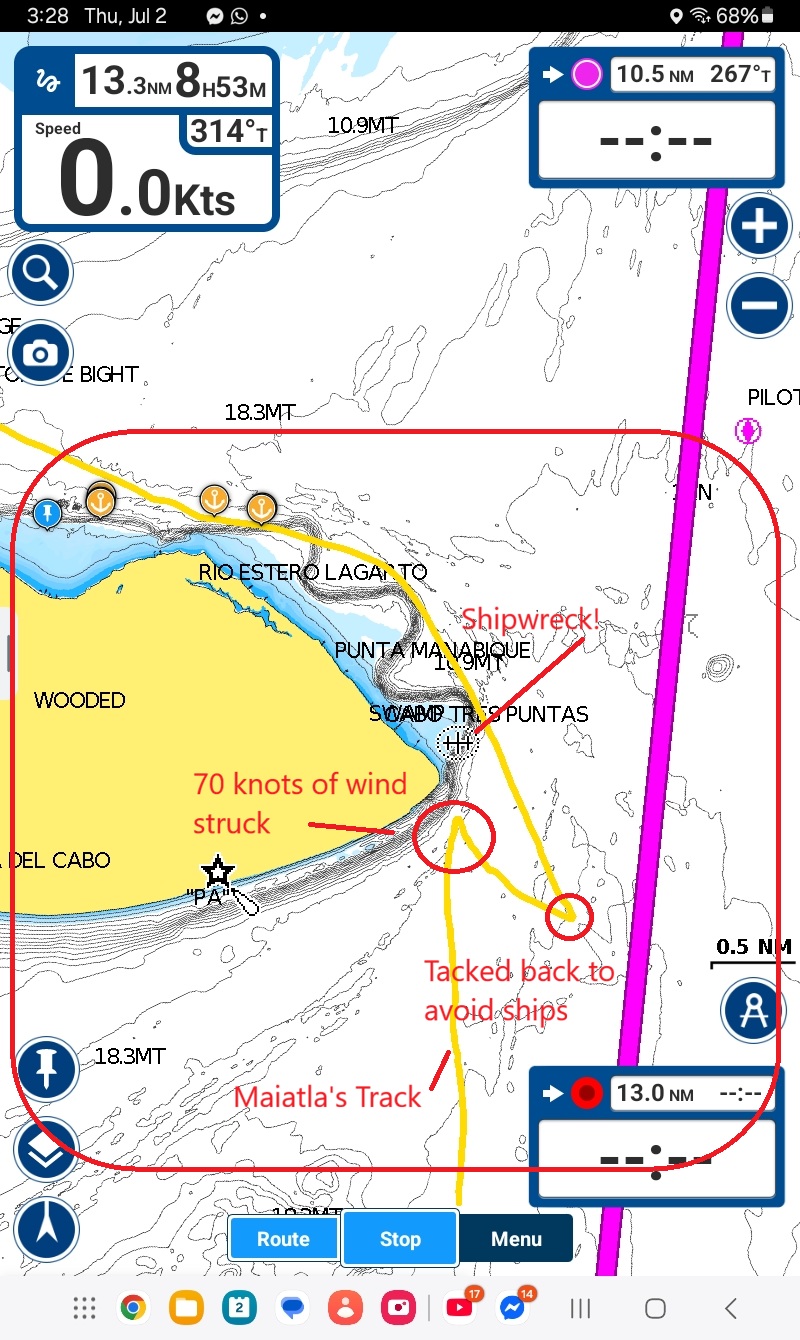
Photo of my chart plotter and Maiatla’s actual course as it happened. Notice the shipwreck on the point!
The land behind me showed itself once again and the rain quit. Checking the chart plotted I calculated how far out on this heading I would need to go so when I tacked back, I would clear the point. Another mile, a mile and a half should do it. It was at this point I realized my clothes were soaked and with the strong winds pulling on them, it sent a shiver through me. Stripping off, I tossed my soggy cloths to the end of the cockpit. I was just about to drop below to grab a towel when I saw it. It was ship about a mile away and he was headed directly at me. But if one was not enough, approximately a mile further back was a second ship, but he was perhaps another half mile out. “Really!” I shout into the air. I had no time to track their speed and movements on radar so I made a guess. If I hold this course the first ship should pass behind me, but barely. Holding my course, I watched the ship and as I did, the ship made a slight but critical course change. He had seen me and was making room. My attention now turned to the second ship and like the first, he was now coming directly at me. While the first ship was still passing my stern, I tacked Maiatla and began to race back the way I had come in an attempt to get out of the way of the second ship. Apparently, I cut it a bit close as I had to head down to pass under the first ships stern, but in doing so, I was now clear of the following freighter.
On my present heading we easily cleared Tres Punta, and enter Bahia De Amatique. I had long given up on attempting to carry on to Livingston as all I wanted was to find a calm anchorage, get into dry clothes and have a stiff rum or two. Not Necessarily in that order. Fortunately, I knew just the place. I had been in Bahia La Graciosa before. It was isolated bay, surrounded by mangroves and clear water. And it was only 5 miles away. The anchorage was as calm as I remembered and after dropping the anchor, I surveyed Maiatla’s deck. It was the first time since it all started that I was really able to take stock of my home. She had taken beating, but she had taken care of me and I’m happy to report, we didn’t break a thing. But I wish I could say the same for my cell phone which succumbed to drowning somewhere along the way. Despite placing the phone in a bag of rice, two days later she was pronounced dead and taken off life-support. Thankfully my only casualty.
After spending a peaceful night at anchor, by 8 a.m. I was back underway, motoring the last 11 miles to Livingston Guatemala. The sand bar at the mouth of the river is shallow, so shallow that many sail boats require being towed in. Literally dragged through the mud. Some boat with slightly deeper drafts gets stuck and have to be tipped and dragged, a process that requires having one boat pull and another, with a long rope secured to the top of the mast, pulling sideways “Tipping” the boat over to reduce the vessel’s draft. One boat would require tipping this morning. This was my 9th crossing of the bar and fortunately, I’ve never have had to be tipped or towed. I have struck the bottom a few times but due to the shape of Maiatla’s long keel, Maiatla at full throttle, would simply plow a trench through the soft mud.
As I approached the bar a full hour late for high tide, I was fearful that this time I may not be so lucky. I had called ahead and warned the towing company (Hector) that I may need a tow or God forbid, a tip and tow. On my first crossing back in 2022, I bumped bottom but I made it without issue. I charted my course over the bar and have used the same headings ever since. Today on my 9th cross, it went without a hitch with the shallowest spot still leaving 8 full inches under Maiatla’s keel. Easiest crossing yet.
After anchoring in front of town, I hoisted my Q Flag, (Quarantine) and waited, along with 7 other sail boats for customs and immigration to board and clear us in to Guatemala. When I had departed from here 7 months ago, I had no intentions of returning. The plan was to spend this hurricane season in the Eastern Caribbean. Dominican Republic or Trinidad. But after spending over three months castaway on the Honduran island of Roatan with engine problems, my cruising season was shot. By the time the engine was repair the hurricane season was upon us leaving me with little choice but to head back to the safe hurricane hole of the Rio Dulce. Maiatla and I have spent the last four years sailing out of the Rio so as we sat here waiting, I realized that it felt like returning home.

